Have one like this? Check yours freeOr have an appraiser value it
Lot description
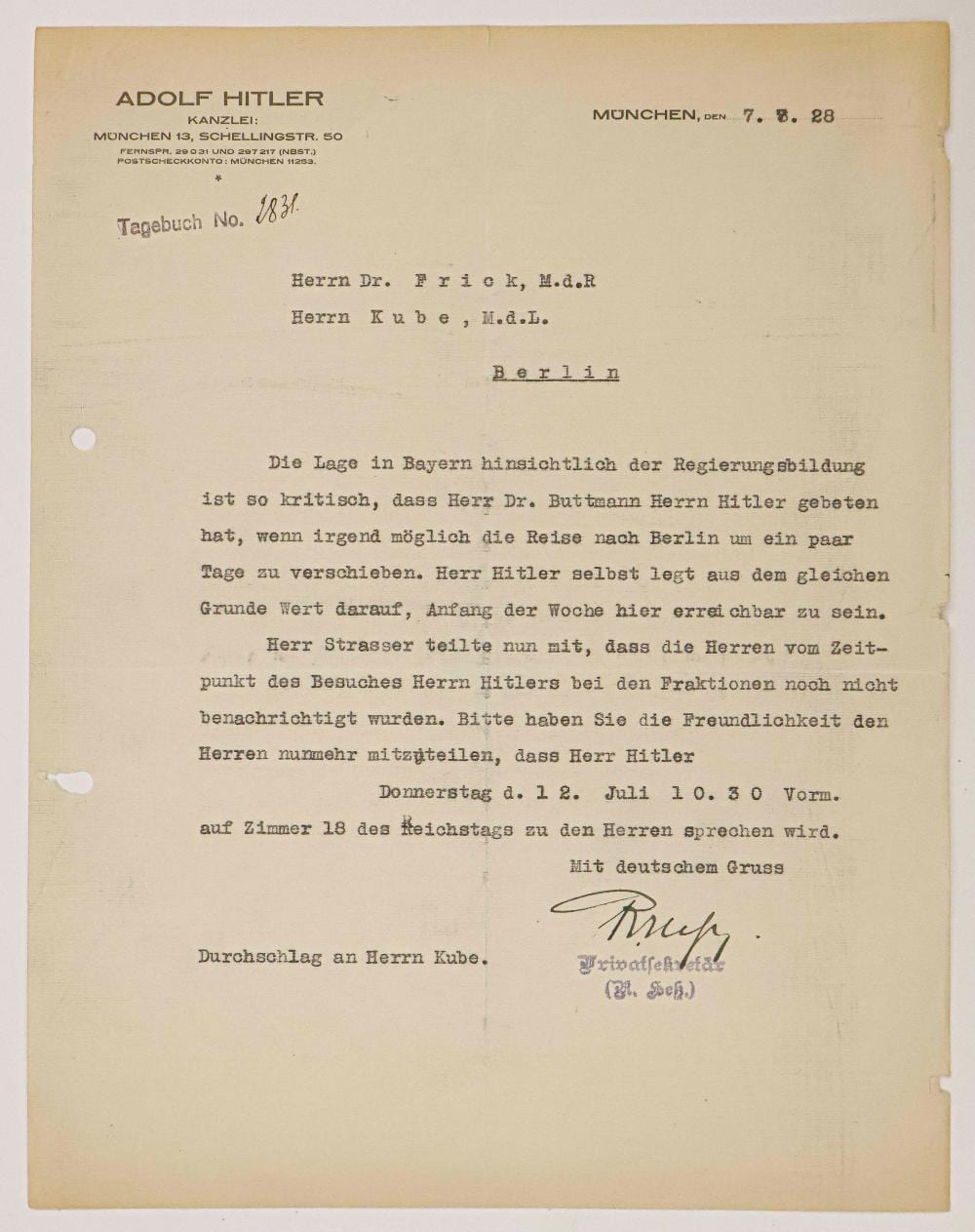
RUDOLF HESS (1894 - 1987) Nazi German Deputy Fuehrer and second in command after Goering, Hess was one of Hitler's closest confidantes and friends. In an unauthorized peace mission, Hess flew a German fighter to England and surrendered, purportedly attempting to ally Germany with Great Britain against Russia. His mission, of course, failed and Hess was imprisoned at Spandau where he was found hanged in 1987. Very early and rare fine content T.L.S. in German, 1p. 4to., typewritten on Adolf Hitler's printed letterhead, Munich, July 7, 1928, a joint letter as Hitler's secretary directed to Dr. Wilhelm Frick and Gauleiter Richard Kube. This signed carbon copy was sent to Kube or retained as Hess's signed copy (as it bears a stamp indicating that it was entered into a day-letter book) concerning Hitler's desperate political situation in Bavaria. As Hitler's private secretary, Hess writes, in part: '...The situation in Bavaria regarding the formation of a cabinet is so critical that Dr. Buttmann has asked Herr Hitler to postpone the trip to Berlin for a few days if at all possible. For the very same reason Herr Hitler himself considers it most important that he be accessible here at the beginning of the week. Herr [chief NSDAP organizer Gregor] Strasser reports that the gentlemen do not yet know the time of Herr Hitler's visit to the [political] parties. Please be so kind to inform them now that Herr Hitler will speak to them in Room 18 of the Parliament Building on Thursday, July 12th, 10:30 a.m...'. File holes at the left, some marginal toning and wear, very good. Federal elections were held in Germany on 20 May 1928. The Social Democratic Party of Germany (SPD) remained the largest party in the Reichstag after winning 153 of the 491 seats. The recently reformed Nazi Party contested the elections after the ban on the party had been lifted in 1925, but the party received less than 3% of the vote and won only 12 seats in the Reichstag. However, by 1930 the German economy was beset with mass unemployment and widespread business failures, and the Social Democrats and Communists were bitterly divided and unable to formulate an effective solution. This gave the Nazis their opportunity and Hitler's message, blaming the crisis on the Jewish financiers and the Bolsheviks, resonated with wide sections of the electorate. A historic, early letter.