Have one like this? Check yours freeOr have an appraiser value it
Lot description
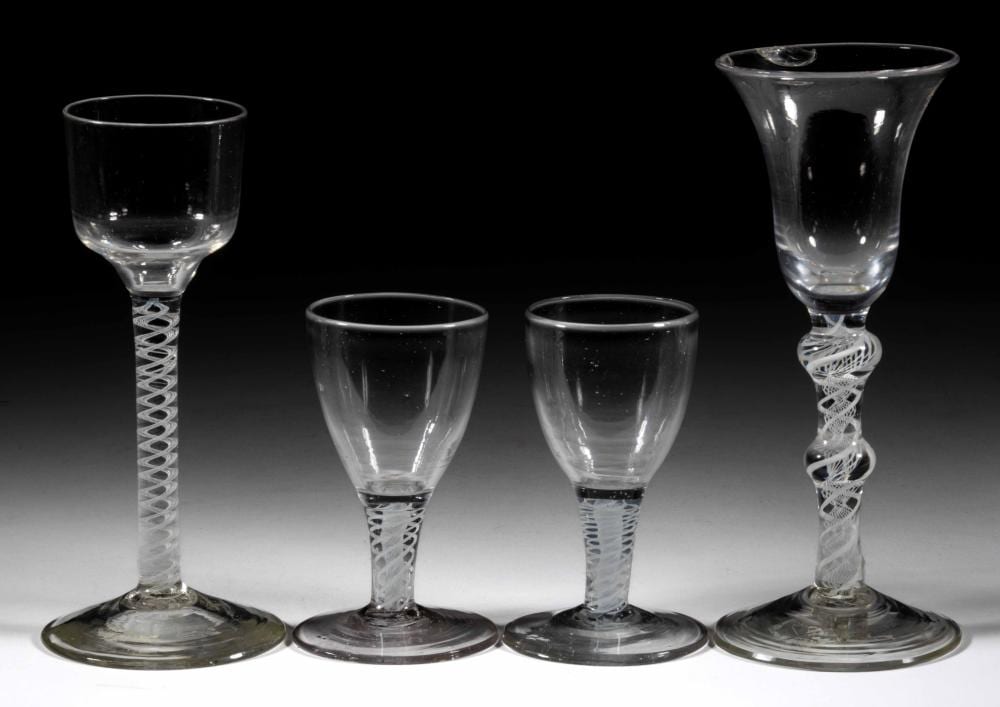
ENGLISH / CONTINENTAL FREE-BLOWN OPAQUE-TWIST STEM WINE / DRINKING GLASSES, LOT OF FOUR, colorless lead and non-lead glass, comprising a near pair of non-lead dram glasses with rudimentary stems having four thin opaque spiral threads outside gauze, one lead glass wine having ogee bowl atop a straight stem with a pair of spiral gauzes/corkscrews, and the tallest having bell bowl atop a double-knopped stem with two spiral threads outside a lace twist; all four glasses with rough pontil marks. Lead glasses English, dram glasses probably German or Bohemian. Third quarter 18th century. 3 5/8" H dram glasses, 6 3/8" HOA. Literature: Double knop parallels Bickerton - Eighteenth Century English Drinking Glasses, p. 230, fig. 699. Catalogue Note: These glasses are from a group assembled during the 1930s and 40s by Mrs. Warfield E. Haw, who primarily purchased from English and occasionally American dealers including mainly Arthur Churchill and Cecil Davis of London, among others. Mrs. George E. Haw (Warfield) (1887-1968) was an extremely active collector and member of the preservation community in Richmond. In addition to being a member of the Antiquarian Society and Director of the Association for Preservation of Virginia Antiquities, she was Chairman of the Furnishings Committee at Wilton House Museum from 1948 to 1965. She ushered Wilton House Museum through a period of rapid collection growth, loaning many pieces of her own as well as soliciting donations, gifts, and loans from other members, family, friends, and even strangers. Per her memorial, "[Mrs. Haw's] enthusiasm for her task was so contagious that she was able to interest members and friends, not only in giving treasures to Wilton, but also in bequeathing to it silver, furniture, rugs, and porcelain. She made people feel it was a privilege to do so." Upon Haw's death in 1968, she bequeathed her valuable collection of rare drinking glasses as well as a hanging japanned cabinet in which they were displayed in the Dining Room of Wilton for 50 years before being deaccessioned.