Have one like this? Check yours freeOr have an appraiser value it
Lot description
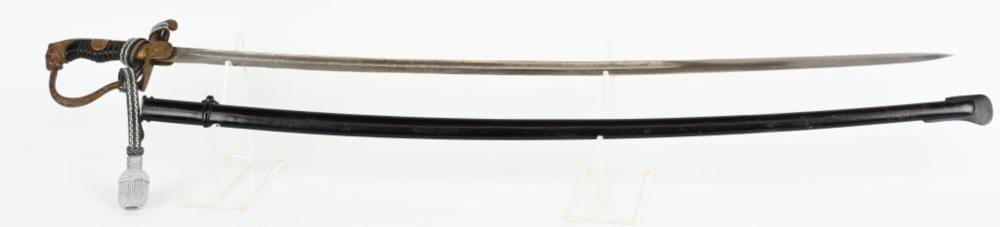
Roughly 35 3/4" long slightly curved drop forged steel construction leaf and floral design to the obverse "Die Treue ist das Mark der Ehre". The reverse is engraved "Gewidmet von dem Uffz. korps stabsbatterie 309" The reverse ricasso is also well marked with the stamped manufacturers logo, name and initials. The logo consists of a knight's head and WKC. The brown leather blade washer is still intact. The saber has die cast brass langets, flat cross guard, ferrule, "P", knuckle bow, back-strap and "Lion Head" pommel with a gilt finish. The obverse rounded tip, shield shaped languet has a Wehrmacht style eagle with down-swept wings on a plain pebbled field. The integral cross guard features a downward curved, curled tip to one side, and the base of the, "P", knuckle bow to other side. The knuckle bow, ferrule, back-strap and "dove" pommel all feature engraved, repeating oak-leaf patterns. The knuckle bow is inserted into the bottom edge of the pommel and the tang end has been skillfully hidden in the engraved oak-leaves. The saber has a molded black Bakelite grip with a central bulge and repeating, recessed horizontal grooves with dual twisted silver wire wrap flanked at both the top and bottom edges by a single, fine silver wire wrap. The saber comes with its original, black painted, sheet metal construction scabbard. The scabbard retains its original black paint, with normal usage scrapes and scratches revealing the base metal with light to moderate surface spotting. The scabbard has an integral drag to the bottom edge and a sweated on horizontal scabbard band near the top edge with a raised rectangular suspension bar to the reverse and a suspension ring to the reverse edge. Excellent. The Sword/Saber is an age old military tradition, that evolved from a functional weapon into an item of uniform dress ornamentation by the start of WWI. This strong tradition continues in many armies to this day as a symbol of strength and power. After Hitlers rise to power in January 1933 and the reintroduction of conscription in March 1935 a wide variety of new sword and saber designs were introduced to outfit the rapidly growing Wehrmacht. This revival in sword/saber production resulted in the numerous blade manufacturers, mainly located in Solingen, to develop a wide variety of ornate designs in an attempt to compete for the lucrative manufacturing contracts which resulted in over one hundred different patterns of the army sword/saber being produced during the Third Reich era. Dress regulations for Officers and senior NCOs prescribed wear of side arms as a component of particular forms of dress. As a result of the war situation production of the swords and sabers was to be discontinued as per regulations of May 27TH 1943, although those already issued could still be worn on ceremonial occasions. Additional regulations of December 23RD 1944 indicated that all officers ranks were to wear a pistol in place of the sword/saber or the dress dagger.