Have one like this?
Upload a photo for a free check of what yours may be worth.
Lot description
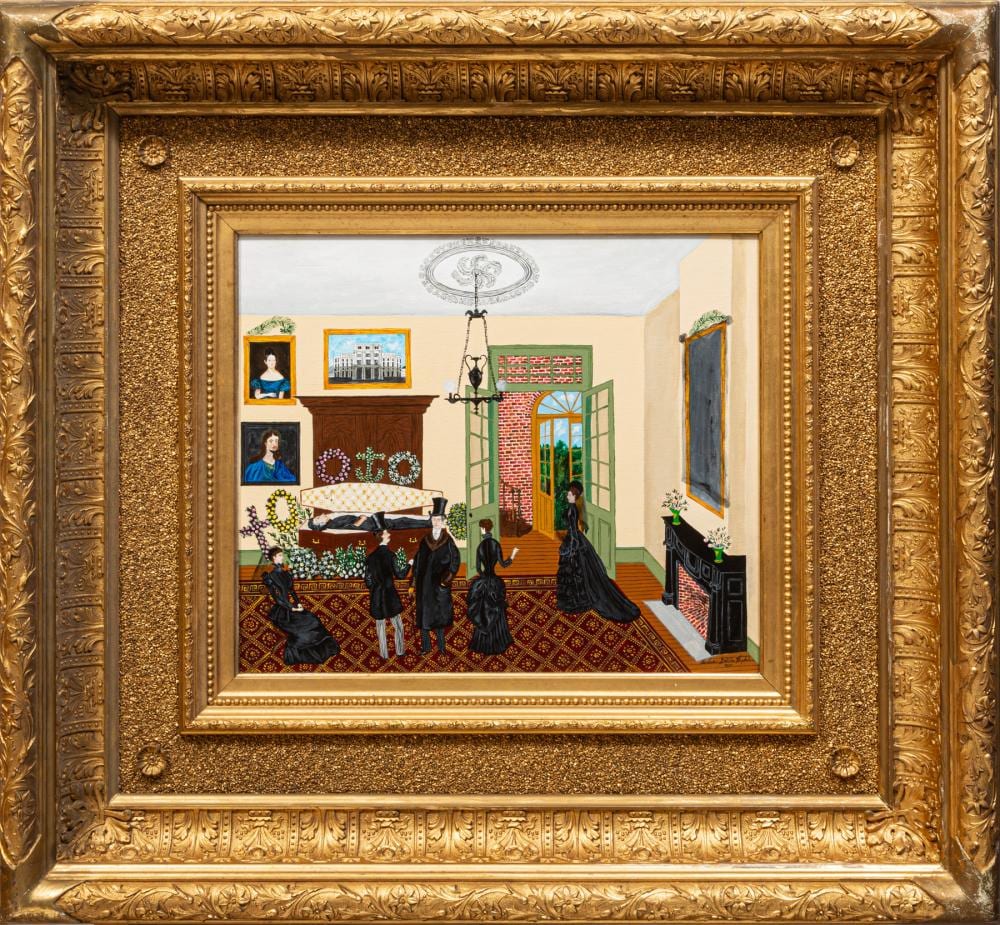
Andrew LaMar Hopkins (American/Louisiana, b. 1977), "Madame Boudousquie Wake", 2021, acrylic on canvas board, signed and dated lower right, signed, titled and dated en verso, 16 in. x 20 in., framed, overall 32 1/2 in. x 35 1/2 in. x 4 1/8 in.; together with Hopkins, Andrew LaMar. Creole New Orleans, Honey!. Altona, Canada: Friesens Corporation for The Louisiana Museum Foundation, New Orleans, LA, 2022. (2 pcs.) Exh.: "Creole New Orleans, Honey!: The Art of Andrew LaMar Hopkins", Louisiana State Museum, New Orleans, LA, Nov. 22, 2022 - Sept. 30, 2023, and illustrated in the accompanying catalogue, p. 37. Note: Andrew LaMar Hopkins, who graces the cover of the April/May issue of Garden & Gun, has been the subject of numerous articles and accolades including in The New York Times, Artforum, Architectural Digest and The Wall Street Journal. The artist’s first New York solo exhibition took place at the Venus Over Manhattan gallery in October of 2020, and he has since had several solo shows, including his Creole New Orleans, Honey! The Art of Andrew LaMar Hopkins exhibition at the Louisiana State Museum. Hopkin’s inspirations are his own Creole heritage and his passion for antiques. Drawing on his knowledge as an antiquarian, Hopkin’s interiors contain accurate historical depictions of period appropriate furniture, decorative objects and costume combined with underlying complex concepts of race, class and southern American history. Hopkins describes the painting offered here as such: “Madame Boudousquie [1815-1898] was a soprano, prima donna in Antebellum New Orleans. A 1830’s portrait of her hangs in the left corner of my painting. She married, [in] May 29, 1858, impresario Charles Boudousquié of New Orleans. Charles Boudousquie was the head of a stock company and later manager and commissioner of the French Opera House on Bourbon street. The French Opera house is depicted over the armoire. The French Opera House’s construction began in 1859 on the corner of Bourbon and Toulouse Streets. It took 233 days and $118,500 to build. Construction workers used bonfires to illuminate the construction site in the evenings, allowing the structures rapid construction. Madame Boudousquie lived in a 1824 Creole cottage known as the Cousin Cottage, which is still standing in Faubourg Tremé which is my neighborhood.”