Lot description
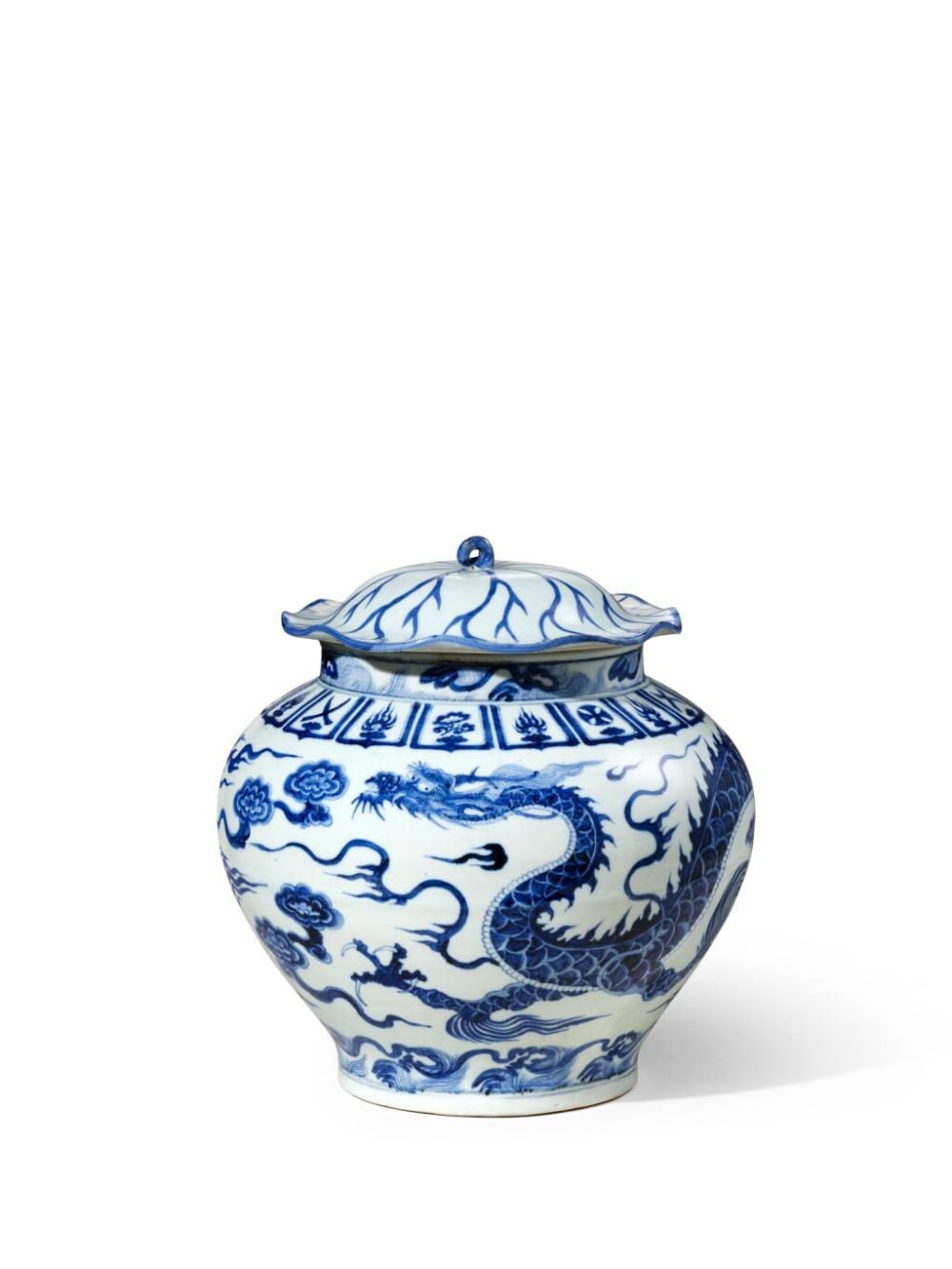
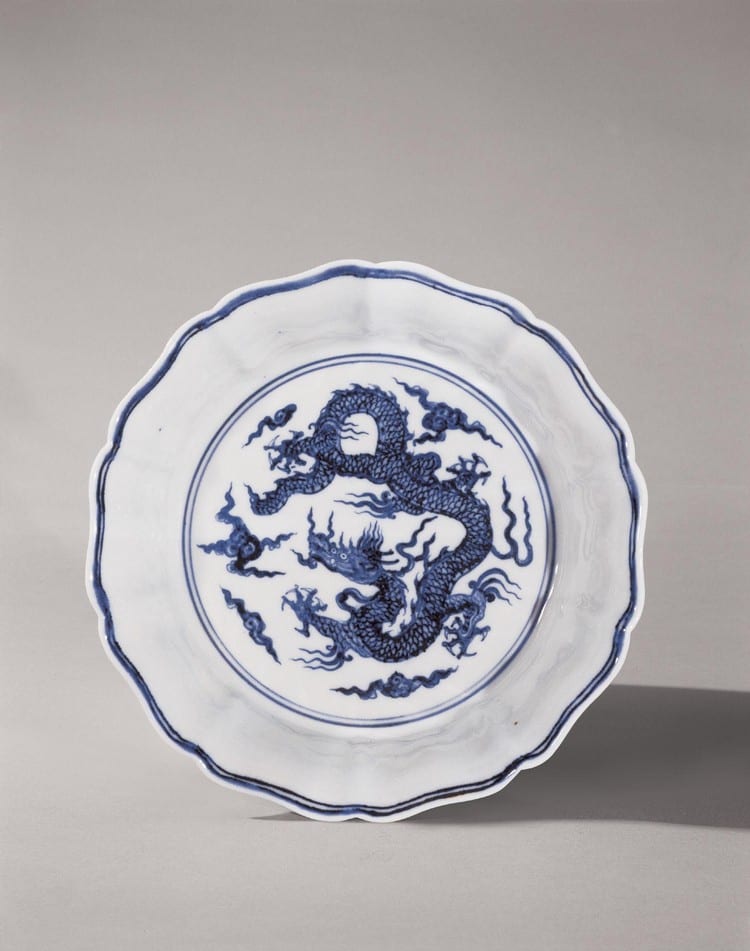
AN EXCEPTIONALLY FINE AND RARE BLUE AND WHITE 'DRAGON' BRUSHWASHER MARK AND PERIOD OF XUANDE measurements note 18.9 cm., 7 1/2 in. the finely potted upright sides divided into ten bracket-shaped lobes forming shallow radiating ribs on the interior and flaring at the rim to evoke a blooming flower, the very slightly convex centre superbly painted with a medallion enclosing a writhing five-clawed dragon plunging amid lingzhi-shaped cloud scrolls, all within a double-line border repeated around the rim, the exterior with ten quatrefoil panels enclosing alternately leaping and plunging dragons similarly amid clouds and flames, all between further double-line borders at the foot and mouth rims, the underglaze cobalt-blue of rich midnight-blue colour with areas of 'heaping and piling', the glaze with a slight bluish tint, the unglazed footrim neatly cut to conforming lobed shape and encircling the slightly concave base inscribed with a six-character mark within a double-circle Quantity: 1 PROVENANCE Sotheby's Hong Kong, 15th November 1988, lot 117. The Collection of T. Endo. Sotheby's Hong Kong, 29th April 1997, lot 405. LITERATURE Sotheby's Hong Kong Twenty Years: 1973-1993, Hong Kong, 1993, pl. 57. Sotheby's Thirty Years in Hong Kong: 1973-2003, Hong Kong, 2003, pl. 221. NOTE Brush washers of this 'mallow' shape can be traced back to the Song dynasty, when similarly shaped vessels were made by the official (guan) kilns of Hangzhou and are known with a variety of crackled greenish glazes. The form was revived in the Yongle period of the Ming dynasty and became one of the classic shapes of the Xuande reign. Unlike the Song prototypes, the Ming porcelains usually are supported on a foot which conforms in shape to the outline of the vessel. Ming brush washers of this type were probably made over a number of years, as different versions are known of this design, in different sizes. The present piece is one of the larger examples. Six other brushwashers of the same design, with dragons in quatrefoil panels on the exterior and Xuande reign marks on the base are known. Four such pieces in the National Palace Museum, Taipei, are listed in the inventory of the Museum's holdings, Gugong ciqi lu, part II, vol. 1, Taipei, 1965, pp. 105f., ranging in size from 15.9 to 18.5 cm., of which two are illustrated in A Panorama of Ceramics in the Collection of the National Palace Museum: Hsüan-te Ware I, Taipei, 2000, pls. 30 (fig. 1) and 31 (fig. 2). One washer in the Percival David Foundation of Chinese Art, London, is illustrated in Oriental Ceramics: The World's Great Collections, vol. 6, Tokyo, 1982, no. 94; and another was sold at Christie's Hong Kong, 28th April 1996, lot 49. Compare also three Xuande-marked brushwashers painted with a similar dragon in the centre, but with unbordered dragon roundels on the exterior; one reconstructed from sherds recovered from the imperial kiln site at Jingdezhen was included in the Chang Foundation exhibition Xuande Imperial Porcelain Excavated at Jingdezhen, Taipei, 1998, cat.no. 19-1 (fig. 3); another was sold in these rooms, 27th October 1992, lot 35; and a third was sold at Hanhai, Beijing, 30th June 1996, lot 990. A washer of this design but lacking the reign mark, in the Capital Museum, Beijing, is illustrated in Shoudu Bowuguan cang ci xuan, Beijing, 1991, pl. 90. Matching dragons appear in the centre of two bowls of the same outline, with more elongated barbed dragon panels around the exterior, one in the Shanghai Museum, illustrated in Wang Qing-zheng, Underglaze Blue and Red, Hong Kong, 1987, pl. 133, and the other from the T.Y. Chao collection, included in the China Institute in America exhibition Ming Porcelains, New York, 1970, cat.no. 14, and sold in these rooms, 18th November 1986, lot 40; similarly on a dish in the Freer Gallery of Art, with dragon roundels on the exterior, illustrated in Oriental Ceramics: The World's Great Collections, vol. 9, Tokyo, 1981, no. 99; and matching stemcups with similar barbed dragon panels are found in the Palace Museum, Beijing, illustrated in Geng Baochang, Mingchu qinghua ci, vol. 2, Beijing, 2002, pl. 163; and in the National Palace Museum, Taipei, included in Minji meihin zuroku, vol. 1, Tokyo, 1977, pl. 74. Xuande-marked washers of this form are also known with dragon and phoenix and with pairs of phoenixes. A dragon-and-phoenix washer in the National Palace Museum, Taipei, also with roundels on the exterior is included in A Panorama of Ceramics, op.cit., pl. 29; and one with pairs of phoenixes, also with roundels on the exterior, is in the Palace Museum, Beijing, illustrated in Geng Baochang, op.cit., pl. 124; another, formerly in the Sedgwick collection, was sold in these rooms, 19th May 1981, lot 405, from the Edward T. Chow collection. An unmarked dragon-and-phoenix piece, with a plain base, in the Palace Museum, Beijing, is illustrated in Geng Baochang, op.cit., pl. 123. Xuande washers of this form can also be found painted with an additional dragon on the base, matching that on the interior and replacing the reign mark; compare an example, with dragon roundels around the sides, in the Cleveland Museum of Art illustrated in the Catalogue of the Severance and Greta Millikin Collection, Cleveland, 1990, pl. 27; and another sold in these rooms, 14th November 1989, lot 18, and again, 5th November 1997, lot 1351, and illustrated in Sotheby's Thirty Years in Hong Kong, op.cit., pl. 220. The design of double phoenix with quatrefoils on the exterior, of which no example appears to be extant, can be seen in the pictorial scroll catalogue of the Imperial Collection of Yongzheng, vol. VI, dated to the sixth year of his reign, which was sold in our London rooms, 19th May 1939, lot 62, from the Moorhead collection and is now in the Percival David Foundation.