Have one like this?
Upload a photo for a free check of what yours may be worth.
Lot description
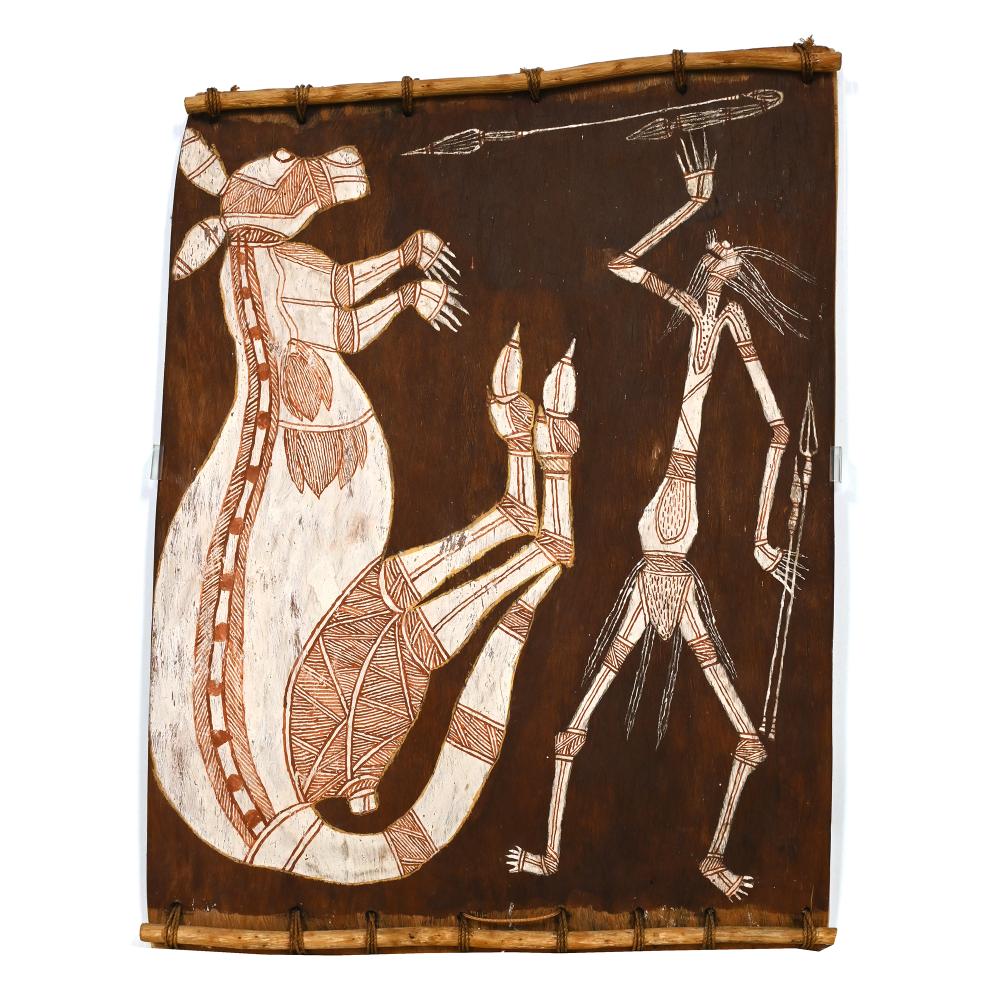
Born in Kakadjerri, situated on the Liverpool River plateau between Gunbalarya (Oenpelli) and Maningrida, Dick Nguleingulei Murrumurra's life spanned nearly a century. His formative years were spent in the hinterlands west of the Liverpool River, and he briefly attended school at Gunbalan in the 1930s. Subsequently, his endeavors took him across diverse landscapes - from working as a crocodile shooter on a cattle station at Goodparia to laboring in a timber camp within the Kakadu region. In 1965, Murrumurra relocated to Gunbalanya while maintaining a strong connection to his mother's homeland, Kurrukkur (Table Hill), which was being developed as an outstation. During the late 1960s and throughout the 1970s, Murrumurra emerged as a pivotal figure in the bark painting movement while residing in Gunbalanya. He collaborated closely with Dr. Peter I. Carroll, a linguist and part-time art advisor, who was stationed at the Church Missionary Society in Oenpelli between 1967 and 1979. Murrumurra's artistic focus often centered on the Arnhem Plateau's stone country, his ancestral home. His depictions of stone country fauna, such as the freshwater crocodile, echidna, and kangaroo, reflect a hunter's acute sense of proportion, anatomy, and an innate connection to these creatures. Additionally, he translated stories of the spirits inhabiting the escarpment into vivid artworks. From the 1980s onward, Murrumurra predominantly worked at the Malkawo outstation, in close proximity to his ancestral Bularihdja clan lands, collaborating with fellow artist Lofty Bardayal Nadjamerrek and their respective families. His life ended tragically in 1988, on this land he cherished. Notably, in 1982, one of Nguleingulei's paintings was selected for reproduction on the 75-cent Australian stamp, a testament to his artistic prowess. This bark painting depicts the kangaroo clearly showing the internal organs of the animal. The kangaroo is being speared by a Nalidgidgi Mimi spirit who has a spear and woomera. His body is painted with ceremonial markings (a captured kangaroo always adopts this special stance).* (*"Inspired by Country. Bark Paintings from Northern Australia, The Gerd and Helga Plewig Collection", Museum Funf Continente, Munich, 2022, 197)