Have one like this? Check yours freeOr have an appraiser value it
Lot description
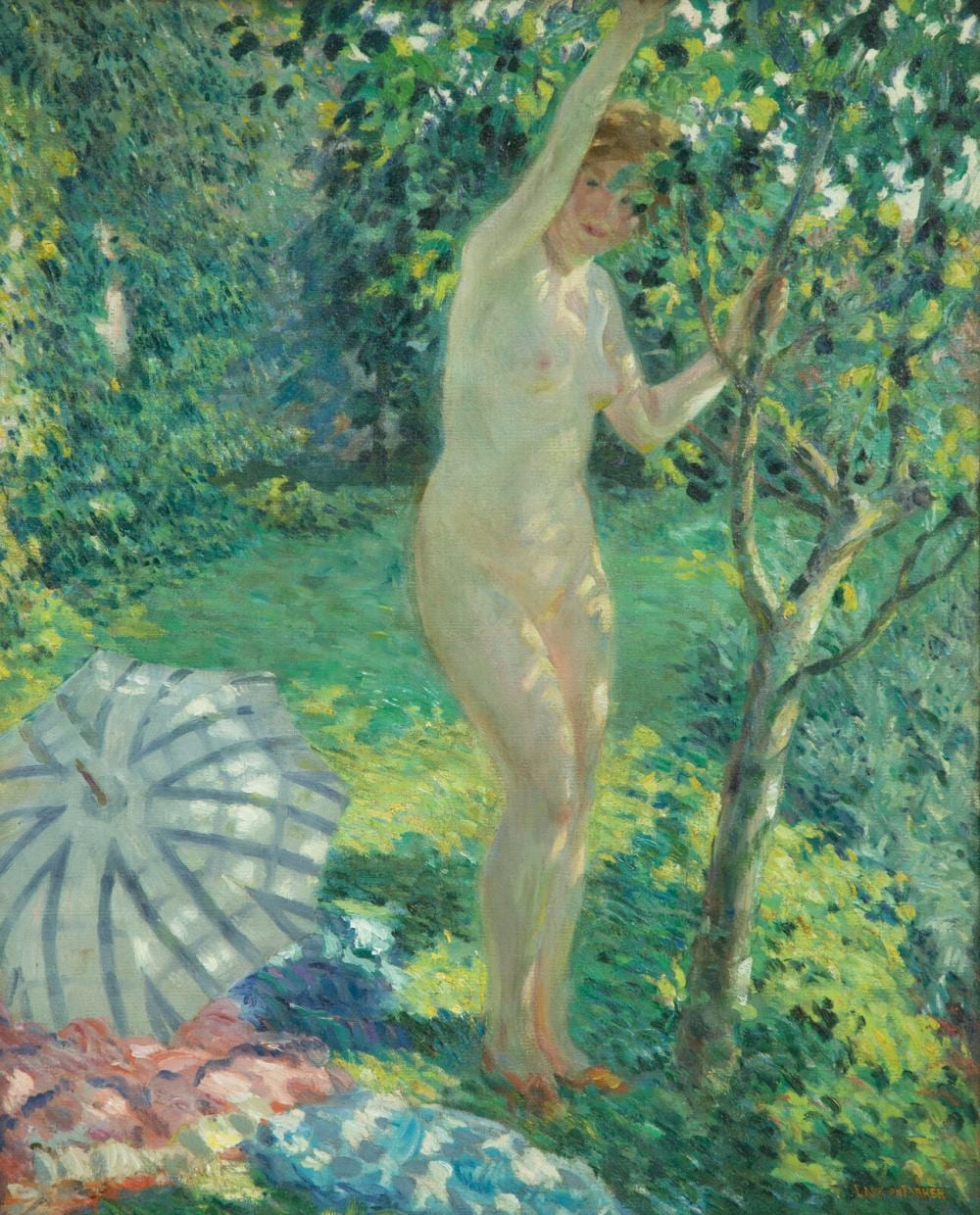
Lawton S. Parker (American, 1868-1954) Sylvia, c. 1910 oil on canvas signed Lawton Parker (lower right) 32 1/4 x 25 3/4 inches. Provenance: Graham Gallery, New York Goldfield Galleries, Los Angeles Private Collection, Arizona and California Debra Force Fine Art, New York Acquired from the above by the present owner, 2016 Exhibited: Evanston, Illinois, Henry Kitchell Webster residence, June 27 - July 1911 Chicago, Art Institute of Chicago, Paintings by Lawton Parker, March 5 - 27, 1912, no. 12, illus. New London, Connecticut, The Lyman Allyn Museum, The Art Colony at Old Lyme 1900-1935, February 5 - March 13, 1966, no. 82, p. 38 (loaned by Larry Parker) Washington, DC, Adams Davidson Galleries, Four Decades of American Impressionism: 1880-1920, May 30 - July 6, 1985 Los Angeles, California, Goldfield Galleries, American Impressionists in Giverny New York, Berry Hill Galleries, The Giverny Luminists: Frieseke, Miller, and their Circle, November 29, 1995 - January 27, 1996, no. 21, p. 42 San Diego, San Diego Museum of Art, Monet’s Followers: American Impressionists in Giverny, June 27 - August 30, 1998 Literature: Harriet Monroe, "Lawton Parker's Paintings on Exhibition; De Monvel's Decoration Panel Arrives," Chicago Tribune, July 16, 1911, p. A9 H. Effa Webster, "Parker Paintings Catch Glint of Summer: Sunshiny Canvases Now at the Art Institute," Chicago Examiner, March 7, 1912, p. 7 George Breed Zug, "The Art of Lawton Parker," The International Studio, vol. LVII, no. 226, December 1915 The Arts Guild Galleries, An Illustrated Annual of Works by American Artists & Craft Workers, Chicago, 1916, p. 22, illus. Like many painters of his generation, Lawton Parker was lured to the American art colony outside of Claude Monet’s home in Giverny. He joined the second generation of American painters drawn to the small French village in 1903 and became a part of the resident assemblage of Impressionists called the Giverny Group. It was in this picturesque setting that Parker painted Sylvia, c. 1910. A brilliant American painting imbued with then revolutionary French elements of quick, loose brushstrokes, a vivid color palette, and acute attention to light and shadow, Sylvia is a remarkable example of American Impressionism. Born in Fairfield, Michigan in 1868, Parker first studied at the Chicago Art Institute and in 1889 went to Paris, where he enrolled at the Académie Julian with William Bouguereau, Robert Fleury, and later with James Abbott McNeill Whistler. He then traveled to New York and attended the Art Students League as a student of William Merritt Chase and Henry Siddons Mowbray, and then returned to Paris for training in mural painting. In 1897, Parker enrolled at the École des Beaux Arts with Jean Léon Gérôme. He had intermittent teaching positions including the St. Louis School of Fine Arts in 1892 and the Chicago Fine Arts Academy. In Paris, he ran the Parker Academy, his own school of painting, from circa 1900-1903. Once the artist arrived in Giverny, he became close friends with Guy Rose, Frederick Carl Frieseke, and Richard Miller, who were also in residence there, and eventually they exhibited together in New York City, sometimes referring to themselves as The Luminists. In 1913, Parker was awarded the gold medal from the Société des Artistes Français for his painting, La Paresse (Florence Griswold Museum, Old Lyme, Connecticut), the highest award available to a foreigner by the annual Paris Salon. Originally Parker focused on portrait paintings executed in a solid Academic manner, but working closely with his friend and neighbor Frieseke, he transitioned to painting the female figure in various garden settings. According to Dr. William H. Gerdts, it is possible that Parker explored the theme even earlier than Frieseke. Dr. Gerdts writes of Parker: "he tackled plein air in earnest in his water gardens at Giverny; he began studying the full outdoor light on things: how foliage and dresses and naked human flesh look against the light, down the light, across the light." (American Impressionism, New York, 1984, p. 270) By the time he painted Sylvia, the artist had fully developed his characteristic style of depicting his subjects, often female nudes posing in gardens, in various angles of shifting sunlight. Parker spent the summer of 1911 in Chicago, where a large exhibition of his work was held at his friend Henry Kitchell Webster’s home in Evanston, just north of the city. In her July 16th Chicago Tribune review of the show, critic Harriet Monroe was effusive in her praise, which included 22 paintings by the artist: “Most of the pictures are studies of women out of doors in Giverny gardens or verandas or beside pools, lit by dappled sunlight… painted last summer, others the summer before, when Mr. Parker first fell in with Richard Miller, Frederick Frieseke, and other Americans of the plein air school who use the little French village as their summer headquarters… Never did [a] painter effect a more complete revolution in style, nor with happier results. Giverny taught Mr. Parker to throw away the heavy and somber secondary tones…The result is a series of fresh, clear, finely inspired pictures…” Monroe also singled out Sylvia for admiration, stating that the painting was “…especially remarkable for [its] flower-like grace, and for the iridescent quality of the flesh painting.” The following year, Sylvia was also included in a solo exhibition on the artist at the Art Institute of Chicago. In a review, the critic Monroe said of the group of paintings that, “...sunshine and shadows seem to ripple and shimmer like a running brook; flesh and draperies take the sunlight in spots of gold and melt into the blue and green of shadowed leaves.” With its brilliant light, dense and lush landscape, and intense color, Syliva is certainly among Parker's best and most beautiful works.