Have one like this? Check yours freeOr have an appraiser value it
Lot description
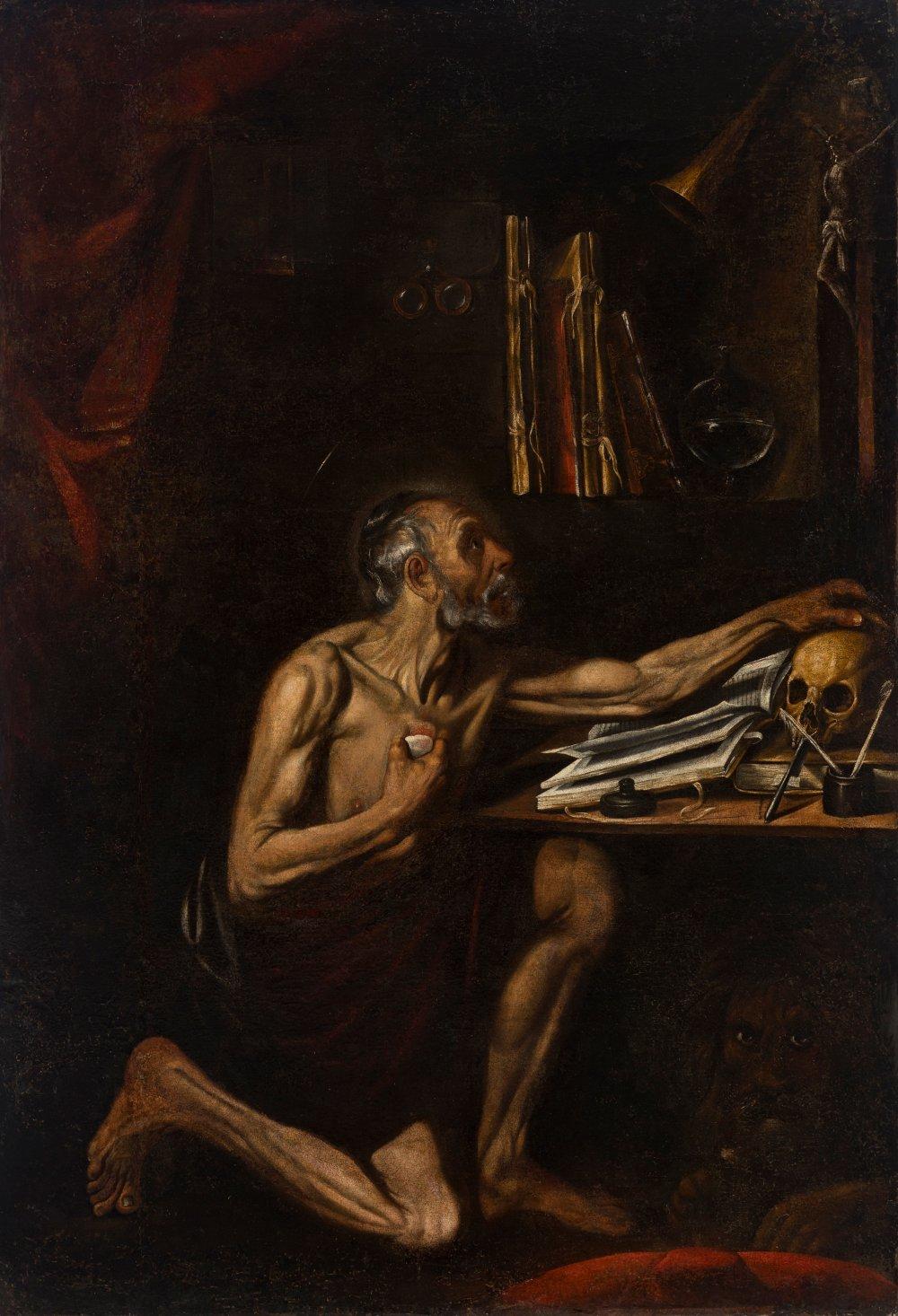
LUIS TRISTÁN (Toledo?, 1580/85 - Toledo, 1624). "Penitent Saint Jerome. Oil on canvas. Re-tinted. It presents restorations. Measurements: 177 x 124 cm. There are several versions of Tristán representing Saint Jerónimo, as penitent and in his study, in fact a very similar to the present painting is in the Museo del Greco (Toledo), as well as another version in the convent of the Jerónimo de san Pablo (Toledo). In this canvas the theme of Saint Jerónimo penitent in the desert is approached through a classical, clear and open composition. Thus, the saint appears full-length, looking at the crucifix, highlighted by the lighting and also by the intense crimson tone of the curtain in the background and the hat indicating his cardinal's life, both elements perfectly balanced by the whites of the cloth covering his legs and his beard and hair. The saint is depicted in a motley setting, next to him is the lion, lying at his feet, and on the table is the pen with which he is writing the scriptures. Barely discernible in the present canvas, the artist depicts a trumpet in the upper right corner next to some books, signalling the Last Judgement. A disciple of El Greco and Ribera in Italy, he returned to Toledo for good in 1613. His style, thanks to the heterogeneous nature of his training, is very varied, almost contradictory at times. The strong influence of El Greco will always remain in his work, especially in the elongation and expressive instability of his figures, but his direct knowledge of Caravaggism in Rome, precisely during its heyday, is reflected in a naturalism that is particularly evident in some of his works. Tristan seems to lean towards one or other style at specific moments, either by his own decision or at the behest of his clientele. The study of Venetian compositions is also evident in his language, although the clearest influence on his work is determined by the paintings that Juan Bautista Maíno left in Toledo, especially the "Portrait of the Four Easters" in the church of San Pedro Mártir, which combines Roman naturalism with sumptuous colour. All of this is reflected in works such as the set that Tristán painted in 1616 for the parish church of Yepes. He is currently represented in the Prado Museum, the El Greco Museum in Toledo, the Louvre in Paris, the Louvre in Cambridge, the Pollock House in Glasgow, the Fine Arts Museums in Budapest, Caracas, Bucharest and Seville, Toledo Cathedral and other churches in the region, the Santa Cruz Museum and the Archbishop's Palace in Toledo, the Royal Palace in Madrid and other collections and museums.