Have one like this?
Upload a photo for a free check of what yours may be worth.
Lot description
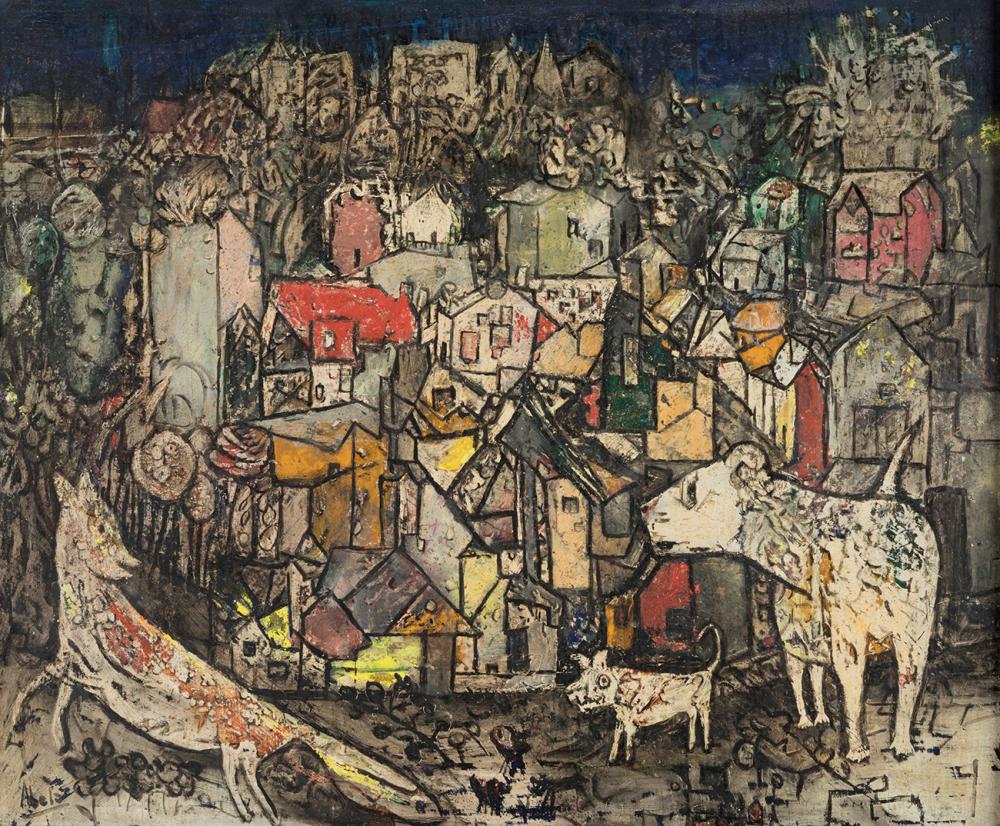
EDUARDO FÉLIX ABELA VILLARREAL (San Antonio de los Baños, 1889-Havana, 1965). "City". Oil on panel. Signed in the lower left corner. measurements. 32 x 39 cm; 48 x 56 cm (frame). Provenance: Manuel Reguera Saumell collection, recognised as one of the great Cuban writers and playwrights of the 20th century. As the set of photographs accompanying this collection testify, Reguera forged close friendships with the leading exponents of Cuban art during the years he spent in his native country. It was then that Reguera, backed by the bond that united him with Amelia Peláez, Rene Portocarrero, Carlos Abela and Antonia Eiriz, began his facet as a collector, giving birth to what would become his personal collection. From the 1950s onwards, Abela began to change both his figurative and naïve style for a more complex and variegated aesthetic, as can be seen in this work. In addition, his palette also changes towards more ochre tones and cooler ranges that he shakes up with light touches of warm tones, an example of which is his painting "Chaos", which belongs to the collection of the Museo Nacional de Bellas Artes de Cuba and which bears great similarity to the present painting. The figures swirl in his compositions creating a kind of horror vacui composed of elements characteristic of his native Cuba. Eduardo Abela was a Cuban painter and comic artist. Born in San Antonio de los Baños, he studied at the San Alejandro Academy of Fine Arts, graduating in 1921. For the next decade he lived abroad, first in Spain and then in France. In Paris he met numerous Cuban intellectuals, among them Alejo Carpentier, who encouraged him to develop his talent for depicting native Cuban themes. Encounters with the work of Jules Pascin and Marc Chagall further shaped his style. On his return to Cuba, Abela created the character of "El Bobo" as a protest against the Machado government. He drew him for El Diario de la Marina from 1930 to 1934. Abela's Creole character played the fool by satirising the difficult social and political situation in Cuba under Machado. In the second half of the 1930s, Abela returned to painting, employing a naturalistic style influenced by early Renaissance painting and the Mexican muralist movement. At this time he focused on an idealised vision of the Cuban peasant and the countryside, as seen in his best-known painting, Los Guajiros (1938), in which classical sobriety and order are the result of his contact with Italian medieval and Renaissance art. He also continued to paint, serving later in his career as a cultural attaché in Mexico and Guatemala, and in 1937 he directed the short-lived Estudio Libre de Pintura y Escultura.