Have one like this?
Upload a photo for a free check of what yours may be worth.
Lot description
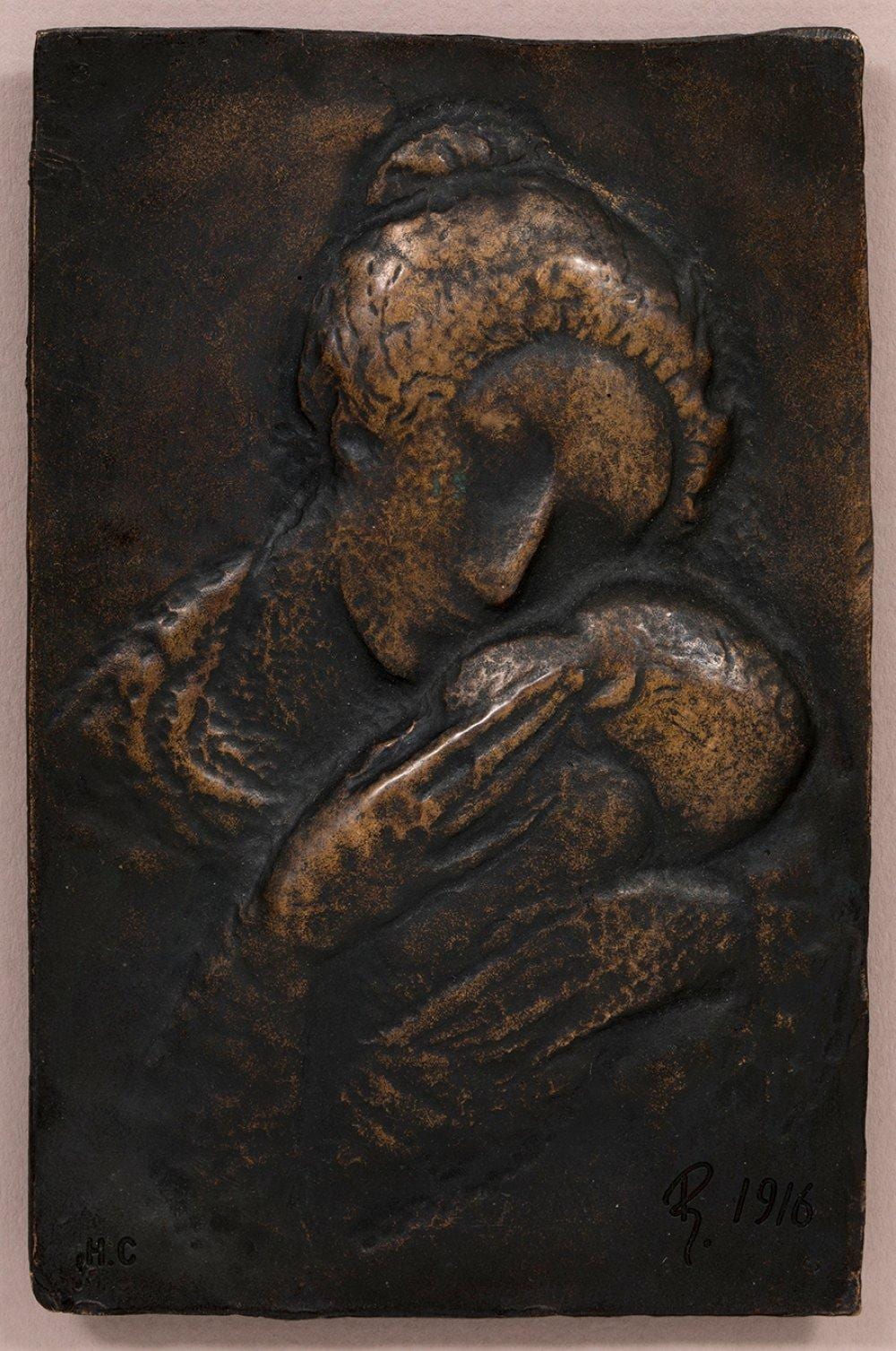
PABLO GARGALLO CATALÁN (Maella, Zaragoza, 1881 - Reus, Tarragona, 1934). "Petite maternité", 1916. Bronze. Exemplary H.C. Current print run of 35 copies. Work reproduced in: Pierrette Gargallo Anguera, "PABLO GARGALLO. Catalogue raisonné". Editions de l'Amateur, Paris. 1998. Size; 13.2 x 8.7 cm; 31.5 x 26.5 cm (frame). Throughout his life, Gargallo developed in parallel two apparently opposing styles: one with classical roots, related first to modernism and later to noucentisme, and the other avant-garde, which experiments with the disintegration of space. However, both have in common the central theme of the human figure and the harmonious combination of space and volume. In his works with classical roots, such as the one we present here, we can appreciate the same taste for fluid planes, the appreciation of hollows and massifs, of the fragment for the whole, as in paradigmatic works of his avant-garde production, such as "The Prophet" (1933). Thus, in this "Torso of an Adolescent" the volume does not appear simply modelled, but acquires entity thanks to the sinuous profile, the emptiness that surrounds it, the missing fragments that demand the active participation of the spectator. As in his iconic masks, here Gargallo sculpts the void, while maintaining the mass in the key of classical, archaic and timeless idealisation. In fact, this sculpture that ends up being a drawing in the air, like "Greta Garbo with eyelashes" (1930) is the reduction to the essence or purification of this other, more traditional-looking statuary, and one cannot be thought of without the other. In fact, we can see works which are exactly symmetrical in volumetric terms and which represent both languages, such as "Silhouette of a Young Man" and "Boy on the Beach", both made in 1934. Pablo Gargallo is considered the forerunner of iron sculpture, and learned the technique of forging from his father, who owned a blacksmith's shop. In 1888 his family emigrated to Barcelona for economic reasons and there he began his artistic training in the workshop of the sculptor Eusebio Arnau and at the La Lonja School, with Venancio Vallmitjana as his main teacher. At the height of the Modernist movement in Barcelona, Gargallo frequented the gatherings at "Els quatre Gats", establishing relationships with artists such as Nonell and Picasso. This is why his early works were influenced by Modernisme, such as the decoration of buildings in Barcelona that he did in collaboration with the architect Domènech i Montaner, such as the Hospital de la Santa Creu i Sant Pau and the Palau de la Música. In 1903 Gargallo was awarded a grant that enabled him to travel to Paris to complete his studies. His stay in the French capital was brief, but from then until 1923, when he settled permanently in Paris, he made frequent trips there. In Paris he encountered the aesthetic formulations of Cubism, assimilated its expressive systems and sought the schematism and essentiality of figures and objects, attempting to find the authentic three-dimensional expression of the Cubist postulates. Around this time he began to use metallic materials such as sheet metal, copper and iron. Around 1911-12 he produced his first masks, highly simplified pieces made from cut-out sheet metal and linked to the Cubist aesthetic. Using sheet metal, Gargallo began to suggest volumes and to exalt voids through the penetration of light into interiors. In 1920 he was appointed professor of sculpture at the Escuela Técnica de Oficios Artísticos de la Mancomunidad de Cataluña, a post from which he was removed in 1923 for political reasons. It was then that Gargallo settled permanently in Paris with his wife and daughter. From then on his style took on a very personal dimension, derived from his interpretation of Cubism, based on the search for a formal synthesis of the figure in ever-fluid geometric planes, replacing conventional materials with sheets of wrought iron, and introducing a new sculptural language by introducing the void as volume and endowing his figures with great expressive drama. Pablo Gargallo is currently represented in the museum that bears his name in Zaragoza, the MoMA in New York, MACBA in Barcelona, the Museum of Modern Art in Paris and the Reina Sofía in Madrid, among many others.