Lot description
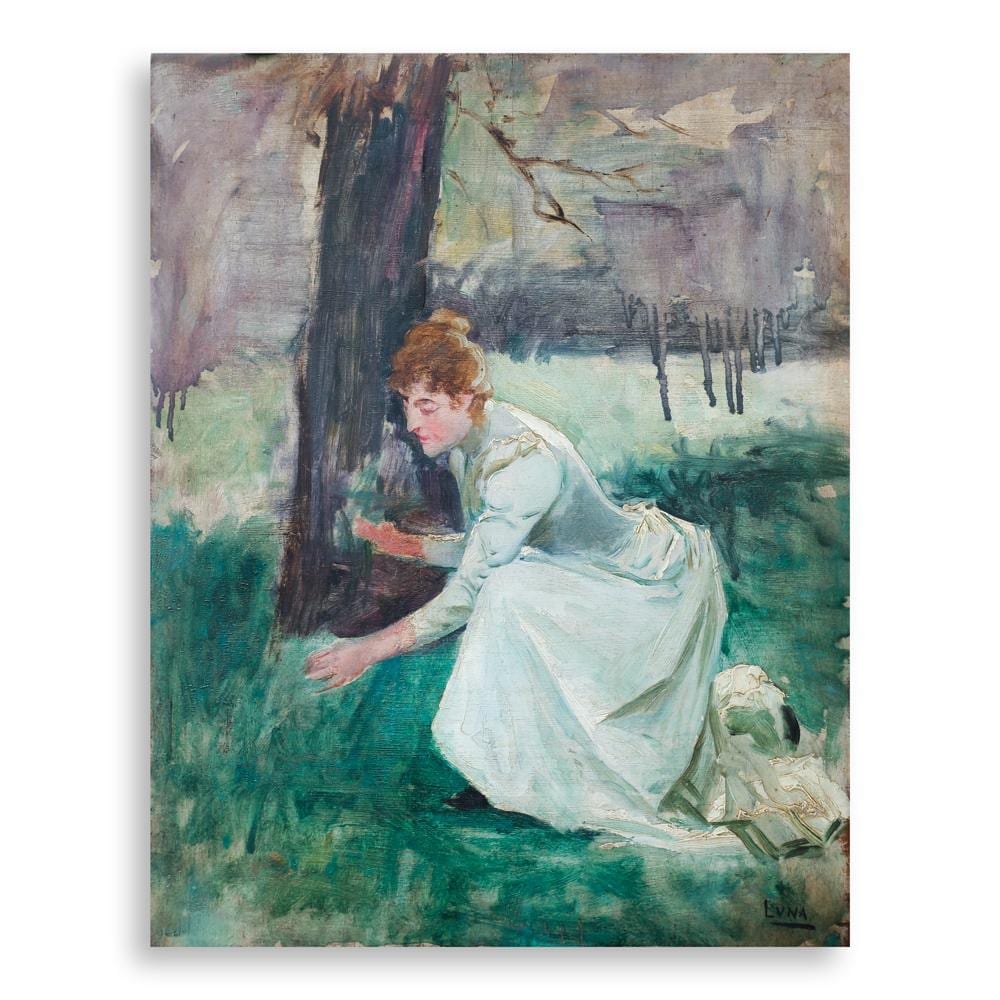
PROPERTY FROM THE AMBASSADOR PEDRO CONLU HERNAEZ COLLECTION Study of Paz Picking Flowers in a Garden signed lower right oil on wood 18” x 14 1/2” (46 cm x 37 cm) WRITE UPThe Private Life of Juan Luna Rare Portraits of the Artist and His Wife Paz by LISA GUERRERO NAKPIL There is a second work also featured, described as “‘Self-Portrait’ with Luna facing a mirror, holding his palette. He is wearing a bonnet and his face is dark. Behind him is the lighted altar.” The self-portrait is from the year 1885, presumably from the testimony of Grace Luna, when Luna had just arrived in Paris after his triumph at the Exposicion Nacional de Bellas Artes in Madrid, the biggest art competition in Spain — and its most fiercely contested. Luna would as a result become the most famous artist in the country, winning a gold medal for Spoliarium. It became a tantalizing matter of Spanish national interest (and Filipino honor) that the painting missed not being given the overall accolade, the “Prize of Honor.” The King of Spain Alfonso XII himself took a personal interest in the case that was consuming the public’s appetite and that is said to have dominated the headlines for almost two years with opinions, accusations and conspiracy theories against the Filipino artist. (The king had become acquainted with Luna through their mutual friend, the sculptor Mariano Benlliure and would later decide to make amends by commissioning the Battle of Lepanto to be hung in a place of honor in the Spanish Senate.) All this added to Luna’s reputation and attached a certain glamor and fame to him, making him the most famous artist (of any origin, Spanish or Filipino) in Spain and its prized colony, the Philippines. He would find Madrid too small for his artistic horizons and would move to Paris, the center of the world of art. Juan Luna would set up a studio at No. 65 Boulevard Arago, in the same picturesque enclave of artists in which Felix Resurreccion Hidalgo also lived. It consisted of half-timbered villas surrounded by paths and pretty gardens. There was a huge skylight that would illuminate the photographs of Luna and his friends, including Jose Rizal and the Pardo de Taveras, gamboling among tapestries and paintings and the colorful props for Luna’s historical works. It was plain that it was only a matter of time before he would come into the same orbit as the Pardo de Taveras who were friends of his neighbor Resurreccion Hidalgo from Old Manila. It was through the brothers Trinidad and Felix that he would meet Paz — the article which is based on the recollections of Andres Luna de San Pedro — would report that “Often Luna would be left alone with Paz. That started the love between them. Both lonely, they talked about the native country and all its nostalgic memories. They apparently found a common understanding, and on December 8, 1886, Luna and Paz got married, the bridegroom, thirty, the bride twenty-one.” The Study of Paz Picking Flowers in a Garden can be viewed as the first part of a series that would include The Study of Paz and a Friend Picking Flowers in a Garden. Both have the loose brushstrokes and lighting that would distinguish the winds of Impressionism that would blow through Paris in the 1860s with the works of Claude Monet and Auguste Renoir. It would have been impossible for Luna not to take notice of this artistic revolution; and despite his being knee-deep in the world of academic painting, his private works not intended for salon competitions reflected this. Impressionist works, at the time, were routinely accused of being ‘studies’ or preparatory works but this ‘Studio’ as Luna would term it can easily stand on its own. It fit into the new pre-occupation of the art world away from scenes of historical importance to those that captured everyday life in the city of Paris. The location would have been in the Paris park, the Bois de Boulogne, which was a few blocks from the Pardo de Tavera home in posh Villa Dupont. There are photographs of the entire flock of ilustrados roosting in its woods, Juan Luna, Paz, Jose Rizal and other worthies, enjoying al fresco luncheons. The depiction of Paz in the womanly pursuit of gathering blossoms was perhaps part of his courtship ritual of the attractive heiress who would have been flattered by the focus one needed to paint a portrait. The Study shows how Luna was experimenting with compositions — using the strong silhouette of the tree to divide the work — and with the treatment of light and dark in the distant treeline that would be more polished, as seen in the other works from the same period, also at the National Museum and shown here. Later, the same vignette would become the basis of the highly polished “Picnic in Normandy”, now in the collection of the Jorge Vargas Museum of the University of the Philippines. It is a view of a field with women in various poses, looking out to the distance, enjoying the fresh air, and yes, gathering wild flowers.On the 100th year of Juan Luna’s birth — October 25, 1857 — This Week Magazine published an entire issue in his honor. Dubbing him ‘painter, patriot, and propagandist’, it produced a comprehensive report on his ‘life and times’ as well as a “representative collection of his works.” Two of those works, from the Grace Luna de San Pedro collection, shine a spotlight on a side of Luna not seen in his heroic works such as ‘Spoliarium’ or the “Blood Compact” nor his lyrical Roman opus ‘Hymen oh Hymenee.’ Under the heading of ‘He Liked to Paint Portraits of His Family’ is one (of several) works that captures his bride, the heiress Paz Pardo de Tavera. It is captioned “Study of Paz (sitting) and a friend picking flowers in a garden was painted by Luna in Europe.” That work is now in the Philippine National Museum, part of that trove acquired from Grace Luna and donated to it. It was part of a series of his private home life that was included in those pages, explained as follows, “Wife, Paz Pardo de Tavera, was a favorite subject of Luna. Many times, he would ask her to pose for him when he was in low spirits,” the article said. “Luna would paint her as she lay in bed after giving birth to their son Andres as he lay in the decorated crib beside her. In the same bed, she modeled for his Ensueños de Amor (Dreams of Love.)…(at left) is a portrait of Paz in a dimly lit room, the light coming from the single window behind her.