Have one like this? Check yours freeOr have an appraiser value it
Lot description
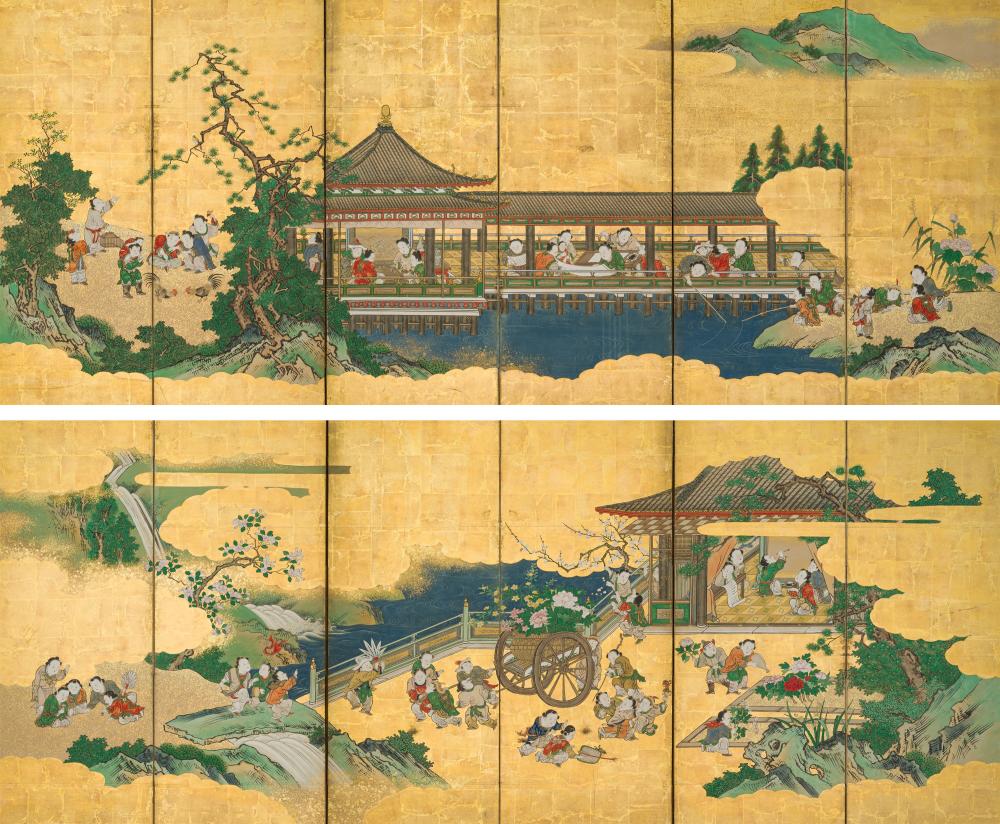
KANO SCHOOL: A FINE PAIR OF ‘KARAKO BOYS’ SIX-PANEL BYOBU SCREENS Japan, 17th-18th century, Edo period (1615-1868) Ink, gouache, watercolors, and gold paint on paper. Mounted on six panels within a silk brocade attached to a black-lacquer frame with chased metal fittings. Finely painted, the screens depict 62 children engaged in various activities in a beautiful landscape with gentle streams, blossoming peony, prunus, and magnolia, as well as pine and maple trees growing along the rocky landscape. Beautiful gold clouds isolate individual vignettes, a device that also lends considerable opulence and decorative impact to the composition. SIZE 121 x 281 cm (each) Condition: Good condition with wear, minor soiling, minute tears, a few touchups, chips and scratches to the lacquer frame, and a few small losses. The silk brocade with wear and several losses. Overall presenting very well. With a fitted box containing both screens. One screen depicts boys pulling a hana-guruma (flower cart) laden with a bamboo basket overflowing with peonies (emblematic of riches and honor) and other flowers associated with good fortune. The figures display the artist’s awareness of Chinese traditions; in China the theme of One Hundred Boys was a popular and auspicious subject for painting, and in Japan the motif of karako (Tang-Dynasty Children) symbolized longevity and health for offspring. The theme of karako boys undoubtedly drew its inspiration from the extremely popular Chinese ‘One Hundred Boys’ motif. While the felicitous theme of ‘One Hundred Boys’ first appeared during the Song dynasty (960-1279), these screens are indebted to prototypes from the later Ming era (1368-1644), when the subject also appeared widely on ceramics and other decorative arts objects. The detail, variety, and sheer number of figures, executed in fine-quality pigments, along with the finely fitted box indicate that the family who commissioned these screens was aristocratic. They may have belonged to a bride's wedding trousseau, perhaps to inspire the creation of a large and joyous family. Museum comparison: Compare a closely related Kano School pair of ‘one hundred boys’ screens, by Kano Eino, dated to the 17th century, in the Metropolitan Museum of Art, accession number 2009.260.1,.2. Compare a related screen depicting the seven gods of good fortune with children pulling a similar flower cart, dated 17th-18th century, in the Metropolitan Museum of Art, accession number 29.100.498.