Have one like this?
Upload a photo for a free check of what yours may be worth.
Lot description
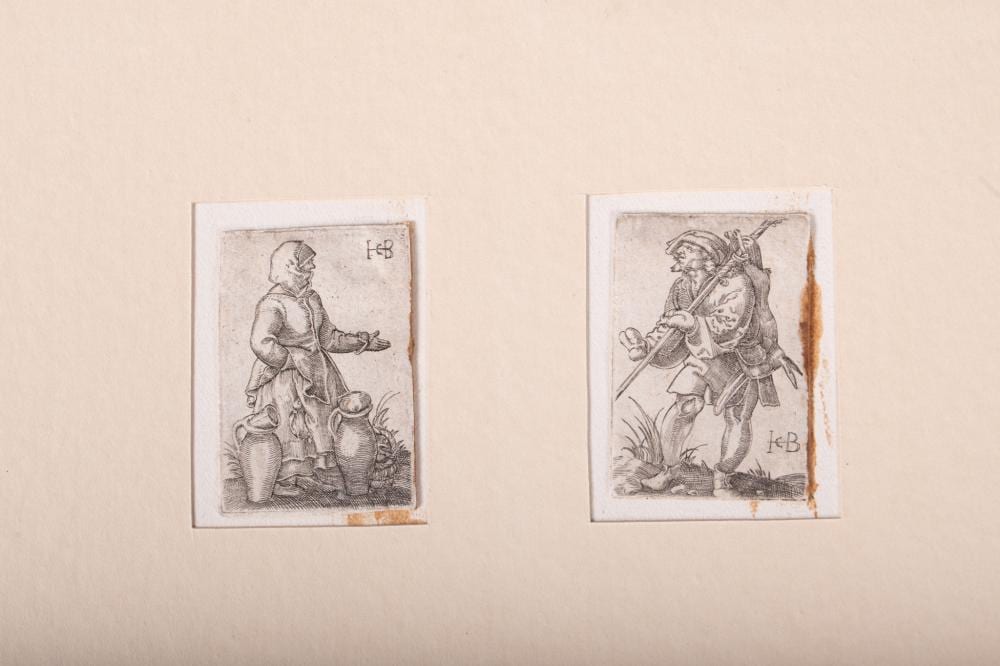
Jacob Binck (or Bink) Germany/ Denmark/ Flanders, ca. 1500-1569 Two 16th Century Engravings of German Peasants Engraving These two tiny 16th c. engravings were created by a German master painter, engraver, medallist and sculptor named Jacob Binck (or Bink) whose monogram can be clearly seen on each print: IcB (with a horizontal line running through and the middle area of the letter group thus connecting them into one form). Born in Köln (Cologne) around 1500, Binck moved to Nuremberg for artistic training (often studying and copying prints made by the Beham brothers there), and he later worked in Denmark and the Netherlands, increasingly influenced in and by Flemish masters such as Allaert Claesz. Although Binck was highly capable of creating original engravings, he enjoyed copying and printing (while only slightly altering) the works of other well-known contemporary masters. He was an active member of the Kleinmeister (Little Masters) group of about seven artists based in Nuremberg—a group heavily influenced by the local iconic master Albrecht Dürer as well as by the famed Bolognese printer/ engraver Marcantonio Raimondi—before the group was expelled from the city in 1525. The group became known as the "Little Masters" because they loved to create engravings (mostly of biblical or genre scenes) that were very, very small. 16th c. people liked to collect these small prints, keeping them safe by pasting them into personal albums. After many years working abroad across Northern Europe, Binck died in Königsberg (today Kalinigrad, Russia) on the Baltic Sea in 1569. This rare pair of two engravings by Binck focus on two middle-aged German country folk. The woman wears the humble and basic early modern kleider (dresses) of a German peasant including a kerchief-like headcover as she stands alongside two jugs and two cups fit presumably for water consumption (or possibly for milk). This scene had been originally created by Barthel Beham (1502-1540) in Nuremberg in 1524—so Binck admired, studied and copied Beham's engraving, creating a near-identical copy of Beham's peasant woman. Binck however flipped Beham's image, removed Beham's ‘1524' date and added his own monogram to the piece: IcB—thus claiming it and printing it as his own work (in the days before the idea of intellectual property had became an accepted topic). The engraving of the German peasant man was possibly created directly by Binck himself. The print features a middle-aged soldier/ hunter with an enormous recently-captured lifeless hare hanging from his halberd (or from some other pole weapon); the hare had also been a favourite subject of Dürer, as seen in his famous 1502 watercolour. The man also sports a pair of the then-popular puffy three-fingered gloves. This fine detailed work on such tiny images demonstrates the extraordinary technical skill employed by Binck and by his fellow early modern Nuremberger "Little Masters."