Have one like this?
Upload a photo for a free check of what yours may be worth.
Lot description
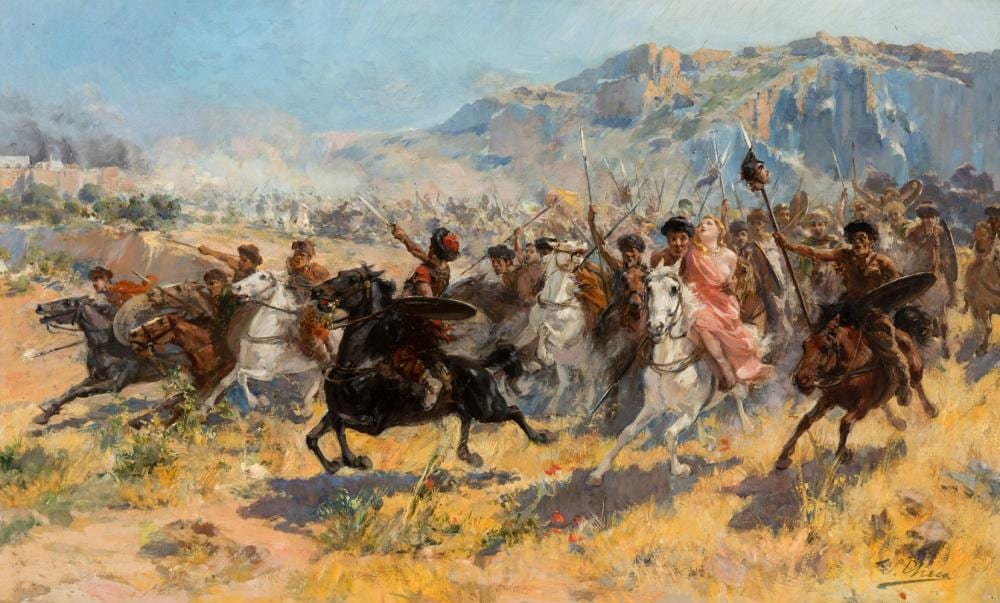
ULPIANO CHECA (Colmenar de Oreja, Madrid, 1860 - Dax, France, 1916). "The Hun invasion". Oil on canvas. Signed in the lower right corner. Titled on the back. Size: 48,5 x 79,5 cm; 79 x 111 cm (frame). A group of young men on horseback dominate the scene, emphasizing the presence of one of them who holds a lady dressed in pink whom he has abducted, a composition that is repeated in several works of the artist as the famous painting of the painter titled "The abduction of the Sabines" or "The abduction of Proserpina", which belongs to the collection of the Ulpiano Checa Museum. In this particular case, an inscription on the stretcher indicates that it may be a depiction of the Huns, a recurring theme in Checa's painting, who presented a work on the same subject at the Paris Salon in 1891. To depict the scene, the artist used a concave composition that invites the viewer to become part of it, and within this general distribution of the elements in the painting, other more classical compositional devices can also be seen. It is worth mentioning that this use of distribution brings a great deal of dynamism to the image in harmony with the theme represented. In style and subject matter, we can appreciate the characteristic aesthetic of Ulpiano Checa, a painter gifted with a technical capacity for drawing and the right tones, but also with a notable inventiveness capable of transporting the contemporary viewer to other periods, imagined by the painter as in this particular case. All this is captured in the scene through the exaltation of the public, the speed of the horses in the competition and the harmony of the bodies. Ulpiano Checa began his artistic training in 1873 at the Madrid School of Arts and Crafts. In 1876 he moved on to the San Fernando Academy, where he became a pupil of Federico de Madrazo. On completing his studies, in 1884, he obtained a grant to study at the Spanish Academy in Rome. During his third year he sent a work that won him the first medal at the National Exhibition of 1887 and the second at the Universal Exhibition in Vienna in 1888. At the end of 1887 he took up residence in Paris, where he exhibited regularly at the Salons, achieving success when his work was awarded a prize in 1890. There he combined painting with his work as a graphic correspondent for "La Ilustración Española y Americana". At the beginning of the century he settled in the south of France, in Dax, where he remained until his death in 1916. It is important to note how Checa's work influenced the adventure films of Hollywood in the 1950s and 1960s. Film directors such as Stanley Kubrick ("Spartacus"), Mario Bonnard ("The Last Days of Pompeii"), Mervyn LeRoy ("Quo Vadis"), William Wyler ("Ben-Hur") and, more recently, Ridley Scott ("Gladiator") were inspired by his works for their set designs, costumes, mass movement studies and characterisation of characters. In fact, he also influenced earlier filmmakers, since in the 1930s and 1940s his work showed directors the possibility of creating visual effects of depth and perspective hitherto unheard of in cinema. During his lifetime, in 1901, he collaborated with Henry Sienkiewick on the set and costume design for the theatrical version of the novel "Quo Vadis". In fact, part of Checa's work is based on literature, especially this novel, "Ben-Hur" and "Les Miserables". Works by Ulpiano Checa are kept in the Museo Municipal Ulpiano Checa in Colmenar de Oreja, the Museo del Prado, the Museo Nacional de Bellas Artes in Buenos Aires and the Museo de la Real Academia de Bellas Artes de San Fernando, among others.