Have one like this?
Upload a photo for a free check of what yours may be worth.
Lot description
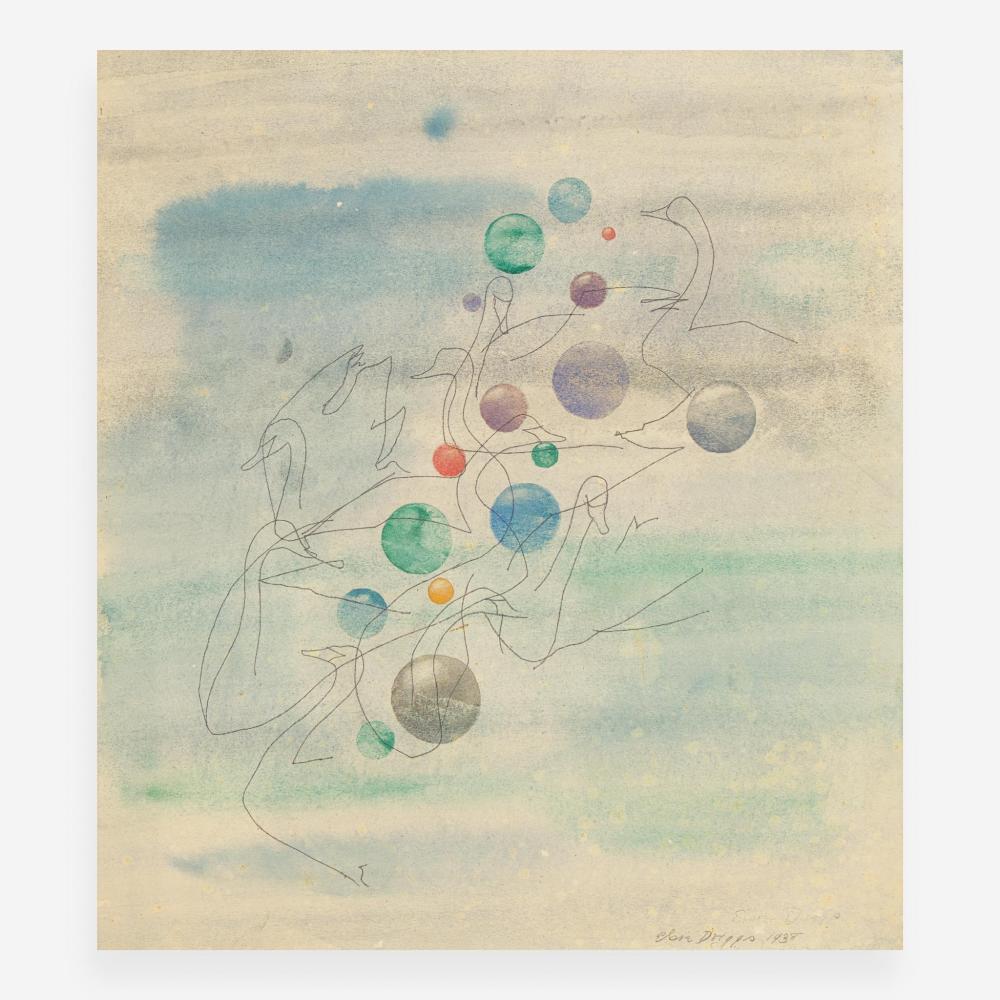
Elsie Driggs (American, 1898-1992) You've Seen Balloons Set––Haven't You? (From Emily Dickinson's Poems of Death) Signed and dated 'Elsie Driggs 1938' bottom right; signed again (twice) faintly bottom right; also accompanied by a hand-written rendition of Emily Dickinson's poem below, watercolor on paper Sheet size: 14 15/16 x 13 13/16 in. (37.9 x 35.1cm) Provenance Martin Diamond Fine Arts, Inc., New York, New York. Graham Gallery, New York, New York (as Balloons). Rosenfeld Fine Arts, New York, New York. Property from the Estate of Angela Gross Folk, New Jersey. Exhibited "Elsie Driggs: The Quick and the Classical," James A. Michener Art Museum, Doylestown, Pennsylvania, January 19-April 13, 2008. "Elsie Driggs: A Woman of Genius," New Jersey State Museum, Trenton, New Jersey, October 13, 1990-January 6, 1991; and The Phillips Collection, Washington D.C., January 26-March 17, 1991 (traveling exhibition), no. 36. Literature Dr. Thomas C. Folk, Elsie Driggs: A Woman of Genius, an exhibition catalogue, New Jersey State Museum, Trenton, 1990, p. 36 ("thirty-six"), fig. 22 (illustrated). Constance Kimmerle, Elsie Driggs: The Quick and the Classical, James A. Michener Museum of Art, Doylestown, 2008, p. 97, no. 36 (illustrated). Note By the time she created the present work, Driggs had developed interest in Americana. The present work is based on first two stanzas of the Emily Dickinson poem, "You've seen Balloons–Haven't You?," published posthumously in 1896. In 1934, she had already created two watercolors that depicted characters from The Emperor Jones and Merrymount, both of which are derived from American literature including Nathaniel Hawthorne's The May Pole Lovers of Merrymount. Sulky (Lot 35) follows the same principle by adapting a typical subject derived from Currier & Ives' prints, and combining it with modernist shapes inspired by Paul Klee. In overall good condition. While the transcription of the poem is affixed to the verso of the overmat, the sheet itself is affixed to the undermat via two (realtively new) strips of white paper tape at upper left and upper right corners. With a band of discoloration running along the top outer edge of the sheet, which makes us think the work was previously affixed by a band of old brown paper tape along its top edge: faint remnants of old brown tape verso seem to confirm it. The outer edges of the work are straight and even. With more or less prominent scratching areas, which appear consistent with the artist's technique (see for example in the backgroun at center right, close to the right outer edge), center left. Slight discoloration smears make us think the work is lightly toned. With an almost diagonal crease running along the top tier of the work (which gets prominent at bottom right, where the crease is slightly crackled). See Specialist's pictures for more details. To request additional information or access to more images, please contact Specialist Raphael Chatroux at rchatroux@freemansauction.com. Frame: 27 1/4 x 21 1/2 x 1 1/4 in.