Have one like this?
Upload a photo for a free check of what yours may be worth.
Lot description
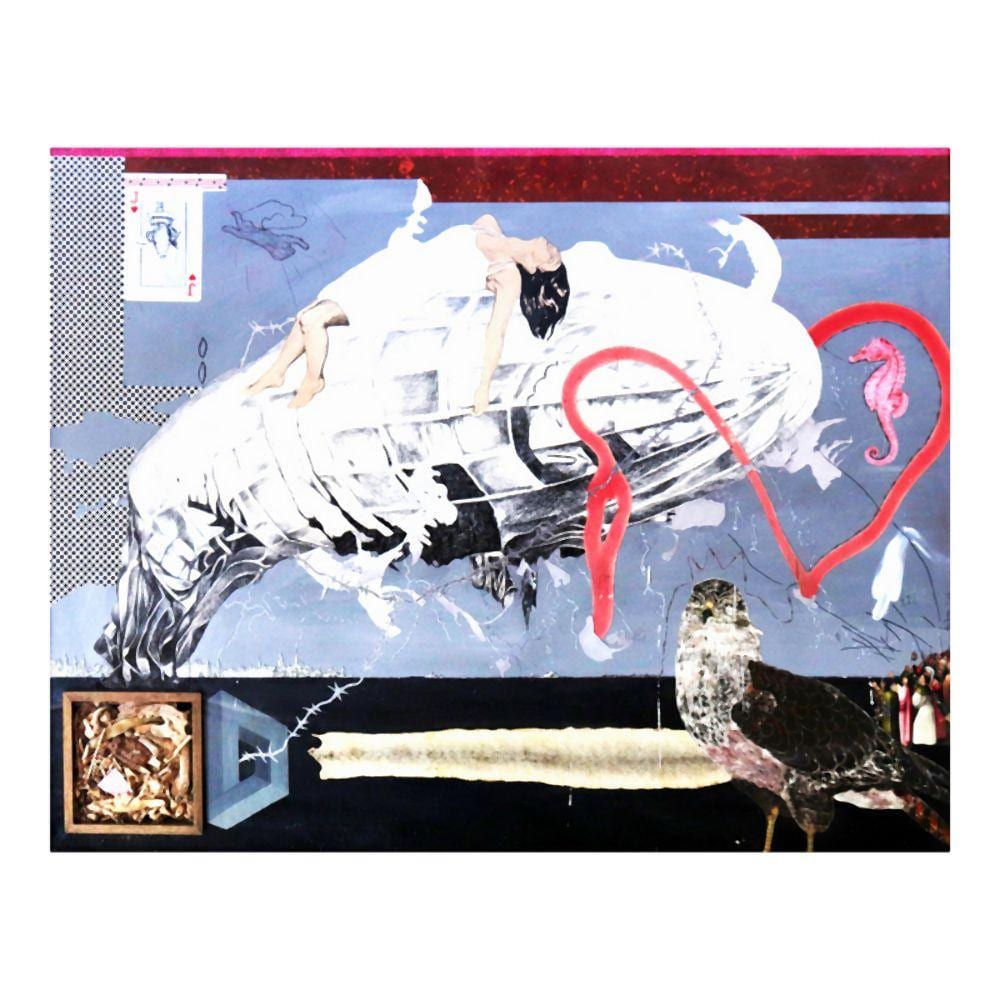
Kawayan de Guia (b. 1979) House of Exhausted Lovers signed and dated 2018 (lower left) mixed media 45" x 57 1/2" (114 cm x 146 cm) Accompanied by a certificate issued by The Drawing Room Contemporary Art Gallery and signed by the artist confirming the authenticity of this lot At first glance, the works of Kawayan de Guia are a hodge-podge of conflicting objects and elements. But art is rarely completely understood only through a mere glance.While great art goes beyond the consumption of a message and opens up the path towards inquiry. Such is the effect of the undoubtedly maximalist works of de Guia. His collection of mixed media works seemingly reflect an aspect of reality; one that showcases its inherently convoluted and even chaotic underpinnings. More specifically his works are a reflection of the nuances of contemporary Filipino culture. As a society at the center of multiple cultures, histories and influences, a cohesive singular interpretation of Filipino culture and identity would not suffice. Even one that sees the concept as layered would be disingenuous. Instead one can see culture as a web of objects and phenomena. Here, contrasts do not clash but intersect, acting as an ecology of things that treat and even accept objects no longer just as extensions of human beings but effective entities in-themselves. One could argue that de Guia’s practice utilizes the theories of philosopher Jane Bennett. Bennett argues that non-human entities also have a sense of agency, but this agency does not arise from consciousness but from their capacity to affect and be affected by other entities. This is what she calls affective ecology," which refers to the emotional and sensory responses that emerge from our interactions with the world. For example, encountering a vibrant sunset or feeling a sense of awe in nature. These affective experiences demonstrate that our emotions are not solely products of human consciousness but also arise from our engagement with the environment.affective ecology," which refers to the emotional and sensory responses that emerge from our interactions with the world. For example, encountering a vibrant sunset or feeling a sense of awe in nature. These affective experiences demonstrate that our emotions are not solely products of human consciousness but also arise from our engagement with the environment. In the same vein, de Guia’s collage of works and undoubtedly maximalist practice showcases how meaning and interpretation does not also stem from merely human interaction, but also the interaction between the various elements within. The interplay between the objects creates context, tension, and inevitably, meaning. Here, the nuances of love, its loss, its strain, is expressed through the nuanced interconnectedness of objects. One can even argue that this effect could not have been achieved without de Guia’s mixed media and even sculptural approach. Given the fact that knowing that such objects have been taken out of their original showcases a level of agency that, although aided by human hands, continue to chart a path of their own. (Jed Daya)