Have one like this?
Upload a photo for a free check of what yours may be worth.
Lot description
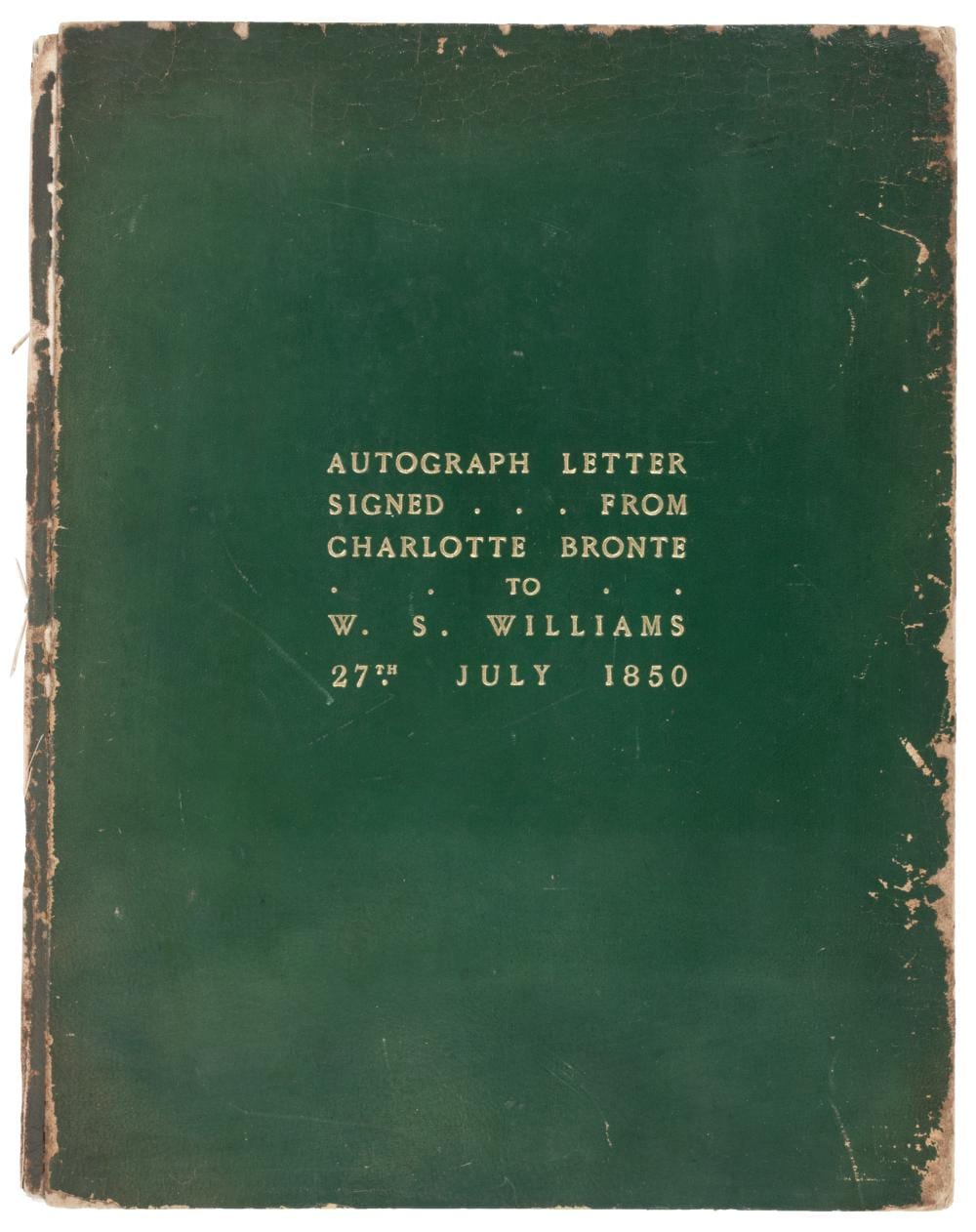
Heading: Author: Brontë, Charlotte Title: Autograph Letter from Charlotte Brontë to William S. Williams, one of her editors at the publishing house of Smith, Elder, and Co., regarding a portrait she sat for, and ruminations at a time of change and challenge Place Published: Publisher: Date Published: July 27, 1850 Description: Autograph letter signed C. Brontë. 54 lines, in ink, on the 1st 3 pages of a conjugate lettersheet. 18.5x11.5 cm (7¼x4"). Neatly sewn into a glassine protective sleeve which is in turn hinged with white linen cloth into a gilt-lettered leather folder (from the 1920s?) along with typed transcript of the letter and 3-page typed description of the letter's import and Charlotte Brontë's relationship with W.S. Williams; old auction catalogue description tipped to front free endpaper, armorial bookplate of Anglo-Canadian press baron Lord Beaverbrook (1879-1964) on front pastedown. Folder measures 31.5x25 cm (12¼x9¾"). Significant letter from Charlotte Brontë, author of Jane Eyre and other works, and the elder sister of authors Emily and Anne Brontë, to her "reader" or editor at her publisher, Smith, Elder, and Co. The letter refers in part to a portrait of Charlotte by George Richmond that she had sat for when visiting the offices of Smith Elder in June of 1850, but had yet to see. The remainder is quite personal and eschews the business of writing and editing for ruminations and private concerns. Emily had died two years earlier, and Anne, the youngest, just a little over a year before the letter was written. It was also not long after the sisters were revealed as women, and not the fictitious male authors of their pseudonyms, Currer, Ellis, and Acton Bell. Charlotte begins the letter, "My dear Sir, The long and interesting letter you sent me reminded me of the old days - (they seem old days now) when you wrote to me as 'Currer Bell Esq'..." She mentions reading the letter, and its "disquisition" on portrait painters, to "Papa." "...it served well to explain in what Mr. Richmond's peculiar excellence, as an artist, consisted, and will be a good preparation for the due appreciation of the picture when it comes." Charlotte is glad to hear that "Mrs. Williams' health is improved by her sojourn in the country," but briefly bemoans country living "where there is so little of human and social interest to give a lasting charm." She then opines that "In Scotland, for instance, though the narrowness and prejudice of which you complain, may indeed be found, yet that stagnation of ideas, that insensibility to natural beauties, that extreme pettiness of feeling scarcely, I should think exist. I am bound, however, to confess that all these weeds grow rank enough in the cold, Moorish soil of the North of England.... Believe me, my dear Sir, Yours very sincerely, C. Brontë." William Smith Williams has a special place in the literary history of Charlotte Brontë. In 1846, the three sisters, under their masculine Bell pseudonyms, submitted the three novels, "The Professor," "Wuthering Heights," and "Agnes Grey," to various publishers. The latter two, by the younger sisters, were accepted, but Charlotte's submission, The Professor, was refused by Smith & Elder, though in terms "so delicate reasonable and courteous" that it encouraged her to offer the firm "Jane Eyre," already nearly finished. It fell to Williams, then in his late forties, and he was overwhelmed by his first reading, and immediately gave his impression to publisher George Smith. Just six weeks later, on October 19, 1847, Jane Eyre was published, beating the two novels by Charlotte's siblings, which came out in December of that year. The letter is not listed in "The Letters of Charlotte Brontë," Oxford: Clarendon, 1995. A letter from Charlotte Brontë written on the same day, to George Smith, also referring to the portrait, is listed, however. George Smith wrote in his Memoirs, "During Miss Brontë's visit to us in June 1850, I persuaded her to sit to Mr George Richmond for her portrait. This I sent afterwards with an engraving of the portrait of the Duke of Wellington to her father, who was much pleased with them. Mr Richmond mentioned that when she saw the portrait (she was not allowed to see it before it was finished) she burst into tears, exclaiming that it was so like her sister Anne, who had died the year before." We have chosen to leave the letter enclosed in the glassine sleeve. The lower portion of the second sheet, containing the closing salutation, recipient's name, and Brontë's signature, was, prior to its being stitched into the sleeve, very neatly cut along the fold. While close examination reveals it to be separated, it is clearly the same sheet, and not an amalgamation.