Have one like this?
Upload a photo for a free check of what yours may be worth.
Lot description
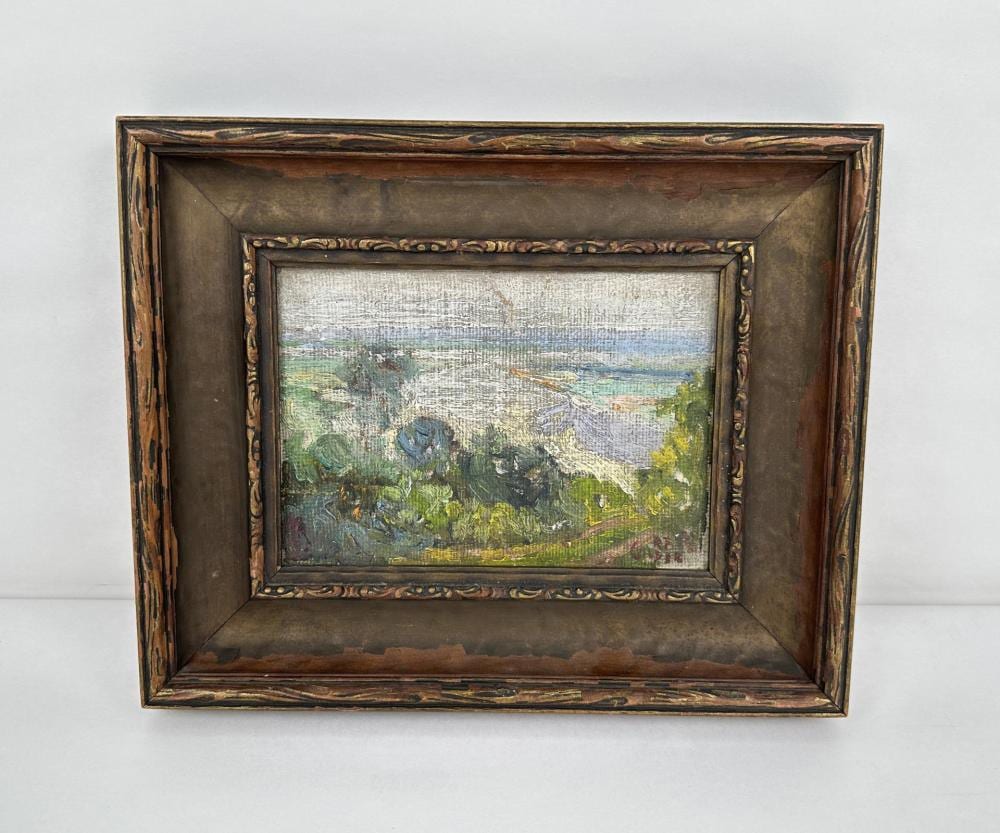
10 5/8" by 8 5/8" framed Robert Fletcher Gilder (1856 - 1940) was active/lived in Nebraska, New York. Robert Gilder is known for Landscape, snowscene and forest interior painting. Born in Flushing, New York, Robert Gilder was a long-time landscape painter in Omaha, Nebraska, known for impressionist winter scenes of the creek that ran through his property. Gilder was also a respected archaeologist and writer. He was the son of Reverend William Henry* and Jane Nutt Gilder and grew up in a family of highly successful siblings. His brothers were John Francis Gilder, concert pianist; William Henry Gilder, noted Arctic explorer; Richard Watson Gilder, writer, poet and editor of Century and Scribner's magazine; and Joseph Gilder, executive of Industrial Finance Corporation in New York City. A sister, Jeanette Gilder was author, editor, and newspaper executive. Robert Gilder was educated in Newark, New Jersey public schools and The Gunnery School in Washington, Connecticut, and studied art with Hudson River School painter August Will in New York City. Gilder's father was a good friend of naturalist John Burroughs, who stirred the artist's interest in nature. Because of two failed marriages, accusations of wife abuse and alcoholism, he settled in 1887 in Nebraska where, disdained by his eastern family, he started a new life. He worked briefly as a printer's assistant at Rees Printing Company, and then for thirty-two years worked for the Omaha World Herald, where he became City Editor. From Nebraska, he traveled extensively, and began painting in the early 1900s at the Nine Bar Ranch, owned by an Omaha friend, near Lusk, Wyoming where Gilder had gone to get material for a newspaper story on cowboys. For twelve years, Robert Gilder served as archaeologist of the University of Nebraska Museum in Lincoln. He discovered prehistoric flint quarries in Wyoming in 1904, and also discovered The Nebraska Loess Man, to that time the oldest documented human being. In 1917, the University of Nebraska gave him an honorary Doctor of Science degree for this accomplishment, and in 1922, he became president of the Nebraska Academy of Sciences. In 1927, he founded the Omaha Philosophical Society, and in 1928 the Omaha Nature Study Society. In 1916, in Fontanelle Forest south of Omaha, he built a cabin and studio that he called "Wake Robin" after a character in John Burroughs' book, Wake Robin. His art studio was in this cabin. (The name of his cabin home is from the plant Trillium erectum an early spring flower. Wake-robin is a member of the lily family. The flowers are usually dark reddish-purple, a woodland flower, preferring shade and blooms April to June. This flower wakes the robin in spring. Note from Janet Smith) A close friend of Harold Bell Wright, famous novelist who lived in Tucson, Gilder spent much time there and in other locations painting desert scenes, beginning 1919. A frequent companion on these trips was Augustus Dunbier, Omaha painter. Gilder also discovered forty-seven pueblo ruins in southern Arizona. Gilder's working method was to do oil landscape studies in "plein air," and then complete the painting in the studio. He worked quickly, usually finishing a painting in one day. He sold his paintings through the Whitmore Gallery at 1517 Dodge Street, and from 1924, the supervisor of art for the Omaha Public Schools required all eighth grade students to spend one week studying Dr. Gilder's work. He died of pneumonia on March 6, 1940. He is buried in Bellevue Cemetery south of Omaha. In November, 1957, the Greater Omaha Historical Society presented a special program commemorating Gilder, and the main speakers were Augustus Dunbier and Dr. Christlieb, an art collector. Allard Auction Collection Inv: MSU