Have one like this?
Upload a photo for a free check of what yours may be worth.
Lot description
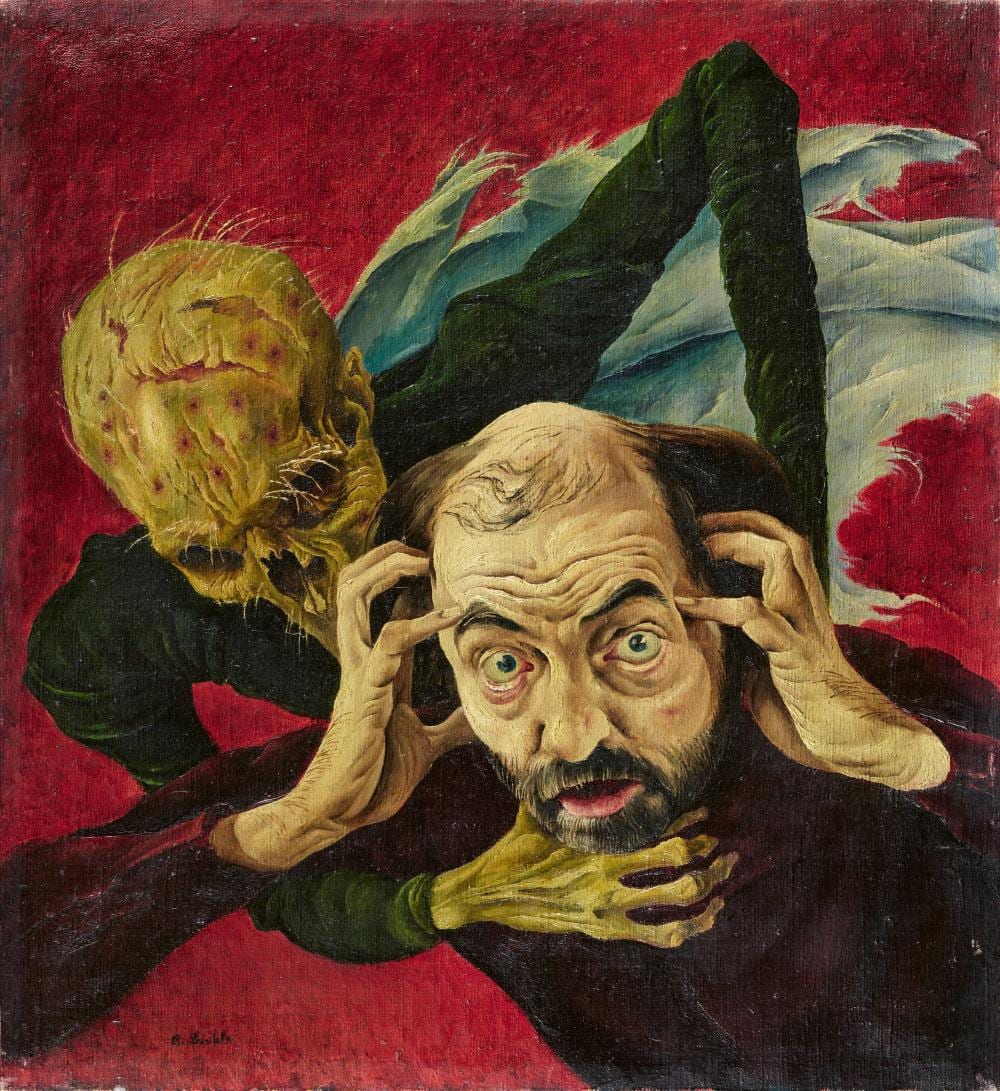
Signed 'A. Birkle' in black lower left. Signed and titled on the stretcher 'A. Birkle "Irrsinn"' and inscribed 'Akademie Ausstellung 1925' and 'Preis 1200' [crossed out]. We would like to thank Roswita and Viktor Pontzen, Archiv und Werkbetreuung Albert Birkle, Salzburg, for their kind support. The work is listed in the internal catalogue of works under number 803. With his characteristic, overstated depictions of physiognomies and his old-master-like precision in executing his paintings, Albert Birkle occupied a unique artistic position. In his oeuvre, surreal motifs and an aesthetic based on the New Objectivity combine to form an exceptional sort of magical realism. “Irrsinn”, from 1925, thematises the dark depths of the human psyche and human beings’ all-too-realistic fear of death. With this work – alongside the painting “Der letzte Kavalier” (Salzburg Museum), which was created the same year – Birkle produced a Dance of Death of his own, based on late medieval models. These images featuring drastic personifications of Death, such as the Dance of Death frieze in St Mary’s Church in Lübeck (c. 1460) or the woodcut series by Hans Holbein the Younger (c.1530), served as memento mori reminding the living of their inevitable mortality. In Birkle’s version, the theme is imbued with a particularly dramatic dynamism. Death, as a skeleton shimmering with a greenish light and still displaying traces of decomposition, leaps up to ambush his victim from behind, grasping his throat. The deathly terror gripping this man in the midst of his delusion is depicted with the utmost clarity: the eyes bulging in panic and the rigid fingers pressed against his temples. The red background, which also accompanies “Der letzte Kavalier”, keeps the scene set within a nightmarish void. As Silvia Kraker conjectures in her doctoral thesis, Birkle’s wartime experiences, a possible severe illness of his own or the literature of Baudelaire, for whom he had a special predilection, could have led to these extraordinary explorations of death.