Have one like this? Check yours freeOr have an appraiser value it
Lot description
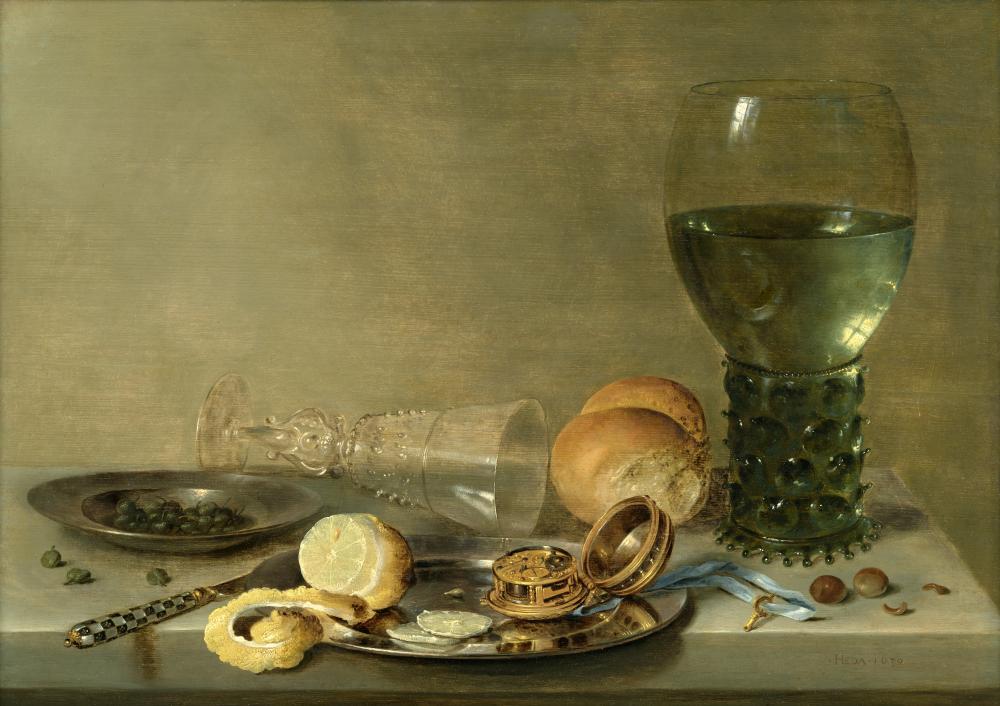
WILLEM CLAESZ. HEDA (1594 Haarlem 1680) Still life with Roemer, peeled lemon and pocket watch. 1630. Oil on panel. Signed and dated lower right: HEDA 1630. 41.5 × 57.3 cm. Provenance: - Sale Frederik Muller, 14 May 1912, lot 122. - Frans Smulders Collection. - Sale Gallerie Royale, The Hague, Frans Smulders Collection, 9 November 1937, lot 2. - Private collection, spanning two generations. - Sale Sotheby's, Amsterdam, 11 November 2008, lot 39. - European private collection. Exhibited: - Haarlem 1998-2008, Frans Hals Museum (loan). - Niigata 2003 / Toyohashi 2003 / Sakura 2004, Dutch Art in the Age of Frans Hals from the Collection of the Frans Hals Museum, Haarlem, Niigata Bandaijma Art Museum, 1 October–30 November 2003 / City Museum of Art and History, Toyohashi, 6 December 2003–18 January 2004 / Sakura City Museum of Art, 24 January–7 March 2004, no. 55. - Haarlem 2004 / Zurich 2005 / Washington 2005, Pieter Claesz: Meester van het stilleven in de Gouden Eeuw, Frans Hals Museum, 27 November 2004–3 April 2005 / Kunsthaus, Zurich, 22 April–22 August 2005 / National Gallery of Art, Washington, 18 September–31 December 2005. Willem Claesz. Heda, together with Pieter Claesz. (1597–1660/1) is considered one of the main representatives of the so-called ‘Monochrome Banketje’, a still life genre that specialised in depicting meals in monochrome tones. With this still life from 1630, one of the earliest examples of this genre by Claesz. Heda comes to the art market. It was last exhibited on loan to the Frans Hals Museum, and as part of the exhibition dedicated to Pieter Claesz. and his environment in 2005 in the Kunsthaus Zurich. The artist succeeds in imbuing the painting’s composition with a refined elegance as well as rendering the various textures with finesse, while depicting an atmospheric, fleeting moment. Before us is a simple table in front of a monochrome background, where someone not long before had a meal. On the table are two pewter plates, on one of which are capers, on the other a partially peeled lemon and an open pocket watch. Behind them, an empty glass ‘à la façon de Venise’ has been placed on the tabletop. Next to it glows a yellow-brown loaf of bread with a crispy surface. A large Roemer filled with wine to the right reveals a glimpse of the room through the reflection of a mullion window. In front of the glass are two hazelnuts and broken pieces of shell. The composition is arranged diagonally from lower left to upper right, and is purposefully accented by other geometric lines, such as the table edges, the knife, and the recumbent glass. The objects projecting over the edge of the table in the foreground, such as the knife handle, the pewter plate and the lemon peel, further reinforce the spatial impression. The composition is repeated, with slight variations, in another example from 1630, in which the capers have been replaced by olives and the hazelnuts by a walnut (formerly Robert Noortman, 1993, RKD no. 2540). Heda also prominently displays the Roemer in a smaller portrait format in the Groningen Museum (inv. no. NK2489), also dated 1630, as well as in a composition in the Museum Boijmans-van-Beuningen in Rotterdam (inv. no. 1286), painted somewhat later, in 1634. --------------- WILLEM CLAESZ. HEDA (1594 Haarlem 1680) Stillleben mit einem Römer, geschälter Zitrone und Taschenuhr. 1630. Öl auf Holz. Unten rechts signiert und datiert: HEDA 1630. 41,5 × 57,3 cm. Provenienz: - Auktion Frederik Muller, 14.5.1912, Los 122. - Sammlung Frans Smulders. - Auktion Gallerie Royale, Den Haag, Sammlung Frans Smulders, 9.11.1937, Los 2. - Privatsammlung, über zwei Generationen. - Auktion Sotheby's, Amsterdam, 11.11.2008, Los 39. - Euopäische Privatsammlung. Ausstellungen: - Haarlem 1998–2008, Frans Hals Museum (Leihgabe). - Niigata 2003 / Toyohashi 2003 / Sakura 2004, Dutch Art in the Age of Frans Hals from the Collection of the Frans Hals Museum, Haarlem, Niigata Bandaijma Art Museum, 1.10.–30.11.2003 / City Museum of Art and History, Toyohashi, 6.12.2003–18.1.2004 / Sakura City Museum of Art, 24.1.–7.3.2004, Nr. 55. - Haarlem 2004 / Zürich 2005 / Washington 2005, Pieter Claesz: Meester van het stilleven in de Gouden Eeuw, Frans Hals Museum, 27.11.2004–3.4.2005 / Kunsthaus, Zürich, 22.4.–22.8.2005 / National Gallery of Art, Washington, 18.9.–31.12.2005. Willem Claesz. Heda zählt zusammen mit Pieter Claesz. (1597–1660/1) zu den Hauptvertretern des sogenannten Monochrome Banketje, einer Stilllebengattung, die sich auf Mahlzeitenarrangements in monochromer Tonalität spezialisierten. Mit diesem hier angebotenen Stillleben von 1630 findet sich eines der frühesten Beispiele des Künstlers auf dem Kunstmarkt, welches zuletzt als Leihgabe im Frans Hals-Museum und anlässlich der Ausstellung zu Pieter Claesz. und seinem Umfeld 2005 im Kunsthaus Zürich ausgestellt war. Das Gemälde überzeugt durch eine raffinierte Eleganz in der Komposition und Feinheit der unterschiedlichen Stofflichkeiten. Dabei gelingt es dem Künstler, eine stimmungsvolle momenthafte Situation zu schildern. Es zeigt sich vor uns ein schlichter Tisch mit einem Mahlzeitarrangement vor monochromem Hintergrund, an welchem vor nicht allzu langer Zeit gespeist wurde. Auf dem Tisch finden sich zwei Zinnteller, auf dem einen liegen Kapern, auf dem anderen eine teilweise geschälte Zitrone und eine geöffnete Taschenuhr. Dahinter wurde ein leeres Glas à la façon de Venise auf der Tischplatte abgelegt. Daneben leuchtet ein gelbbrauner Brotlaib mit knuspriger Oberfläche. Ein mit Wein gefüllter grosser Römer zur Rechten lässt durch die Reflektion eines Fensterkreuzes die Räumlichkeiten erkennen. Davor liegen zwei Haselnüsse und aufgebrochene Schalenstücke. Die Komposition ist diagonal von unten links nach oben rechts arrangiert und wird gezielt durch weitere geometrische Linienführungen, wie die Tischkanten, das Messer und das liegende Glas à la façon de Venise akzentuiert. Die über die Tischkante hinausragenden Gegenstände am vorderen Bildrand, wie der Messergriff, der Zinnteller und die Zitronenschale, verstärken ferner den räumlichen Eindruck. Die Komposition findet sich leicht variiert in einem weiteren Beispiel von 1630 wiederholt, bei der die Kapern durch Oliven und die Haselnüsse durch eine Walnuss ausgetauscht wurden (ehemals Robert Noortman, 1993, RKD-Nr. 2540). Den Römer setzt Heda auch in dem kleineren, ebenfalls 1630 datierten Hochformat im Groninger Museum (Inv.-Nr. NK2489) prominent zur Schau ebenso wie in der etwas später, 1634 entstandenen Komposition im Museum Boijmans-van-Beuningen in Rotterdam (Inv.-Nr. 1286). ---------------