Have one like this?
Upload a photo for a free check of what yours may be worth.
Lot description
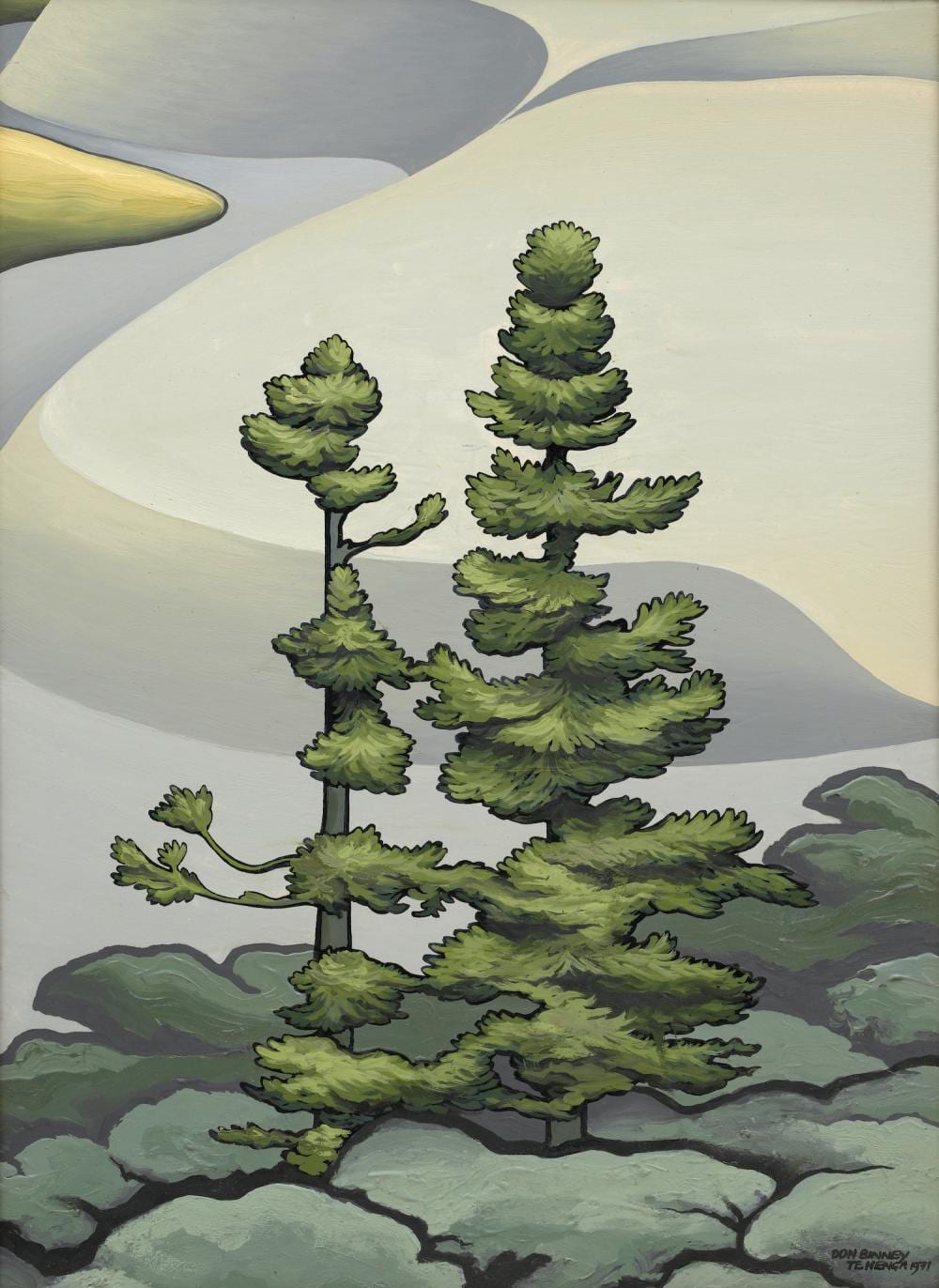
DONALD BINNEY (New Zealander, 1940-2012) Te Henga 1971 oil on board signed, titled and dated lower right: DON BINNEY/ TE HENGA 1971 73.5 x 54cm PROVENANCE: Acquired in Auckland, c.1970 Private collection, Sydney Thence by descent EXHIBITIONS: (Possibly) Earth/Earth, Barry Lett Galleries, Auckland, 19 - 30 April 1971 OTHER NOTES: RELATED WORKS: Donald Binney, Te Henga 1970, oil on canvas, 80.5 x 53.2cm, Art+Object, Auckland, 24 November 2022, lot 70, sold NZD$84,000 Donald Binney, Te Henga, Easter 1970, charcoal on paper, 35 x 26cm, Leonard Joel, Melbourne, 27 February 2011, lot 177 Two sentinels stand assuredly in the midst of the Waitakere, reaching up into the salt-soaked air above. The subtle light sweeping in from carefully crafted contours draws the viewer's eye in a sweeping motion then delicately rests upon the two central figures. The strong dark outline of the two pine trees and the canopy beneath are filled with generous brushstrokes full of colour. As the dense foreground gives way to a harmonious backdrop of land and sky the overall composition reaches an apex of elegant simplicity. This here is Binney's genius - he draws you into the landscape to experience it for yourself and once you do, it is impossible to turn away from it. Te Henga from 1971 is a reverent depiction of the New Zealand landscape and captures an area with which Donald (Don) Binney was intimately acquainted. Te Henga, also known as Bethells Beach on Auckland's west coast, was a favourite painting ground for Binney. Having access to a cabin by the late 1950s, his many summers there informed his painting for decades. He carried with him in his mind this unique seascape, which he referenced in his work even when travelling overseas (1). In a career spanning more than 40 years Binney's iconic landscapes and birds have become almost symbolic of New Zealand's artistic identity, forming part of a lineage of landscape painting within the country's history which has come to be closely associated with its national identity. Much like the art history of Australia, early European painting in New Zealand was dominated by landscapes painted in a conservative English style. The earliest painters were mostly 'amateurs' and their main aim was not to produce works of art but to record information about places. The styles and formulas they employed had little to do with the reality and individuality of the New Zealand environment. By the early 20th century, spurred by the arrival of several influential professional painters from Europe, greater freedom of travel, access to art magazines and books and touring exhibitions, New Zealand began to develop a more distinctive national identity. This new style of painting, sometimes referred to as Regionalism, called for painters to pay greater attention to local subjects. Artists began to approach the landscape with a diversity of styles and interests dealing with themes such as isolation, loneliness and the celebration of rural life (2). Binney's work in the second half of the century was an evolution of these trends, his appreciation of his native land developed and his adoption of new techniques and styles were refined into his own unique visual language. As Binney remarked when referring to his early work of the 1960s and 70s - it was "high-minded, optimistic, non-materialistic, and capable of making an artist feel participant to an emerging national identity"(3). Binney's appreciation for his native land is ever-present in his artistic output, no less so in the present lot through his careful and considered painterly approach. Yet his work is also imbued with a sense of melancholy for the changes that have occurred in the environment he so loyally devoted his time to. R. B. Sibson was the schoolmaster at King's College who later became a good friend and guide to Binney in the field of ornithology. Sibson was the first to encourage Binney to notice the cuckoos signalling summer's coming and in birdwatching Binney "found a way to enter the landscape and know it as an environment" (4). Binney's interests in ornithology and the environment found a pathway into conservation and activism. Living through some of New Zealand's most environmentally-challenged decades, Binney made continuing efforts - often against huge odds - to save remaining and globally unique native flora and fauna, and in particular birdlife. As Binney himself said "conservation, spirituality and art usually conjoin in societies living indigenous to natural habitat… The role of any artist - in the fullest definition - can aid other specialist initiatives in habitat recovery, not just as a recorder but also as a celebrant" . In this manner Binney leaves for us not only his legacy of exceptional artistic talent in representing the New Zealand landscape but also his passion for ecology and the environment. As such, we are also left with the knowledge that these two subjects, the art of landscape painting and environmentalism, must be entwined. Madeleine Norton Associate Head of Decorative Arts & Art, Sydney (1) Binney, D., 1989, Don Binney: 1959-1989: A Survey, TeTuhi, 19 August-17 September 1989, [exhibition catalogue], Auckland, p.2 (2)'Beginnings', URL: https://nzhistory.govt.nz/culture/nz-painting-history/beginnings, (Ministry for Culture and Heritage), updated 30-Nov-2018 (3) Binney, D., 1989, Don Binney: 1959-1989: A Survey, TeTuhi, 19 August-17 September 1989, [exhibition catalogue], Auckland, p.2 (4) Ibid.