Have one like this? Check yours freeOr have an appraiser value it
Lot description
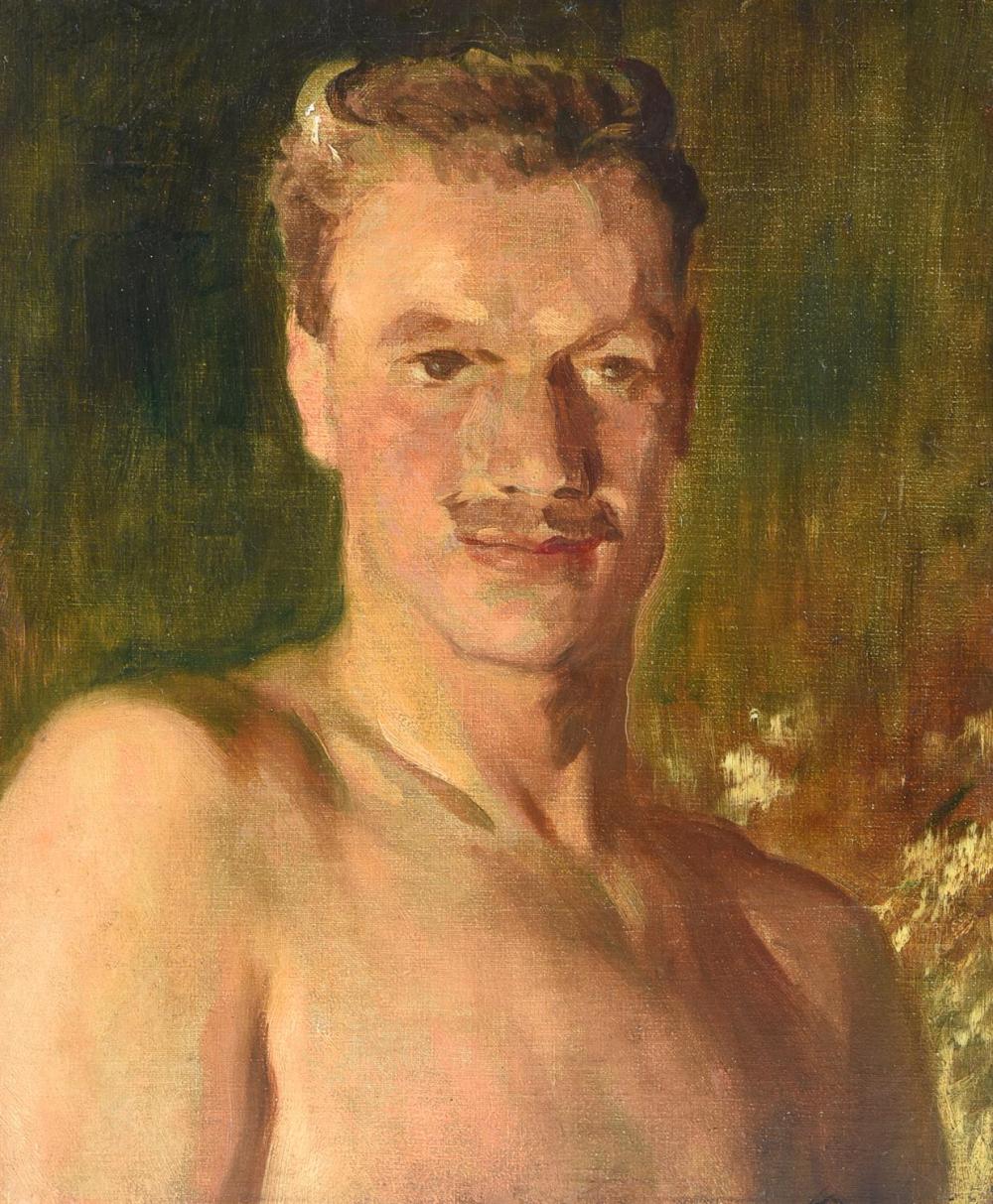
GLYN WARREN PHILPOT (BRITISH 1884-1937)ROBERT ALLERTON, AS A FAUN Oil on canvas 39.5 x 31.5cm (15½ x 12¼ in.)Provenance:Sale, Phillips, London, Modern British Paintings - Watercolours & Drawings, 8 March 1988, lot 35, Private Collection, London Purchased from the above by the present owner c. 1988Literature:Simon Martin, Glyn Philpot, Flesh and Spirit, with an Introduction by Alan Hollinghurst, (Pallant House Gallery, 2022), illustrated, fig. 111, p. 104 In the late 1980s, a chance encounter with Glyn Philpot's niece, Gabrielle, would inspire a fascination with Philpot's work and result in the purchase of the present lot. They recall visiting Gabrielle, who lived in the basement apartment of their friend's property. They would visit for cups of tea as she sat surrounded by exquisite works produced by her uncle. They wanted to acquire a work by Glyn Philpot to add to their own collection and Gabrielle knew of a friend selling a work privately. This sensitive and intimate portrait by Glyn Philpot depicts the American philanthropist and art collector Robert Allerton. He was the son of Samuel Walters Allerton who made his fortune through the livestock trade in Chicago and was co-founder of the First National Bank of Chicago. Determined not to follow in his father's footsteps Robert Allerton decided to follow his passion for the arts and study at the Royal Academy of Fine Arts in Munich followed by further study in Paris. However, after just five years Allerton returned to Illinois to run the family farms. Allerton owned and managed a 12,000 acre estate in Monticello, Illinois which became known as 'The Farms'. Here he built a beautiful Georgian mansion in the style of Ham House in Richmond, inspired by his travels in London. The mansion served as a place to hold lavish parties where he invited artists, friends and notable people from high society. In 1906 the Chicago Tribune released an article surrounding Allerton and his wealth, titled the 'Richest Batchelor in Chicago'. Robert Allerton was a patron of the arts and travelled widely across Europe and Asia. In 1920 he started donating works to the Art Institute of Chicago including pieces by Vincent Van Gogh, Pablo Picasso and Auguste Rodin. By the time of his death in 1964 he had donated 6600 pieces, making him one of the most important benefactors in its history. Allerton also gifted his house, grounds and farmland to the University of Illinois to be used as an education and research centre. This mischievous portrait of Allerton depicted as a mythological faun was not the first time Philpot had explored the subject. In 1912, Philpot sculpted 'The Dead Faun' cast in bronze, believed to be a mask depicting Napier Sturt, Lord Allington. Furthermore, in the spring of 1913 Nijinsky was performing 'L'Apres-midi d'un faune' with the Ballet Russes at the Royal Opera House. Philpot produced a dramatic portrayal of Nijinsky stood against the sumptuous red velvet theatre curtain. This work is now held in a private collection. It was during one of these visits to the opera that Philpot and Allerton first met. Allerton invited the aspiring young artist to visit him in Monticello to which Philpot gladly agreed. In September 1913, Philpot boarded the R.M.S Carmania and set sail on his adventure to the USA. Philpot's arrival caught the attention of 'Madame X' who wrote for the Chicago Sunday Times. The paper published an article on 21st September 1913 which dubbed the artist 'the art sensation of the moment,' and highlighted his highly regarded reputation back in England. Allerton arranged a studio space for Philpot to work from during his stay at 'The Farms' and invited close friends and members of the Chicago elite, including Miss Isabelle McBirney, to have their portrait painted. Enamoured by the people and experience Philpot stayed for four months. Philpot is known to have produced two portraits of Allerton during his stay, The Faun, presented here and a beautifully simple and captivating portrait titled The Man in Black, now held in the Tate collection in London. The present head and shoulder study presents a strikingly different depiction of Allerton compared to all other known portraits and photographs in which he was presented dressed in a smart suit, suitably posed and professional. The admiration felt for Allerton and connection between the painter and sitter exudes from the surface of the canvas. He paints strong muscular shoulders , a chiselled face with a pair of small horns atop his head, glinting in the light. Philpot and Allerton are not believed to have engaged in a sexual relationship but in letters written to Philpot's sister he reveals his infatuation with Allerton and described him as 'the most beautiful wise mature character'. Letter to Daisy Philpot, 22 October 1913.The work is believed to have been a study for a later painting produced by Philpot during his second visit to Allerton in 1921, when he visited with his partner Vivian Forbes. The pair stayed for three months and Philpot painted society portraiture just as Allerton had arranged back in 1913. During their visit Philpot produced Faun and Satyr which was hung above the over-mantel. Unfortunately, this work was moved to Allerton's estate in Kauai, Hawaii and later destroyed in a hurricane. Allerton is known to have had a couple of garden statues which depicted the mythological faun and a bass relief of pan on the carriage house on the estate, which may have further influenced Philpot's decision to depict Allerton as a faun.We are grateful to the staff at Allerton Park Retreat Center, University of Illinois, Nick Syrett and Maureen Holtz for their assistance in cataloguing this lot.