Have one like this?
Upload a photo for a free check of what yours may be worth.
Lot description
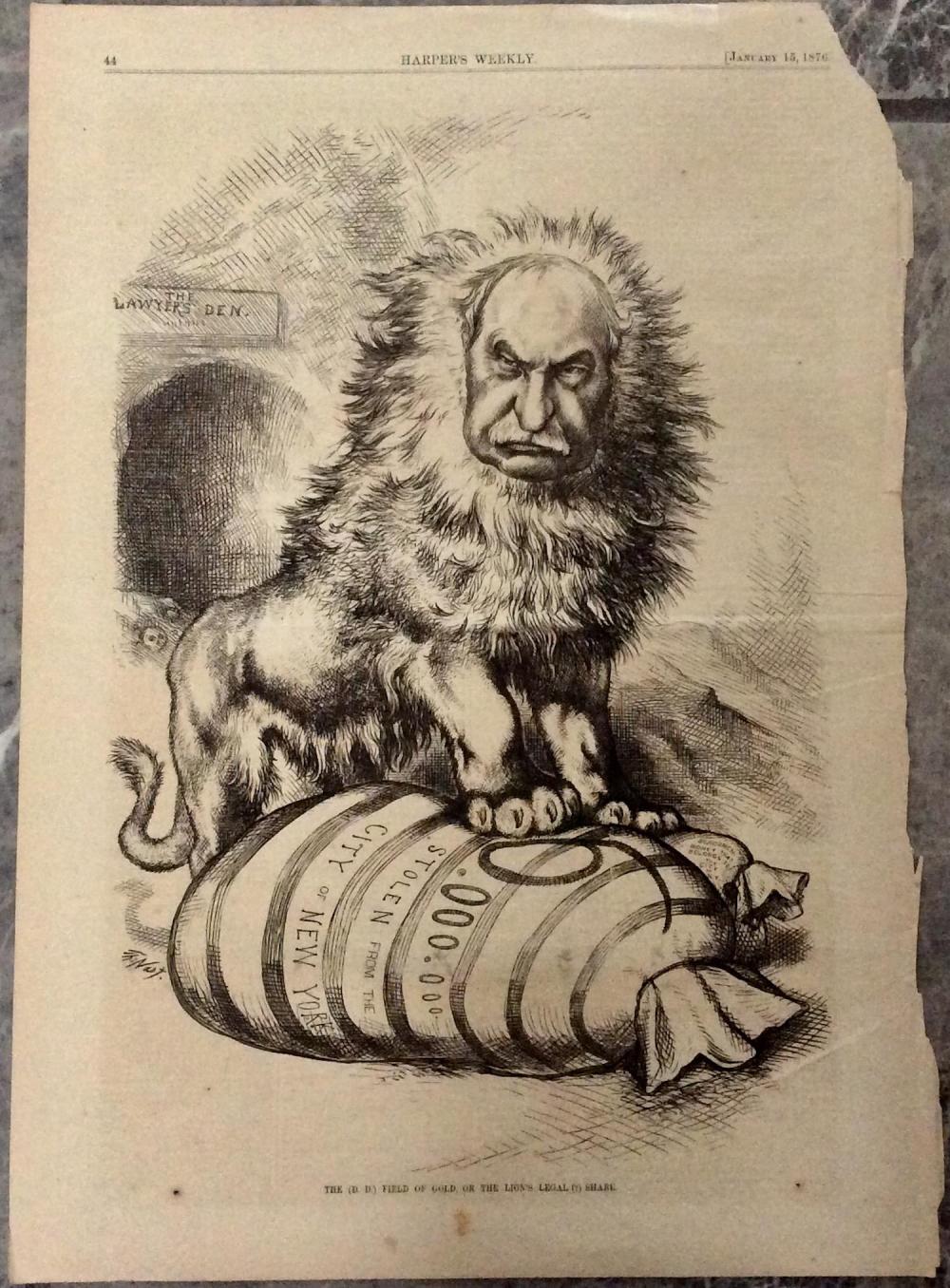
ANTIQUE 1876 Thomas Nast Harper's Weekly Interior Page Cartoon Mocking "Boss" Tweed's Lawyer's Fee From The Stolen NYC Money. It is suitable for framing. Signed in image. Thomas Nast Large Woodblock Political Interior Page Cartoon From January 15, 1876 Issue of Harper's Weekly. Interior Page woodblock cartoon, of that Harper's Weekly issue. Image Titled: "THE (D. D.) OR THE LION'S LEGAL (?) SHARE." Image measures approximately 16 inches high X 11 inches wide including margins. Edges show handling wear/right margin rough where it was removed from the Harper's Weekly volume/upper right corner missing well away from image. Any faults will be covered by the mat when framed. Paper is lightly age toned but not brittle. Signed in image: "TH. NAST." Overall the piece is Very Good Condition. In this powerful "Boss" Tweed Tammany Hall scandal cartoon image, Nast shows his contempt for the David Dudley Field the promient lawyer that defended Tweed. Thomas spent much time & many cartoons in an effort to oust "Boss" Tweed & his Tammany Hall Democratic Party machine from power in NYC. Tweed's downfall began in 1871. The cartoon shows a snarling Field, as a lion, who stands defiantly atop a prison-striped bag labeled "6,000,000 stolen from the City of New York." Under his left front paw is a smaller bag labeled "Bondsmen. Money that belongs to the City of N.Y." Behind him is a cave marked "The Lawyerâs Den," whose entrance is strewn with human skulls and bones. Field is alone, without Tweed, who had escaped from jail and was hiding in New Jersey on his way to Spain to avoid jail. Nast relished the opportunity to attack Ring judges and what he viewed as corrupt elite lawyers, such as Fields. Legal proceedings against the Ring had proven drawn-out and frustrating for a fiery reformer like Nast. Grand juries approved eight separate indictments against Tweed. Finally, over a year after his political downfall, Tweed was brought to trial on a package of 220 counts of failure to audit and abuse of his public position. The trial featured elite lawyers on both sides. Tweed ensured he would be ably defended by hiring David Dudley Field to represent him. The defense called only a few witnesses, and Field skillfully argued there was no evidence that Tweed had intentionally stolen money. The jury began deliberating in the afternoon of January 30, 1873 and remained locked up overnight, having taken over 40 ballots. The next morning, the jurors declared they could not reach a verdict, and the judge discharged them. Prosecutors speculated that several of the jurors must have been bribed. Tweed declared confidently that a jury would never convict him. Nast was not alone in this period in criticizing the jury as too easily led astray by lawyersâ rhetoric. The late nineteenth century saw a turn away from the optimism about democracy and juries â the trust in the common man â that had prevailed in the first half of the century. Eventually Tweed was tried again and given 12 years prison time. In April 1878, he died of pneumonia in prison at the age of fifty-five. One of Nast's many Tweed cartoons shows Tweed's source of power: control of the ballot box. Its title was: "As long as I count the Votes, what are you going to do about it?" Tweed had been under attack from both "The New York Times" and Thomas Nast, the cartoonist from "Harper's Weekly'Â â regarding Nast's cartoons, Tweed reportedly said, "Stop them damned pictures. I don't care so much what the papers say about me. My constituents don't know how to read, but they can't help seeing them damned pictures!" THOMAS NAST (1840-1902) was a German-born American caricaturist and editorial cartoonist considered to be the "Father of the American Cartoon". He was the scourge of Democratic Representative "Boss" Tweed and the Tammany Hall Democratic party political machine & of the Democratic Party in general whom he considered pro-South traitors. He was also strongly anti-Irish & anti-Catholic Church, since in the 19th century the Irish strongly supported the Democratic Party & were predominately Catholic. Nast considered the Catholic Church as a threat to American values. According to his biographer, Fiona Deans Halloran, Nast was "intensely opposed to the encroachment of Catholic ideas into public education". Among his notable works were the creation of the modern version of Santa Claus----based on the traditional German figures of Sankt Nikolaus and Weihnachtsmann----and the political symbol of the elephant for the Republican Party. Contrary to popular belief, Nast did not create Uncle Sam----the male personification of the American people----or Columbia----the female personification of American values----or the Democratic donkey, though he did popularize these symbols through his artwork. Nast was associated with the magazine Harper's Weekly from 1859 to 1860 and from 1862 until 1886. It has been argued by eminent historians that as a political cartoonist, Thomas Nast wielded more influence than any other artist of the 19th century. He not only enthralled a vast audience with boldness and wit, but swayed it time and again to his personal position on the strength of his visual imagination. President Lincoln called Nast "our best recruiting sergeant" for one of his most celebrated cartoons "Compromise with the South", which was directed against those in the North who opposed the prosecution of the American Civil War, as well as, for drawing battlefields in border and southern states. President Grant attributed his victory in 1868 to "the sword of Sheridan and the pencil of Thomas Nast." In the 1872 presidential campaign, Nast's ridicule of Horace Greeley's candidacy was especially merciless. After Grant's victory in 1872, Mark Twain wrote the artist a letter saying: "Nast, you more than any other man have won a prodigious victory for Grant----I mean, rather, for Civilization and Progress." As a crusading civil reformer he helped destroy the corrupt "Boss" Tweed Ring that swindled NYC of millions of dollars. His impact on American public life was formidable enough to profoundly affect the outcome of every presidential election during the period 1864 to 1884. ALL ITEMS ARE GUARANTEED TO BE ACCURATELY DESCRIBED, NOT DEFECTIVE, & GENUINE. PLEASE NOTE: We do all our own shipping. We will combine shipping on multiple items, where possible to save the winning bidder on shipping costs. Shipping will be added to the winning bidder's invoice for item(s) won. Media Mail postage from USPS will be used for shipping in the United States for those items allowed. The lowest alternative cost shipping will be billed for items not allowed by USPS to be shipped by Media Mail. Foreign winning bidders will pay postage based on their countries small/medium/large Flat Rate box postage rates & weight of the package. Other types of postage are available at the added expense at the bidders' request. You also agree to pay any applicable taxes and/or customs/import duties. A Tracking Number will be provided to the buyer. Insurance is mandatory on packages over USD 100 and will be added to postage charges when applicable.