Have one like this?
Upload a photo for a free check of what yours may be worth.
Lot description
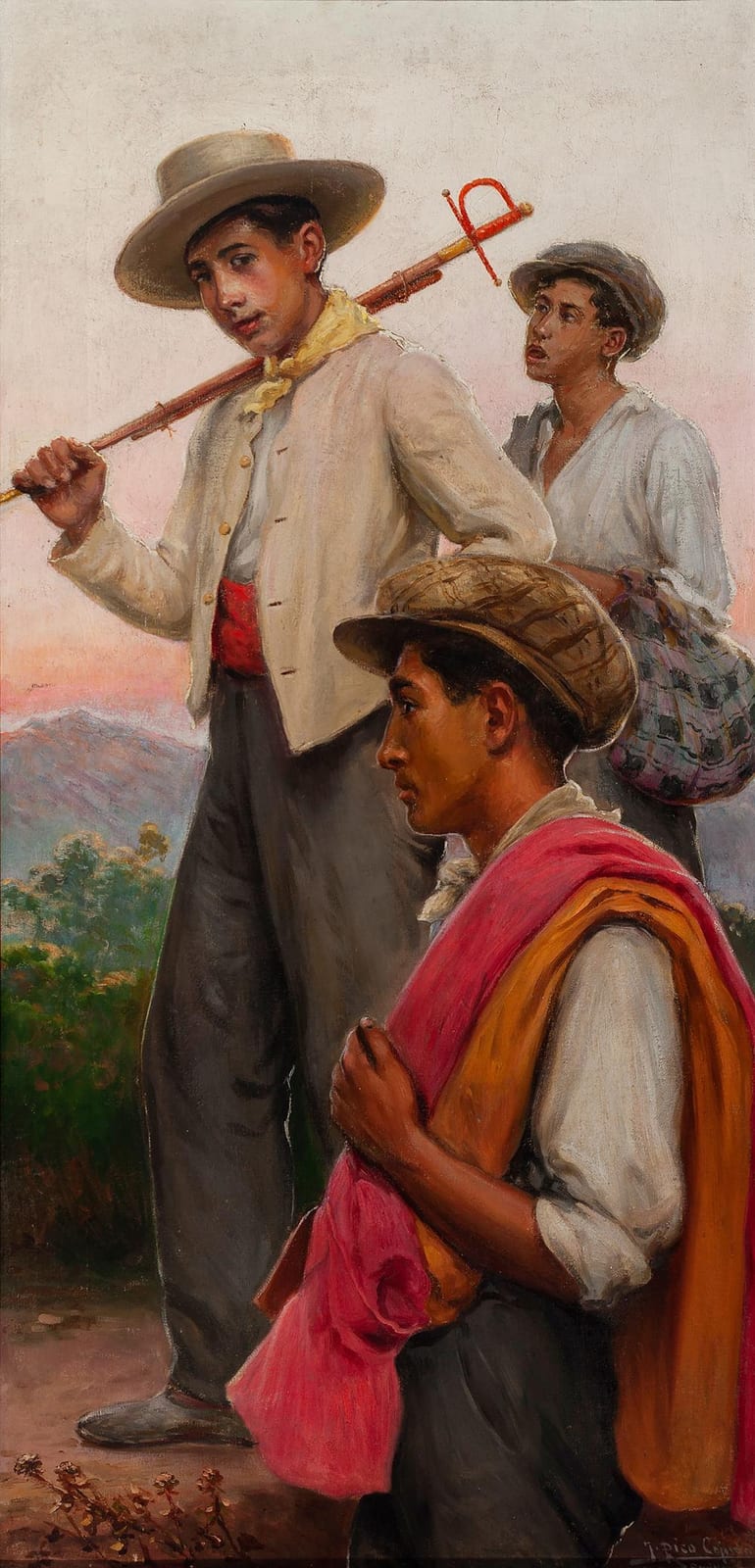
JOSÉ RICO CEJUDO (Seville, 1864 - 1943). "Mozos", Seville. Oil on canvas. Signed and located in the lower left corner. Measurements: 84.5 x 40 cm; 89.5 x 45.5 cm (frame). Rico Cejudo offers us a work which, although it tends towards the anecdotal, possesses great narrative sincerity. He shows three young lads carrying bullfighting implements, such as the rapier and the cape with which the bullfighter will fight in the ring. The firm, vigorous drawing and the sense of colour with its strong tones, but restrained in nuances, are outstanding. Born in Seville on 27 March 1864, he entered the Provincial School of Fine Arts as a child, learning from Manuel Wssel, Eduardo Cano and José García Ramos until 1887, when he was still a pupil at the school and won a cash prize for his painting El niño de la paloma ("The Boy with the Pigeon"). The following year he moved to Rome on a pension from the Seville City Council. He remained there until 1895, seeking the guidance of the Sevillian Villegas and the Jerez-born Gallegos. He also took the opportunity to travel to Naples and Venice, the latter city where he made numerous visits like so many other painters of the Spanish colony in Italy, attracted by the polarising influence of the settlement there of Fortuny's widow, Cecilia Madrazo, and the frequent visits to that "court" of the most prestigious of the Fortuny family, such as Martín Rico and Villegas himself. The Italian paintings Rico Cejudo delivered to the Seville City Council as pension remittances - A Pompeian Woman (1889), Study of a Male Nude (1889) and The Easter Blessing in Rome (1893) - are works that reflect the marvellous resources he had acquired in Italy: a vigorous, firm drawing and a sense of colour with strong tonalities but restrained nuances, balanced compositions and subjects which, although tending towards the anecdotal, possess narrative sincerity. These qualities survive in his early years after his return to Seville and are evident in La promesa ("The Promise", 1906), one of his finest works. In those years, specifically from 1897 onwards, he also devoted himself to teaching, giving drawing classes at engineering, architecture and military preparatory academies, and later, in 1905, to colouring and decorative composition as an assistant at the School of Arts and Industries (which is what the Schools of Fine Arts were called from 1900 onwards), eventually taking up the post of assistant lecturer. Finally, in 1907 he became a full member of the Santa Isabel de Hungría School of Fine Arts in Seville. However, most of his later work was less creative, with easily sold works of little originality, following the prototypes of García Ramos and Gonzalo Bilbao, with the casticism of the former and the luminarist realism of the latter. His participation in official competitions at the National Exhibitions included his third of his pensioner works, La bendición pascual en Roma ("Easter Blessing in Rome") in 1895, for which he received an honourable mention; 1897, ¡Pobre huérfana!; 1901, Vicio y remordimiento; 1904, Con achaque de primo, Para la procesión y dos retratos, honourable mention; 1906, La promesa; 1908, Aseo matutino; 1910, retrato de su hija and Estío; 1915, Futuros astros and El aguador; 1920, En la Feria and Floreras, with the second of which he obtained his highest award, a third-class medal, in addition to its acquisition by the State for 4.000 pesetas; and 1922, Preparando la fiesta and Antes del rosario ("Before the Rosary"). His presence at various exhibitions in Seville, Granada and Malaga is also documented, as is his attendance at some of Pinelo's commercial exhibitions in Buenos Aires and the one in Mexico in 1910, where he was awarded the only medal. Finally, Rico Cejudo was also an illustrator, writer of short novels, author of scholarly articles on archaeology and art in Sevillian newspapers, and even a flamenco singer.