Have one like this? Check yours freeOr have an appraiser value it
Lot description
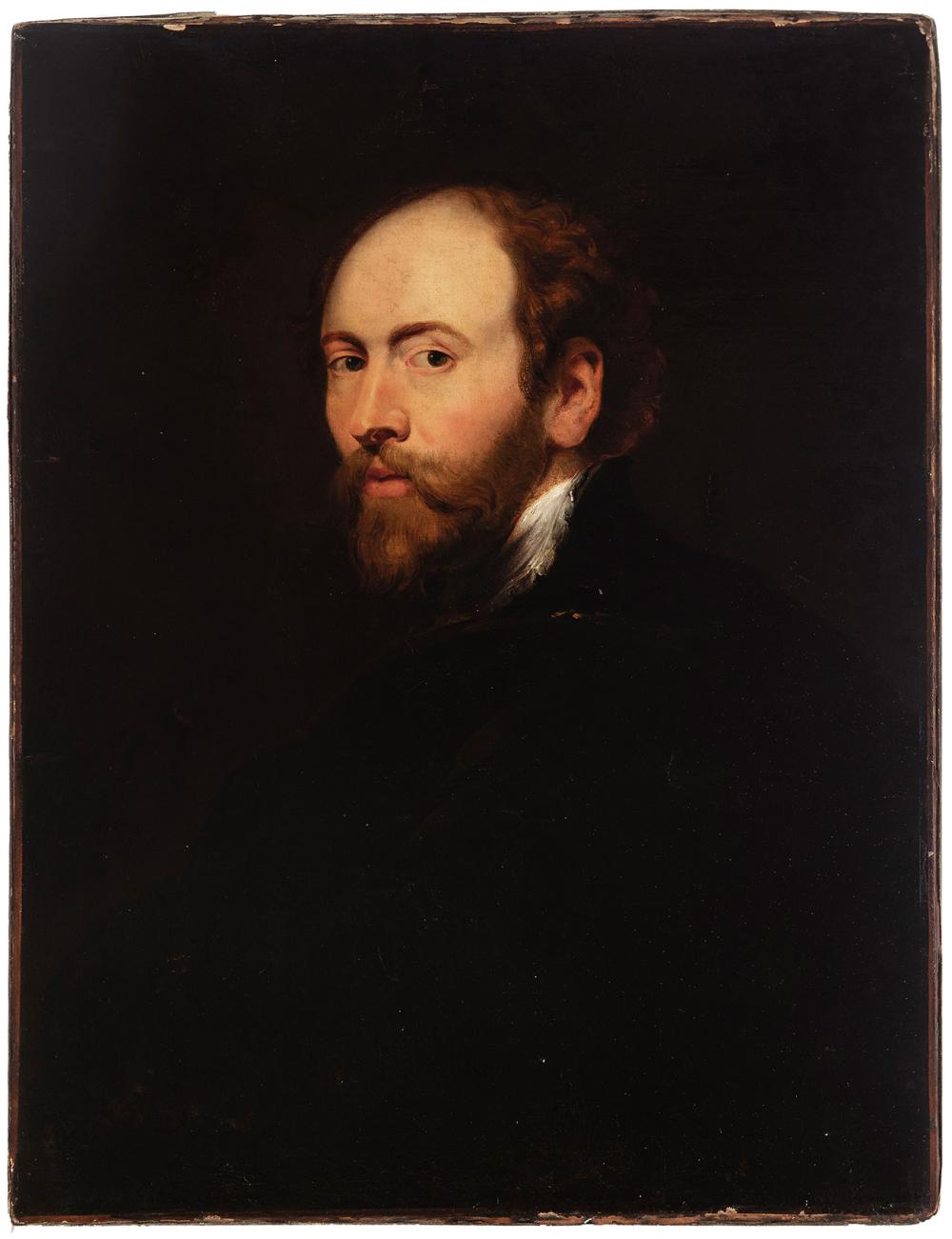
Flemish school of 1620-1630. Workshop of PETER PAUL RUBENS (Siegen, Germany, 1577 - Antwerp, Belgium, 1640). "Self-portrait. Oil on canvas. Relined. With repainting. The frame shows slight lack of polychromy. Size: 75 x 57 cm; 103 x 85 cm (frame). Excellent painting of Flemish school, belonging to the workshop of Rubens, in which we recognise the self-portrait of the baroque genius. It is a work of great artistic quality, which faithfully follows the original model produced by Rubens around 1618, now in the collection of self-portraits in the Uffizi Gallery in Florence. The one in the Uffizi collection shows Rubens at the age of about 41, when he was still living in Antwerp. The artist depicts himself bust-length, with a stern gaze fixed on the viewer, with no other symbols of his rank than the dignity of his face. In the present work, which belongs to the workshop of the Baroque genius, we can appreciate the energy and direct teaching of the master: both the figure and the background share shadows and lights, the spotlight sliding across the flushed complexion and the dark eyes, playing with thousands of nuances that extract velvety textures and naturally capture the boldness of the gallant countenance. As for Rubens's workshop, it is worth noting that the prolific artist could not have tackled the abundant creative fecundity of his work alone. He employed expert collaborators and enlisted the help of external painters, who helped to satisfy the fertile demand for commissions. Peter Paul Rubens was a painter of the Flemish school who nevertheless competed on an equal footing with contemporary Italian artists and was of major international importance, as his influence was also key to other schools, as in the case of the transition to the full Baroque in Spain. Although born in Westphalia, Rubens grew up in Antwerp, where his family originated. After completing his training Rubens joined the Antwerp painters' guild in 1598. Only two years later he travelled to Italy, where he stayed from 1600 to 1608. During this decisive period, the young Flemish master had first-hand experience of naturalism and classicism, the works of Caravaggio and the Carracci. During his visit to Mantua he was impressed by Mantegna, especially by his "Triumphs of Caesar", which influenced his later "Triumph of the Eucharist", where we see the same classical theatrical sense of Mantegna. It was also in Mantua that he would see at first hand the giants of Giulio Romano's Tea Palace. He visited Rome on several occasions, and also studied the art of Classical Antiquity, which influenced his early sculptural and monumental style, which evolved over time towards a more pictorial language. In the Italian capital Rubens also became acquainted with Italian Renaissance painting and the works of Michelangelo, Raphael and Leonardo. On his tour of Italy he also visited Florence and Parma, where he came into contact with the work of Correggio. In Venice he learned the sense of ostentation of Veronese and the dramatism of Tintoretto, and in 1609 he returned to the Low Countries to serve the governors of Flanders, Archduke Albert and the Infanta Isabella Clara Eugenia. In addition to being a court painter, Rubens carried out diplomatic work for the court, which took him to Spain, London and Paris. In 1609 he married Isabella Brant in Antwerp and organised his workshop, recruiting excellent collaborators with whom he worked side by side, many of whom were specialist painters (Frans Snyders, Jan Brueghel de Velours, etc.). He also took on pupils and created an excellent workshop of engravers, who worked from drawings by his own hand and under his supervision. During these years he produced important commissions such as "The Elevation from the Cross" (1610) and "The Descent from the Cross" (1611-14), both for Antwerp Cathedral.