Have one like this? Check yours freeOr have an appraiser value it
Lot description
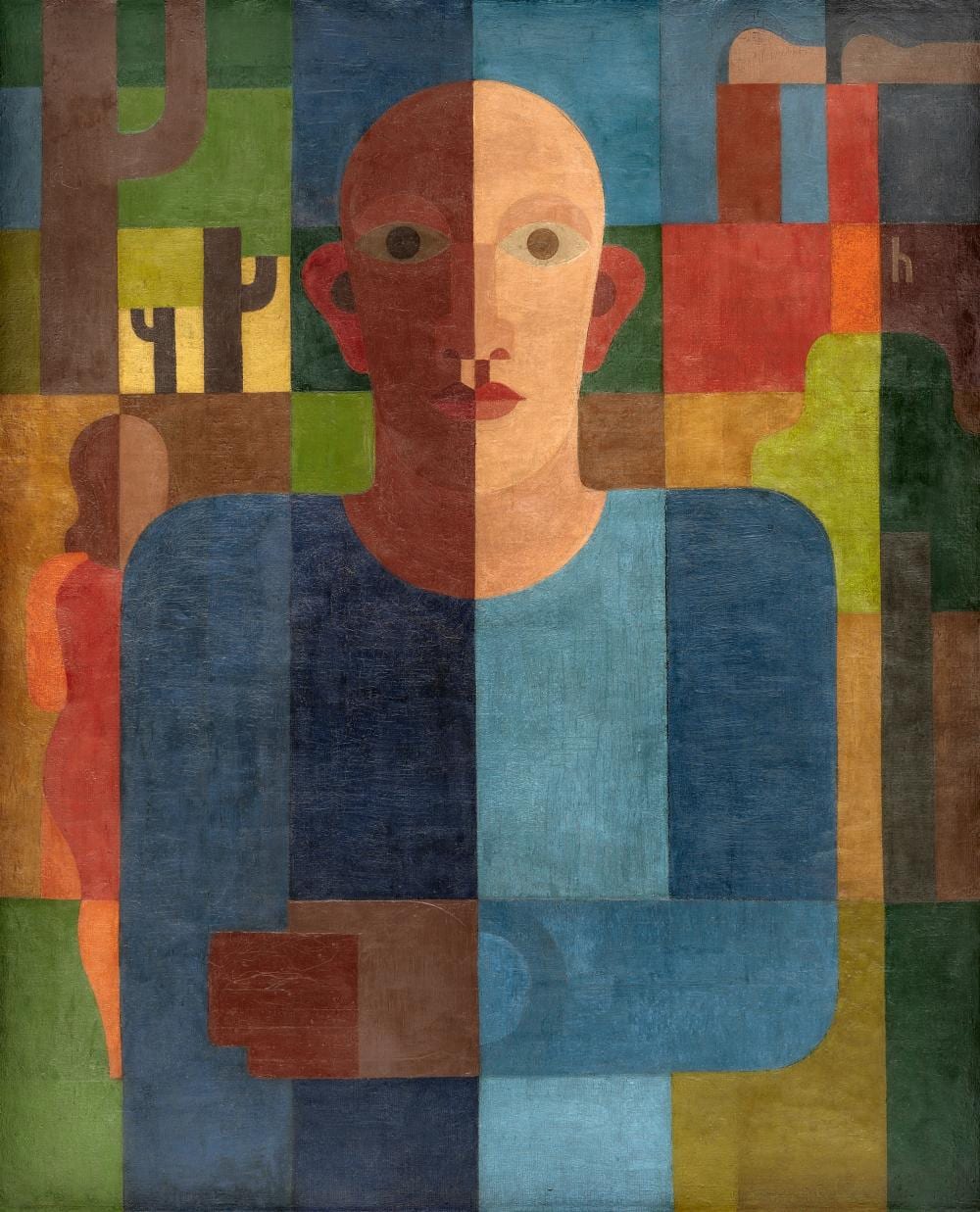
Monogrammed 'h' within depiction to upper right margin. Verso signed, dated and titled 'hoerle 1931/3 arbeiter'. Leaving Cologne’s Dada movement behind them, the friends and fellow artists Heinrich Hoerle, Franz Wilhelm Seiwert and Anton Räderscheidt increasingly turned to social content and a simple visual idiom – according to the “Cologne Progressives”, art was to be created in the service of social criticism and it was to be comprehensible to everyone. At the end of 1919 Seiwert wrote: “We want to do simple work beyond any chattery spirituality […] We use the picture to allow the facts out there become a fact in the picture: profit machines, labour slaves, exploiters and the exploited. Our pictures serve the exploited, of whom we are a part and with whom we feel solidarity; therefore, we reject the supposedly anti-bourgeois, Dadaist harlequinade performed to the delight of the bourgeoisie, because it is not the bankruptcy of the bourgeoisie but the creative will of the masses that we must render visible” (cited in: exh. cat. Heinrich Hoerle, Leben und Werk, Köln 1981, p. 30). The painter as worker: the painting “Arbeiter” is a self-portrait, a statement on which Heinrich Hoerle created variations in his painting and drawings of the early 1930s. Like the French painter Fernand Léger, who had previously arrived at a mechanistic visual vocabulary during his comradeship with miners, lumberjacks and metalworkers due to the war, it was also Hoerle’s engagement with social themes that led him to his visual idiom reduced to the essential (see exh. cat. Köln 1981, op. cit., pp. 38 f.). The male figure is depicted frontally and fills the canvas, with his gaze directed at the viewers; the small female figure, on the other hand, is seen from behind and is turned away from the viewers. The relationship between the trees and the smoking chimneys depicted formulaically in the background is no less antithetical. The antitheses of machine – nature, factory – artist, woman – man, verso – recto and light – dark become resolved in the figure, who reconciles factory labour and art in his own portrait. Relationships between the individual elements of the picture have been ingeniously established through monochrome primary and complementary colours applied in a haptic manner. Just like the differentiated proportions of the picture’s figures and objects, these plumb the spatial continuum. Three-dimensional form is additionally evoked through the alternation of light and dark. The individual elements accordingly fit together like machine parts to guarantee the functioning of the immanent process at work within the picture. The market-fresh painting “Arbeiter” is among Hoerle’s last oil paintings, because the painter turned to the technique of wax crayon on paper from 1932. A similar work “Arbeiter (Selbstbildnis vor Bäumen und Schornsteinen)”, which was also created in 1931, is now in the collection of Harvard University’s Busch-Reisinger Museum (see Backes 83). Our large-format, prominent painting in museum quality can be counted among the most important in Heinrich Hoerle’s oeuvre.