Lot description
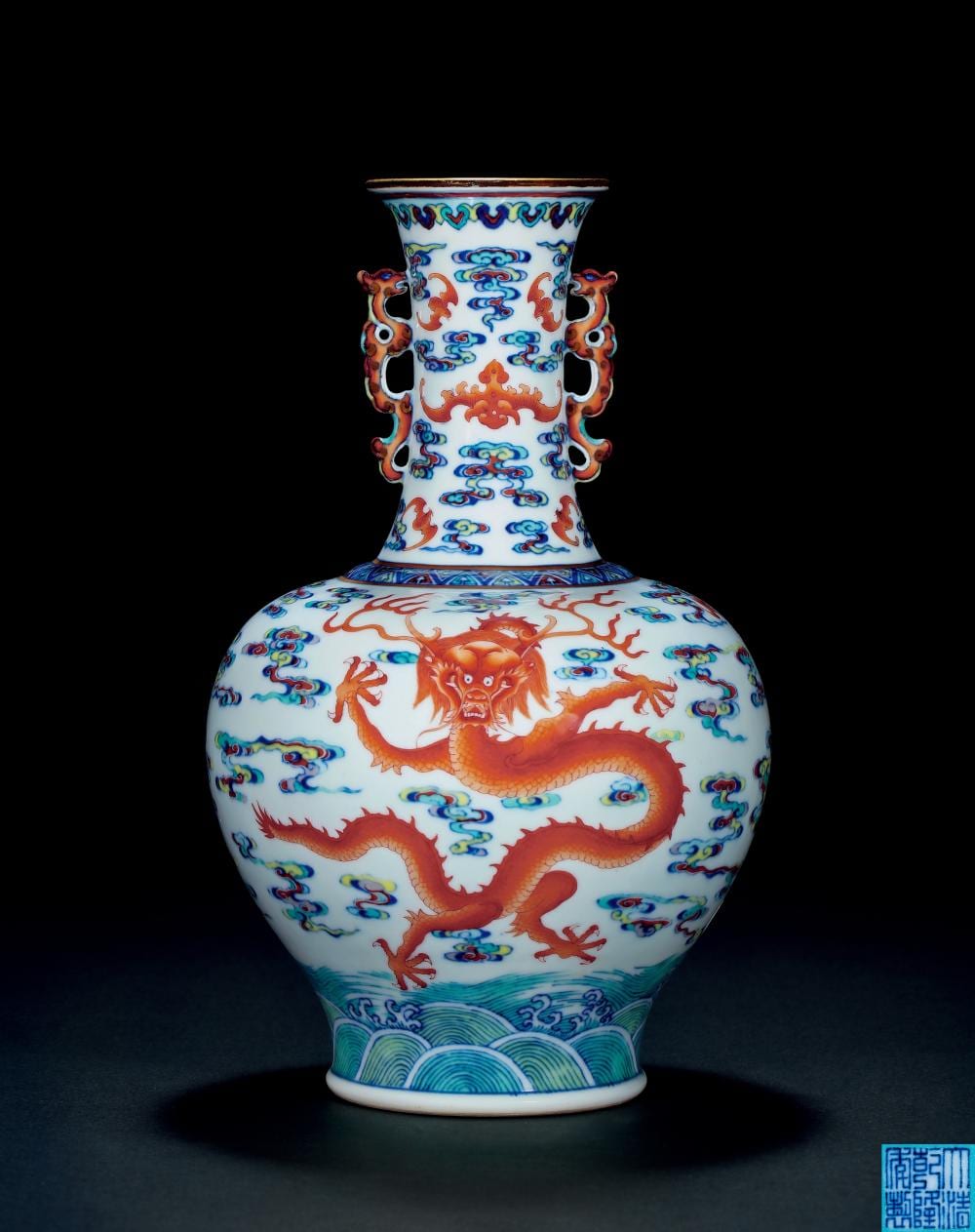
This vase is potted with a bulbous body elaborately painted with two dragons against swirling ruyi-head cloud scrolls enamelled with underglaze blue, green, yellow, aubergine and iron-red, rising from a slightly spreading foot encircled with crashing waves to a tall flaring neck decorated with five bats one both sides. The neck is further flanked by a pair of chi dragon handles which is painted in iron-red, yellow, green and gilt and is outlined with underglaze blue. The shoulder is decorated with a band of triangular pattern and encircled in gilt imitating the cicada motif on the bronze wares during the Shang and Zhou dynasties. The interior and base are evenly covered with a turquoise enamel and the latter is inscribed with a six-character reign mark in underglaze blue. The present vase bears the quintessential imperial symbol of two five-clawed dragons, each with a pair of horns extending backwards. Brought alive by the confident brushstrokes, the proud dragon is splendidly highlighted against the spiraling clouds, precisely recalling the ethereal dragon as the supreme symbol of imperial power. The combination of iron-red, underglaze blue and enamels in different colours on porcelains was rarely used, possibly due to the difficulty of the firing process. The blue decoration, seen on the scrolling clouds and the outlines of the patterns on this vase, was drawn in underglaze cobalt blue first and then fired to a high temperature. Following this, the potter applied the leaping dragons in iron-red and filled with washes of multi-coloured overglaze enamels, and re-fired the vessel for the second time at a lower temperature. The second firing unavoidably increased the cost and risk of failure, hence its rarity. Since the Chenghua period in the Ming Dynasty, doucai decoration gained popularity in the production of prestigious porcelains in small size, including the highly esteemed chicken cups. Later in the Qing dynasty, the doucai colour scheme continued to be appreciated for its elegance, but only during the Qianlong period vessels of the massive size and complex decoration like the present vase were created. Compare a vase in related designs also with archaistic dragon handles, from the Qing Court Collection and illustrated in The Complete Collection of Treasures of the Palace Museum. Porcelains in Polychrome and Contrasting Colours, Hong Kong, 2000, pl. 255. See another doucai vase with chi dragon handles decorated with nine dragons among rainbow clouds, sold in Sotheby's London, 11 May 2022, Lot 13 款識:「大清乾隆年製」 此瓶口微外侈,長直頸設螭耳一對,圓腹漸收成圈足,器形規整。口沿施金彩及如意雲頭一周,頸部以礬紅繪五蝠,於彩雲間飛翔,寓意鴻福齊天。肩部凸起一周,並兩行金彩裝飾,以鬥彩飾三角形仿古蟬紋,上下交錯,排列整齊,色彩艷麗,裝飾風格獨特。瓶身白地上所繪之雲蝠紋尤為精美,青花勾線內,以紅、紫、黃、綠彩渲染,間飾以紅彩蝙蝠紋,取吉祥瑞意「五色祥雲」、「鴻福齊天」。 圓鼓腹以礬紅繪正龍紋,紅龍帶鹿角,長鬚曲卷,口滿利齒,身軀矯健,密披細鱗,足具五爪,鋒利如刀。飛龍從驚濤駭浪中一躍而出,身姿扭動,水波滄浪之上凌空盤桓,周邊密佈卷雲,龍身穿遊於彩雲間,宛延自如,顯騰雲駕霧之勢,氣勢磅礡,盡顯帝王神威。底面施松石綠彩,中心以青花落「大清乾隆年製」六字三行篆書款。 本品形制恢宏大氣,胎質堅致白皙,釉汁瑩潤如玉。瓶身繪雲龍紋,氣勢凌人,躍然眼前。以礬紅裝飾龍紋,色澤鮮妍厚潤,色階過渡自然,騰龍矯健有神,氣勢非凡。祥雲迤邐,浪濤卷卷。本品繪畫頗為講究,需要釉下與釉上紋飾彼此呼應,畫師需在繪製鬥彩海水時,事先留出釉上龍紋的位置,因此畫師必須做到心中有畫,筆自心中,留白過少,則龍紋無法繪製,留白過多,龍紋與祥雲之間空隙過大,則影響美觀。審視本品所繪雲龍,二者連接處過渡自然,分毫不差,恰到好處,融為一體,使人不得不贊嘆畫師技藝之精湛,彰顯乾隆時期宮廷藝術的無比嚴謹和精緻。 此品形態和紋飾皆為臻作,立體的螭龍耳與腹身龍紋主題互相呼應,器身龍紋亦充分顯現出莊嚴大度之皇室氣派。龍素來是中國皇權的象徵,歷代眾多君主中,乾隆皇帝尤好龍,以之彰顯其威名顯赫的宏圖大業。清宮瓷匠為迎合乾隆皇帝之奢華品味,額外加繪繁複的瑞雲和蝙蝠圖案,為作品增添吉祥瑞意。 乾隆一朝瓷品的畫工及用色水準超群絕倫,後世無可比擬。瓶身經二次燒製,先燒製青花勾線,二次入窯燒製粉彩及礬紅彩,礬紅色澤鮮妍厚潤,色階過渡自然,燒製溫度掌握恰到好處,具深淺變化 ,如同西洋畫般有暗影效果,配合其他以鬥彩繪製而成的圖案及適當的留白,更顯整體紋飾和諧平衡。至於鬥彩,乃是結合釉下彩與釉上彩的工藝,工匠先以青花於瓷胎上勾勒圖案輪廓,再罩上透明釉,第一次入窯以高溫燒製,然後再於輪廓線中填入一種或多種彩料,二次入窯低溫烘燒而成。本品青花線條幼細,彩料填色精準,細節猶一絲不苟,闡證此瓶舉足輕重之地位。 相類似作品甚罕,目前僅見一例藏於倫敦維多利亞與艾伯特博物館(Victoria and Albert Museum),此例紋飾與本品鏡相對稱,龍身往左蜷曲,如鏡面折射,原應為一對。另見德累斯頓國家藝術收藏館藏一例清乾隆鬥彩海水雲蝠九龍紋雙耳瓶,亦見一例售於倫敦蘇富比,2022年5月11日,編號13,以185萬英鎊成交。風格相近的例子,尚見國立故宮博物館藏一對清乾隆鬥彩描紅雲龍紋貫耳扁壺,同樣以五色祥雲為地,主體紋飾以礬紅繪正面龍紋,並同樣以一對製作。亦可參考玫茵堂收藏清雍正青花礬紅海水龍紋大盤,載於《玫茵堂藏瓷》,卷四,倫敦,2010年,編號1723。瓶頸巧飾一雙螭耳,參考北京故宮博物院藏清乾隆鬥彩描金勾蓮紋螭耳瓶,載於《故宮博物院藏文物珍品全集:五彩、鬥彩》,香港,2000年,圖版255。