Lot description
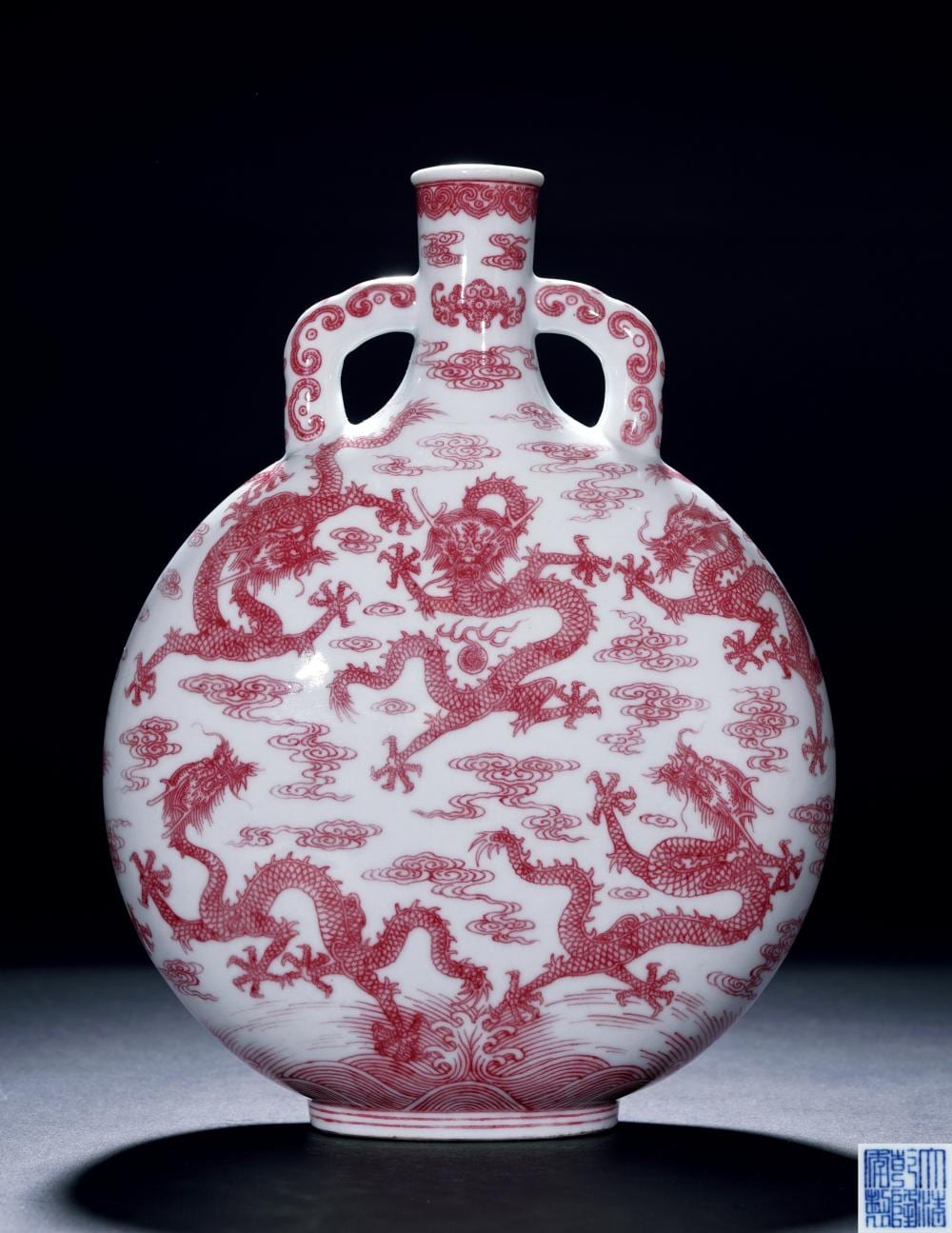
The moonflask is finely potted with the flattened globular body and is superbly painted in vivid ruby tones of copper-red enhanced by simulated 'heaping and piling'. One side is decorated with a leaping five-clawed horned dragon entwining a central 'flaming pearl' surrounded by four further ferocious dragons while the reverse is painted with four dragons in pursuit of a further 'flaming pearl' in the centre. The nine dragons with undulating scaly bodies fly amid a scatter of vaporous clouds and above crashing waves. The shoulder is flanked by a pair of handles with ruyi designs reaching up to the slightly waisted neck decorated on each side with hovering bat, with a band of ruyi heads below the rim. The base is inscribed with the six-character seal mark in underglaze-blue. Vessels decorated in underglaze copper-red are extremely rare and even rarer are those in the form of moonflasks. Only one other similar flask appears to be recorded, although slightly larger in size, sold in Sotheby’s Hong Kong, 1 May 2001, lot 538. The present flask belongs to a very small and special group of imperial Qianlong vessels painted in this style with copper-red dragons amongst clouds above waves. Compare for example, two vases from the Qing Court collection and still preserved in Beijing, illustrated in The Complete Collection of Treasures of the Palace Museum. Blue and White Porcelain with Underglaze Red (III), Shanghai, 2000, pls. 174 and 178; and a pair of double-gourd vases, also in the Forbidden City, Beijing, on display in the Suianshi (Room of Finding Peace) in the Yangxin Dian (Hall of Mental Cultivation) published in situ in Life in the Forbidden City, Hong Kong, 1985, pl. 177. Qianlong period moonflasks painted with a single large front-facing dragon are also known decorated in underglaze-blue and underglaze-red. See a slightly larger flask of closely related form and handles included in The Complete Collection of Treasures of the Palace Museum. Blue and White Porcelain with Underglaze Red (III), op.cit., pl. 213. Compare also a larger blue-and-white moonflask, with a Qianlong reign mark and of the period, with elaborate dragon-form handles and painted with a ferocious front-facing dragon, published ibid., pl. 132; and another vessel of this type decorated with the 'dragon and phoenix' design sold in Sotheby’s Hong Kong, 23 October 2005, lot 212. The number nine (jiu) in China is considered the highest yang or male principle number and is the homonym for the word 'eternity'(jiu). The dragon is the symbol of the emperor, and the motif of 'nine dragons' represents the wish for eternal generations of rulers and the desire that 'all members of the Imperial family live in eternal harmony together'. The nine-dragon motif can be found on a number of Qianlong vessels, including the blue-and-white meiping with the dragons in underglaze-red, in the Palace Museum, illustrated in the The Complete Collection of Treasures of the Palace Museum. Blue and White Porcelain with Underglaze Red (III), op.cit., pl. 205. 款識:「大清乾隆年製」 本品直口,細頸,扁圓腹,橢圓形圈足,頸肩處飾如意形雙耳。通體釉裡紅為飾,口沿外飾如意雲頭紋,頸繪蝠紋,腹部繪九龍圖為主題紋飾,九龍穿梭祥雲,翻騰江海之上,雙目炯炯,五爪分張,恰應乾隆御宇天下,國力隆盛之氣象。腹下以海浪一周做邊飾。底青花書「大清乾隆年製」篆書款。 本品正是唐英《陶成紀事碑》所言「釉裡紅器皿,有通用紅釉繪畫者」。運用釉裡紅線描技法裝飾全器是乾隆御瓷獨具特色之處,此類器皿品質精良,存世寥寥無幾,本品為當中至為珍貴的一例。檢閱清宮檔案所載,乾隆皇帝對釉裡紅瓷器頗為鐘情,多次諭旨御窯廠燒造,尤為留心釉裡紅的燒成效果,根據清宮檔案載,乾隆三年(1738年),高宗指「釉裡紅龍梅瓶,紅龍顏色不好,往好里燒造」(見馮先銘,《中國古陶瓷文獻集釋》,台北,2000年,頁232)。唐英在乾隆四年的一份奏折里曾如此記述「竊奴才在京時十月二十五日,太監胡世傑交出釉裡紅馬掛瓶一件,畫樣一張,傳旨看明瓷瓶釉色,照紙樣花紋燒造幾件送來,務要花紋清真。並將古瓷樣式好者揀選幾種,亦燒造釉裡紅顏色,俱寫乾隆款送來呈覽。欽遵奴才看明釉色,祗領紙樣,恭捧到關,即遵旨揀選古瓷、畫樣內好者數種,一並交窯廠協造葆廣等敬謹燒造,並諭俱造釉裡紅顏色務要花紋清真,釉水肥潤,顏色鮮明。俟造得時奴才揀選送京恭呈御覽。」 釉裡紅燒造工藝繁復,講究物理變化之妙,由於在燒成過程當中氧化銅離子游離激烈,往往易於聚結,凹凸不平,若大面積塗飾,致使紋飾漫漶不清,遂成瑕疵;若火候氣氛掌握不准,其色或是暗沈,或是淺薄,皆不堪入目,影響美觀,故乾隆皇帝對此頗為不滿。為了達到「花紋清真,釉水肥潤,顏色鮮明」的效果,乾隆皇帝專門拿出認為發色理想的釉裡紅馬掛瓶作為唐英燒造的標準,可見乾隆皇帝對釉裡紅的燒造費煞心思。所以唐英引領下的御窯廠秉承乾隆諭旨敬謹燒造,只有從以上兩個方面改進和提升,而火候多賴天成,全靠經驗,唯裝飾分布則可人為規避,最佳方案則是以線描一法為之。所以乾隆朝釉裡紅器物多見以線描法繪就,本品亦然,以釉裡紅勾勒紋飾後加點塗法而成,不使用平塗技法。本品出色鮮妍清晰,不可不歸功於乾隆皇帝的勤勉關注。據此可以推定乾隆朝以線描技法繪畫的「花紋清真,釉水肥潤,顏色鮮明」的釉裡紅御瓷應是乾隆四年之後的產品。 唯一例傳世與本品同類者,乾隆年款釉裡紅九龍紋扁壺,正面飾一條坐龍,四龍環繞,背面有四龍,九龍騰雲駕御海,壺頸飾一道如意紋(圖載《樂山堂藏瓷》,台北,2005年,圖版47,售於香港蘇富比2001年5月1日,編號538)。乾隆時期的釉裡紅抱月瓶甚為罕見,參考之例不多,見故宮博物院清宮舊藏一例,釉裡紅梅雀紋扁壺,為仿永宣風格作品(錄於《故宮博物院藏文物珍品全集.青花釉裡紅(下)》,香港,2000年,圖版177)。它例包括另一件釉裡紅葫蘆瓶,瓶身飾團螭,售於香港蘇富比1990年5月15日,編號193。另見一對類例,存紫禁城養心殿隨安室,據載乃乾隆靜心齋戒時常留之地(實景圖載於《清代宮廷生活》,香港,1985年,圖版177)。清宮舊藏一件釉裡紅穿芝行龍紋葫蘆瓶,現仍存北京(錄於《故宮博物院藏文物珍品大系.青花釉裡紅(下)》,上海,2000年,圖版174)。