Have one like this?
Upload a photo for a free check of what yours may be worth.
Lot description
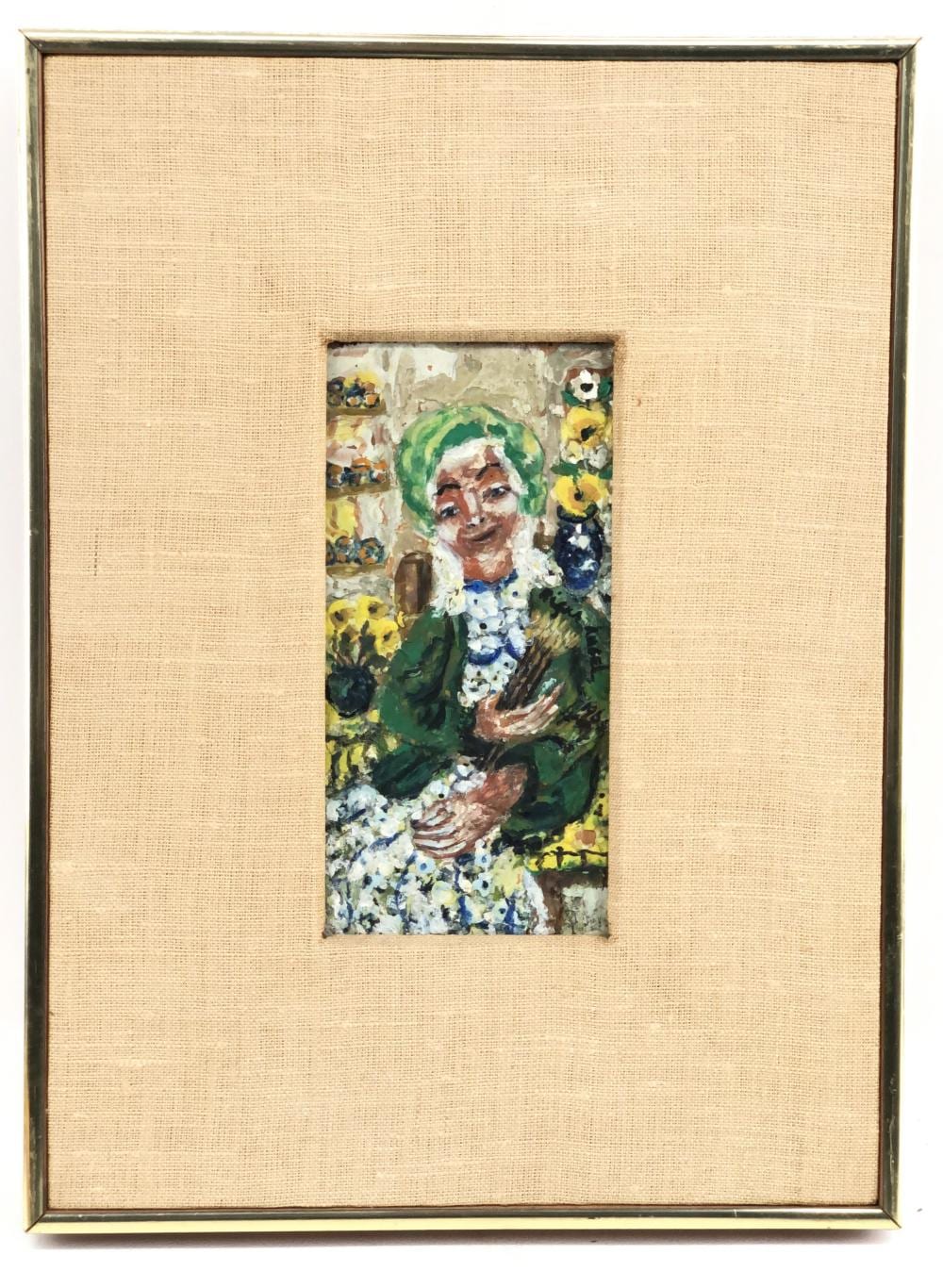
Rifka Angel (1899-1988) "Self Portrait" Oil on Board. The unmatched beauty, permanence, and versatility of encaustic painting have led to its growing importance in the art of the last 50 years. Many would credit this to the influence of Jasper Johns’ breakthrough work in encaustic in 1955, which helped establish the ancient wax-based paint as a contemporary medium. The actual introduction of modern encaustic to the United States came nearly 25 years before Johns’ first work in the medium. Karl Zerbe, the restlessly experimental German émigré painter who headed the painting department of the Boston Museum School in the 1930s and 40s, is widely regarded as being the father of encaustic painting in the United States, but the person – now little known – who deserves credit as the first to employ encaustic and use it throughout her career was a Lithuanian-born painter named Rifka Angel. Angel’s adoption of encaustic preceded Zerbe’s initial experiments by several years. Angel began her painting career in her early20s. Untutored, “except for one term with [political cartoonist and painter] Boardman Robinson at the end of which time Mr. Robinson categorically pronounced me unteachable, I never once sought instruction.” 2 But, according to Angel, her first watercolors “so impressed … [Emil] Ganso, Ernest Fiene, Chaim Gros and Raphael Soyer [that they] all exchanged work with me.” Praise and encouragement also came from John Sloan who pointed her to galleries where she began exhibiting with such later luminaries as Ben Shahn and Louis Ribak.3 In 1927, at the invitation of her sister, Angel went to Moscow where she was accepted into the Moscow Art Academy. Here too she persisted in her willfulness: “the instructor liked my work tremendously but refused to instruct me. I worked in my own free, uninhibited way…” After nine months in Moscow, she went to Paris, spending time with Isaac and Moses Soyer. The sketches she did there on tours around Paris with the German artist Carl Rabus formed the basis of her first one woman show at Knoedler Gallery in Chicago in 1930. Soon after her return to New York, Angel moved to Chicago where she married Milton Douthat, another former student at the Art Students League. They had a daughter, Blossom. With Douthat’s urging, she approached C.J. Bulliet, editor of the weekly art magazine for the Chicago Evening Post. Bulliet’s response was greatly encouraging. In his review of her show at Knoedler, he called her, Encaustic pioneer In 1932 Angel exhibited her first encaustic paintings at the Increase Robinson Gallery. 4 This was followed soon after by further encaustic exhibits in Chicago and New York. Douthat was fascinated with the ancient encaustics and their exquisite surface effects. This led him to research their history and materials, and with the aid of a paint chemist, he developed formulations based on different combinations of waxes. While Angel and Douthat were aware of the contemporary encaustic work done by Diego Rivera and the Spanish painter, Pedro Pruna, they realized that they were the first artists to seriously undertake this revival in the U.S. There had been many attempts over the last few centuries to revive encaustic from its slumber of nearly fifteen hundred years.5 In the 18th and 19th Centuries, European and American painters attempted, with limited success, to “rediscover the ancient secrets.” The memory of those experiments and the availability of portable heating tools, led to a revival of encaustic on a sustained level in the late 19th and early 20th Centuries. Through the 1920s, in Europe, and later in Mexico, James Ensor, Robert Delaunay, Pablo Picasso, Antoine Pevsner, and David Alfaro Siqueiros were among the more prominent artists to try their hand at this rediscovered medium. Rivera went further than any of them executing a mural and a number of prominent easel paintings in encaustic. Artist: Rifka Angel Title: "Self Portrait" Medium: Oil on Board Circa/Year: 1965 Signature Type: Hand Signed Signature Location: Lower Left Site Measurement: 7.5in x 3.5in Keywords: Encaustic Art; Ref: BD1043