Have one like this?
Upload a photo for a free check of what yours may be worth.
Lot description
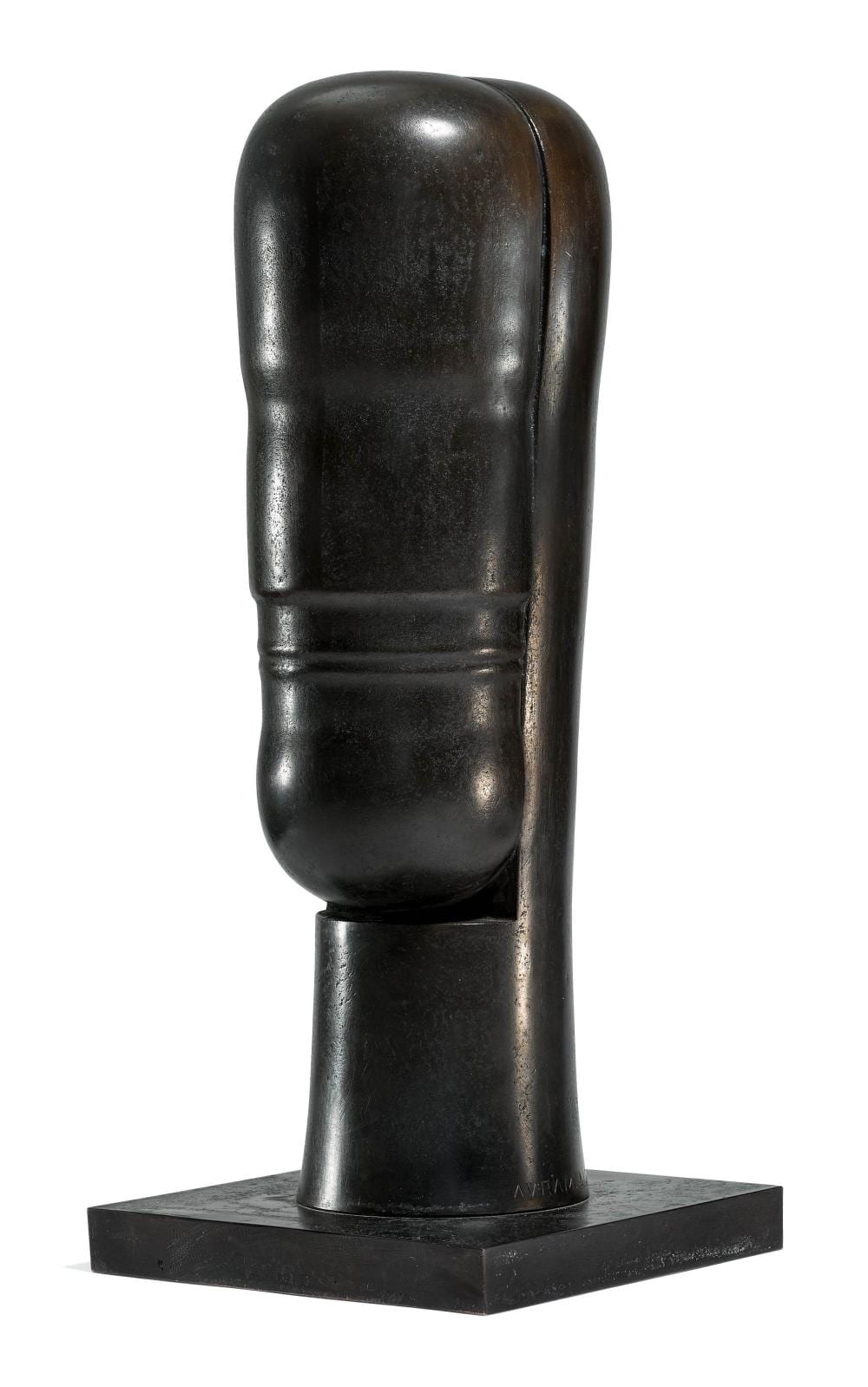
JOANNIS AVRAMIDIS (Batumi 1922–2016 Vienna) Kopf I. 1966. Bronze, patinated in brown. With the incised signature and number lower right: AVRAMIDIS 5/6. Height 36 cm (incl. plinthe). Provenance: - Raimund Thomas Munich. - Purchased from the above in 2000, private collection Switzerland. - By descent to the present owner, also private collection Switzerland. "It is not enough that you do something unique. It must also be seen. But it is precisely the unique quality that many do not see." Joannis Avramidis The Greek-Austrian sculptor Joannis Avramidis was one of the most important figures in modern sculpture. With great skill and precision, the artist succeeded brilliantly in depicting the human body and its parts in sculptures that are abstract, reduced to the essentials and perfect in form. His sculptures, in which nothing can be taken away or added, radiate an impressive austerity, power and rhythm. For Avramidis, drawing was the true creative act; the visibility of the design process and the structure of his figures were paramount. His sculptures were always based on structural drawings with coordinates of the body, measurements, and proportions. Typical of his oeuvre are upright column-like standing figures, block-like groups of figures and sculptures of heads, which present themselves to the viewer as closed forms without any gesture or movement. In all his works, the artist always started from the nature of the human body and was constantly in search of absolute form. Inspired by the theories of antiquity and the Renaissance, and constantly exploring the Greek doctrine of proportion, Avramidis achieved fame with his sculptures in a very short time. As in all his sculptures, in the present bronze sculpture from 1966, he has allowed the boundary between abstraction and the figurative to merge. He has reduced the head more and more to its basic form, leading it back to the geometry of a round shape, until the ultimate possible conclusion is reached. Joannis Avramidis was born in 1922 to Greek parents in Batumi, Georgia, on the Black Sea. At the age of 17 and while still at art school in his home town, his father was arrested by the Stalinist regime and died in captivity. His mother fled back to Greece with the children. During the Second World War, Avramidis was deported to the Austrian capital by the National Socialists as a forced labourer. In 1945 he was able to continue the art studies he had begun in Georgia at the Academy of Fine Arts in Vienna. At first Avramidis studied painting with Robin Christian Andersen. From 1953 to 1956 he was sponsored by the famous sculptor Fritz Wotruba. As Austria's representative at the Venice Biennale in 1962, Avramidis achieved his international breakthrough and was henceforth considered one of the outstanding sculptors of the 20th century. In 1964 he took part in documenta II, and in 1977 in documenta 6. In 1973 he was awarded the Grand Austrian State Prize for Fine Arts. From 1968 until his retirement in 1992, Avramidis held a sculpture masterclass as professor at the Vienna Academy of Fine Arts. Joannis Avramidis died in 2016 at the age of 93. He left behind a complete and comprehensive body of work. --------------- JOANNIS AVRAMIDIS (Batumi 1922–2016 Wien) Kopf I. 1966. Bronze, braun patiniert. Rechts unten mit der eingeritzten Signatur und Nummer: AVRAMIDIS 5/6. Höhe 36 cm (inkl. Plinthe). Provenienz: - Raimund Thomas München. - Bei obiger Galerie 2000 erworben, Privatsammlung Schweiz. - Durch Erbschaft an den heutigen Besitzer, ebenfalls Privatsammlung Schweiz. "Es genügt nicht, dass man etwas Besonderes macht. Es muss auch einer sehen. Gerade das Besondere sehen aber viele nicht." Joannis Avramidis Der griechisch-österreichische Bildhauer Joannis Avramidis gehört zu den bedeutenden Protagonisten der modernen Plastik. Dem Künstler gelingt es auf beeindruckende Weise, mit handwerklichem Geschick und Genauigkeit den menschlichen Körper und Teile davon in Skulpturen abstrakt, auf das Wesentliche reduziert und in einer vollkommenen Form darzustellen. Seine Skulpturen, bei denen nichts mehr weggenommen oder hinzugefügt werden kann, strahlen beeindruckende Strenge, Kraft und Rhythmus aus. Für Avramidis ist Zeichnen der eigentliche schöpferische Akt; die Sichtbarkeit des Gestaltungsprozesses und die Struktur seiner Figuren sind oberstes Anliegen. Seinen Plastiken liegen stets Konstruktionszeichnungen mit Koordinaten von Körper, Mass und Proportionen zugrunde. Charakteristisch für sein Œuvre sind aufrechte, säulenartigen Standfiguren, blockartige Figurengruppen und Kopfskulpturen, die sich dem Betrachter als geschlossene Körper ohne jegliche Geste und Bewegung präsentieren. Bei all seinen Werken geht der Künstler stets von der Natur des menschlichen Körpers aus und ist ständig auf der Suche nach der absoluten Form. Inspiriert durch die Theorien der Antike und der Renaissance und unter stetiger Auseinandersetzung mit der griechischen Proportionslehre erlangt Avramidis mit seinen Skulpturen in kürzester Zeit Bekanntheit. Wie bei all seinen Skulpturen lässt er auch bei der vorliegenden Bronzeplastik aus dem Jahr 1966 die Grenze zwischen Abstraktion und figurativer Darstellung verschmelzen. Er bricht den Kopf immer weiter auf dessen Grundform herunter und führt ihn bis zur letztmöglichen Aussage auf die Geometrie eines Rundkörpers zurück. Im Jahr 1922 wird Joannis Avramidis als Sohn griechischer Eltern im georgischen Batumi am Schwarzen Meer geboren. Mit 17 Jahren und mitten in der Ausbildung an der Kunstschule seiner Geburtsstadt wird sein Vater vom stalinistischen Regime in Haft genommen und kommt um. Seine Mutter flieht mit den Kindern zurück nach Griechenland. Im Zweiten Weltkrieg wird Avramidis durch die Nationalsozialisten als Zwangsarbeiter in die österreichische Metropole verschleppt. 1945 kann er das in Georgien begonnene Kunststudium an der Akademie der Bildenden Künste in Wien fortsetzten. Zuerst studiert Avramidis Malerei bei Robin Christian Andersen. Von 1953 bis 1956 wird er vom berühmten Bildhauer Fritz Wotruba gefördert. Als Vertreter Österreichs auf der Biennale in Venedig erreicht Avramidis 1962 den internationalen Durchbruch und zählt fortan zu den herausragenden Bildhauern des 20. Jahrhunderts. 1964 nimmt er an der documenta II, 1977 an der documenta 6 teil. 1973 erhält er den Grossen Österreichischen Staatspreis für Bildende Kunst. Von 1968 bis zu seiner Emeritierung im Jahr 1992 führt Avramidis als Professor eine Meisterklasse für Bildhauerei an der Wiener Akademie der Bildenden Künste. Im Jahr 2016 stirbt Joannis Avramidis im Alter von 93 Jahren. Er hinterlässt ein umfassendes Lebenswerk, das vollkommen in sich ruht.