Lot description
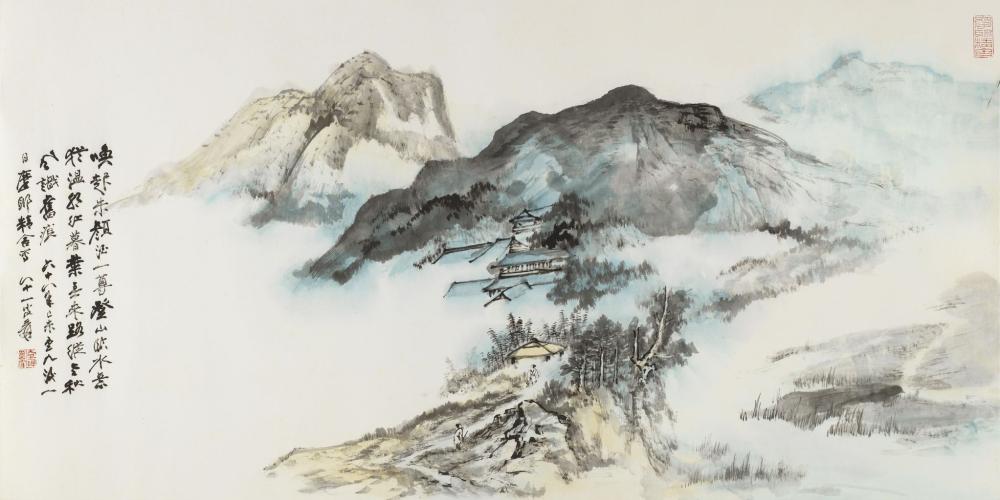
登山臨水圖 Scholars Hiking in the Woods 釋文:喚起朱顏酒一尊,登山臨水意猶溫。朝紅暮葉春來路,縱老秋風識舊痕。 款識:六十八年己未重九後一日摩耶精舍寫,八十一叟爰。 鈐印:摩耶精舍(朱文)、大千唯印大年(朱文) Signed Yuan in Chinese With two seals of the artist 張大千後半生旅居海外,1976年自美國返台、1978年8月 甫定居於外雙溪「摩耶精舍」直1983年溘然離世,這短 暫的寓台期間卻成為他書畫造詣最為純粹、臻至化境的階 段,一代耆宿名流歷盡戰亂滄桑,離鄉去國後卻能欣享晚 景桑榆,故此時的山水創作常懷有思鄉的情緒流露,大千 雖飽受目疾困擾,但其胸懷奇情卻不受阻礙,能融宋元以 降、直至明清文人畫的精微,用筆遣墨出入於前人,卻又 能取各家所長化為己用,開創其晚年「細筆細潑」的寫意 破墨畫法,畫面造景多用簡筆卻能見豐富的微妙變化,以 筆法與意境格調取勝,如同白石老人評其「一筆一畫,無 不意在筆先,神與古會」,看似逸筆草草、不求形似,卻 能達到靈動凝練的氣韻;張大千畢生登千山、閱百川,其 晚年的山水畫更是師古人之心而不師其跡,作於1979年的 《登山臨水圖》即是大千筆墨高華出眾的巔峰力作。 綜觀此畫構圖佈局以黃子久、王叔明兩家之法寫形;用墨 施色則取徐渭、陳淳之技以墨寫神。大千不僅承繼了宋元 畫的蒼秀蕭疏,更能納用明清文人畫的山水精神。全圖山 型以「之」字走勢,遠景三處山頭層疊延伸至近景坡壁與 右側沙渚,左側以留白與色墨做成的雲氣嵐煙收攏於一, 側倚之景粗密有致,布局乍看雖簡括空疏,但卻能彰顯其 化裁之功力;遠山略用短筆解索法析出巒脈,再以乾筆快 速皴擦出輪廓線,分出由左自右清晰的稜線走勢,皴筆不 多,僅以極淡的花青、藤黃與水色層層渲染出山體與陰陽 向背之分,用色彩的冷暖與墨韻濃淡表現出山石的量感與 體積,後用點苔皴破筆點出的蒼茫密林,以小寫意的手法 將遠眺的山景做出「水暈墨章」的效果。中段主山右側點 景則以礬頭寫出屈曲之勢,以色破墨法將雲氣滲入山體, 後用細筆勾勒華屋樓宇掩映其中,由微小見宏大,更能反 襯出山峰的雄偉譎奇;後方遠山只用花青淡墨橫掃、略施 枯筆為之,畫中花青墨色能繪出山勢背光面,藤黃澹色則 點染出山頭受光面,使得畫面光影躍動,瀰漫濕潤氤氳的 效果。 前景則寫近山緩坡,以淡墨粗筆皴擦出山徑走向,後用篆 筆墨線與石分三面法鉤提出主要的山壁岩石,數筆寫出矮 亭,以雙鉤添墨畫林樹,右側多用青藤白陽之法畫樹,主 幹多無見根,喻君子在野,後方崢嶸林樹則以王蒙畫雜樹 法寫成,細心敷染作出筆意蒼茫的村野風景,山路上下方 各佈有遊人,一文士策杖獨行,另一則回眺遠山景致,所 謂「遠人無目」既可知大千落筆此山景的視野角度,是在 極高處遠望;右方則以牛毛細皴出汀州宿莽、淡墨掃出沙 渚輪廓,遠水無痕,僅用極淡的墨色暈染,與左側題款處 大面積的留白相互映照、做出強烈的空間感,營造出浩淼 的意境,虛實之間可見渾然天成的登高臨水之勢,此圖造 景以金陵山景之法,皴法雖軟滲,但卻能將遠山在瀰漫的 霧氣中所顯現的不規則形狀表露無遺,觀之墨趣橫溢,靜 謐清寂與恢弘氣勢並存,彷彿身在此山中且帶可居可遊的 氣氛,此種山水圖式的效果正是張大千晚年在潑墨潑彩的 技法中所領悟出來,佈局構圖繁複卻筆簡,將宋畫的深遠 轉化成闊遠,看似即興,卻能將複雜的山景變成統一的整 體,表現力極為深刻,盡得文人山水畫的藝術精髓。 此幅《登山臨水圖》原為林懷民先生家族舊藏,寫成於 1979年,張大千時年已逾八十高齡,應重陽節時令習俗登 高,大千一生敬老崇孝,或許是對於風景依舊人事已非的 興嘆,觸動了他對故國家鄉的回憶,往事歷歷不勝唏噓, 在這樣深刻的情懷下描繪此景作為寄託,大千晚年雖目力 衰微不及,但桑榆晚筆亦能漸變所尚,將畢生浸染水墨的 造詣化為己用,世人常知其仿古功力一流,揚名於大潑彩 山水與敦煌變法之藝,然而其晚年山水創作蒼厚拙樸, 已屆人畫俱老的境界,大千此時的水墨已不是對外界現實 風景的描繪,而是畫出內化自然與個人情感的心性風景, 市場上更是少見與此同時期的精品,知名藝術研究學者傅 申著《張大千的世界》一書即收錄有張大千晚期《淺絳山 水》、《廬山高》等作,與此《登山臨水圖》齊觀便可知 其珍稀可貴之處,無論設色筆法皆用盡心機經營鋪排,尤 以意境取勝、用「馭繁化簡」之法呈現出作品的氣勢動 態,全圖細觀奇詭變化無窮,文氣筆意清冽,不僅能將前 人功法化為己用,更將具象與抽象的藝術概念在此作完美 結合,實是無愧於其「五百年來一大千」之美名。 After a majority of time spent abroad, Zhang Da-qian left the US for Taiwan in 1976 and settled at Moye Jingshe in Shuangxi from August 1978 until his death in 1983. During his stay in Taiwan, Zhang reached the peak of his career with the most majestic works. Regardless of his endless relocations in his lifetime, he settled and enjoyed his old age in Taiwan. Hence the landscape paintings of this period carry a nostalgic tone. Despite his eye injury, Zhang was able to paint in the style of Song and Yuan with the meticulous details of Ming and Qing. He painted by incorporating classical techniques into his own creation: splashed ink with a fine brush. The composition is constructed with intricate details and variations. As Baishi Laoren mentioned, each stroke was meticulously composed with a poetic finish. A majestic landscape could be depicted with only simplistic and abstract strokes. With years of observing landscapes through his travels, the artist could depict landscape paintings at ease in classical styles at the peak of his career, as shown in this majestic work, completed in 1979. This work was structured in the style of Huang Zijiu and Wang Shuming. The application of ink could be traced back to the style of Xu Wei and Chen Chun. Zhang Da-qian incorporated the elegance of Song and Yuan paintings and the majestic details of Ming and Qing literati landscapes. Structured in a zigzag composition, depth of the painting was represented with layers of hills extending to the cliff and shores on the right. Space on the left was it was deliberately created to enhance the misty atmosphere. The structure appears spacious yet this was deliberately planned to showcase the elusiveness of the environment. Distant hills were finished with short strokes and dried cun for their outlines to highlight depth of the landscape. Light green, ochre and ink were used to depict light and shadow. A mixture of tones and gradation represent its density. Dots and cun with dried strokes create a dense lustrous forest. Carefree strokes were used to create a misty landscape. The middle ground was composed with clusters of rocks. Splashed ink were used to further add moisture to the environment. Fine outlines depicted cottages in a distance, juxtaposing intricate details against the majestic landscape. Light ochre was used to highlight light shone on the hills, creating a harmonious tone in the misty setting. A gentle knoll was depicted in the foreground with light ink and broad cun to represent a trail. Zhuan strokes and slanted brush to depict the rough rugged nature of rocks and cliffs. A kiosk was depicted in simplistic strokes. Trees were outlined with bare trunks in the style of Qingteng Baiyang; while those farther in a distance were depicted in Wang Meng's style. A village was meticulously painted with a few scholars hiking, one with a hiking stick, another looking afar. Ox hair cun were used with light ink connecting the shore and the water. This echoes with the light hue on the left creating a misty and elusive setting. Such technique took reference to Jinling landscape juxtaposing cun strokes with the elusiveness of mist. Such variation of tone highlights the tranquility and grandiosity of the landscape, bringing the audience face to face with nature. Such splash art was the result of years of practice at Zhang Da-qian's later part of his career. Through the contrast of refined and carefree depiction, the painting combined spontaneity with controlled brush to depict the grandiosity of Song landscape. Such is the essence of literati landscape painting. This work was in the collection of Lin Hwai-min’s family. It was completed in 1979, at Zhang's age of 81, after a hike during Chongyang festival. As a loyal scholar who honored filial piety, Zhang created this painting with a nostalgic juxtaposition of the consistency of landscape against the vicissitude in life. Despite the eye injury, Zhang developed splashed ink technique. His talents in splashed ink, along with the techniques of Dunhuang art, were widely acclaimed. Yet his talents did not ease in its existence, but were further enhanced through his nostalgic emotions with age and experience. Such extraordinary works are rarely seen in the current art market. Landscape in Light Ink and Majestic Lushan were a few examples of such work recorded in The World of Chang Dai-Chien by Shen C.Y. Fu. As these paintings are compared to this work one could observe the meticulous composition to produce such majestic landscape with a combination of intricate details and abstract styles. Such elusiveness of landscape makes this work a scholar painting with immense depth echoing with old masters and a sophisticated play of realism and abstraction. This proves the world's acclamation of Zhang as being one of a kind in centuries.