Have one like this? Check yours freeOr have an appraiser value it
Lot description
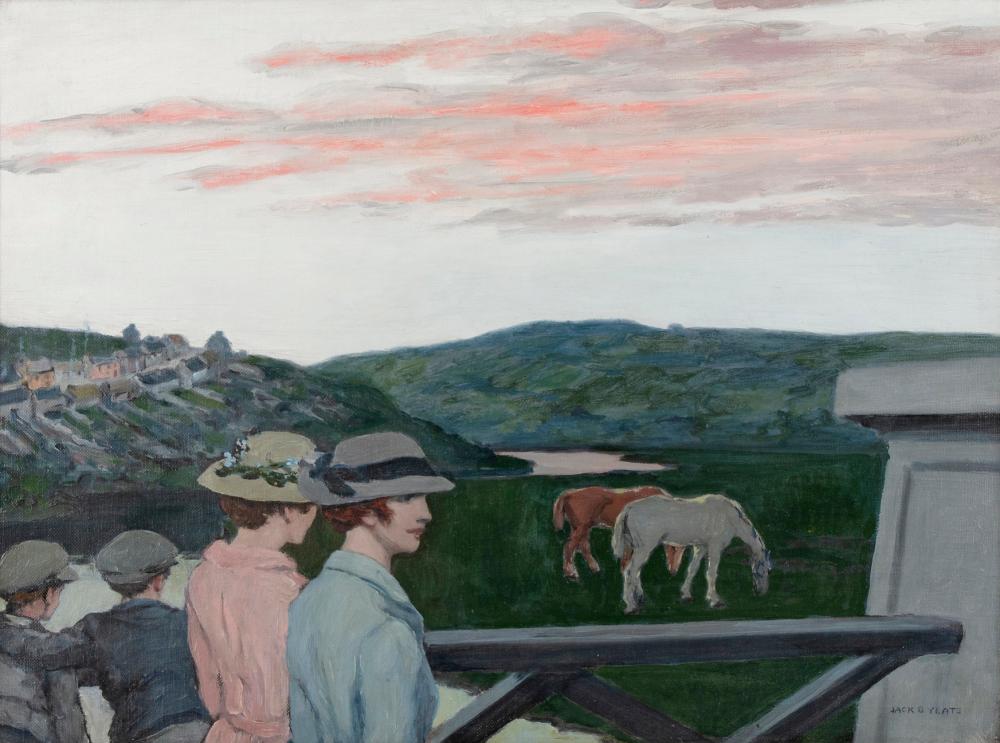
Jack Butler Yeats RHA (1871-1957) The Bridge at Skibbereen (1919) Oil on canvas, 46 x 61cm (18 x 24) Signed Provenance: Sold by the artist to Dr Carey, London, 1950; Victor Waddington, London; With Theo Waddington Fine Art; Private Collection, Dublin Exhibited: Dublin, August 1920, Society of Dublin Painters; Limerick, September 1945, Goodwin Galleries; New York, November 1971, Coe Kerr Gallery, Centennial Exhibition; Dublin, September/October 2004, Douglas Hyde Gallery, Jack B. Yeats Amongst Friends, cat.no. 3; Dublin, October 2010, IMMA The Moderns; Skibbereen, Co. Cork, July/October 2018, Uillinn, West Cork Arts Centre, Coming Home: Art and the Great Hunger. Literature: Hilary Pyle, Jack B. Yeats: A Catalogue Raisonne of the Oil Paintings, Andre Deutsch, London 1992, No. 116, vol.1 In the summer of 1919 Jack B Yeats visited Skibbereen, in Co. Cork, drawing and sketching the surrounding landscape. He wrote to the American collector, John Quinn, telling him that There was good painting ground near to the town. All the creeks and islands of the bay were delightful .[1] Yeats produced several oil paintings based on the scenery of Skibbereen and Schull. The Bridge, Skibbereen is the largest and most ambitious of these works and was exhibited at the inaugural show of the newly formed Society of Dublin Painters in 1920. Two boys and two young women stand on a bridge overlooking the river Ilen. Below them is an expansive view of the surrounding hills and the undulating flow of the water through the countryside. Two horses stand in the field below. The bridge is the old metal bridge which spanned the Ilen river and which was removed in 1963 and replaced by the more modern John F. Kennedy Bridge, the following year. The bridge was located beside the West Cork Hotel, a popular destination for tourists.[2] Its stone capstone and metal railings separate the figures from the view, creating an unusual and modern composition. The fashionably dressed young women seem to belong to the more urbane world of travel and fashion than that of the wild nature that extends before them. Their genteel poses are counteracted by those of the youths, one of whom has his arm around his companions shoulders, emphasizing their shared elation at observing the horses. The height of the surrounding hills has been exaggerated to create a more dramatic environment but one in which a sense of calm prevails. The outskirts of the town are visible on the hill to the left, with smoke emanating from the chimneys and walled gardens extending down the bank. The distant mountain is made of tones of green and blue and the sky is streaked with salmon pink and grey clouds. This palette is subtly picked up in the pink and blue costumes of the women in the foreground, completing a tightly composed work in which all the components of form and colour subtly compliment and enrich each other. Dr. Roisin Kennedy, May 2022 [1] Letter of Jack B. Yeats to John Quinn, 8 October 1919, quoted in H. Pyle, Jack B. Yeats. A Catalogue Raisonne of the Oil Paintings, 1992, I, p.102. [2] I am grateful to Finola Finlay for this information. Dusk is gently setting in, the evening light drawing out and casting pale pink highlights across the clouds. The sunsets reflection is captured in the still waters of the river below, while deep blue shadows fall across the rolling hills in the distance. A street of houses stretches off to the left-hand side of the composition and bends swiftly out of view. Smoke can be seen rising slowly from the small townhouses of Skibbereen village. The two boys standing with their backs to us on the bridge appear animated, looking down on a scene below. Their excitement is wonderfully captured in the young boy reaching his arm across his companion to share in his delight. We notice a smile on the other boys face with his cheeks lifting in amusement. The boys interest seems to be directed at the two horses who are seen grazing in the field beyond. They pay no heed to these on lookers, continuing their evening meal, necks bowed gracefully. The face of the white horse is beautifully rendered by Yeats, the ears tucked back, large eyes searching in the long grass. He even manages to capture the tension of the muscles in the horses jaw while eating. Yeats has a wonderful ability to suggest or gesture towards moments in his compositions without fully revealing the whole scene. We are not aware of any relationship between the figures, it seems as they have all by chance happened upon the same vantage spot. The two boys may be visiting the village on holidays, excited by seeing horses in the wild for the first time. Or are local to the town and thrilled at being allowed to stay out later than usual in the summer evenings, stopping by the bridge to visit the paddock. Their excitement does not seem to have affected the two female figures who gaze calmly out into the distance, enjoying the sunset. This work is an excellent example of this earlier period in Yeats style dominated by Romantic depictions of the West coast of Ireland, of its landscape and people. There is a strong use of line in the work and it reflects his time working as an illustrator, sketching in ink and watercolour the experiences of both rural and urban Irish life. While his style will become much more abstracted in the immediate years following this work, in this example the figures are painted with great attention to detail. In particular the features of the womans profile, the sharp angle of her jaw and nose, a glimpse of her red hair peeking out from under her hat. For the other figure who is turned away from us, her hat is adorned with a beautiful arrangement of blue summer flowers. He expertly handles the drapery of both womens coats, showing the cut and folds of the fabric. They complement each other, standing side by side in dusky pink and pale blue. Although the scale of work is extensive, he uses a closely contained composition, placing the figures in the foreground of the picture plain, to create a greater sense of depth and distance to the surrounding landscape. The upright pillar of the bridge juts dramatically out into corner of the work directing our eyeline across the middle of the composition to the town and hills in the distance. There is an openness and breath to the painting. By using the bridge as horizontal plain, Yeats has provided us with a similar vantage point to that of the figures, as if we are standing behind them revelling in the shared twilight spectacle. Niamh Corcoran, May 2022