Have one like this? Check yours freeOr have an appraiser value it
Lot description
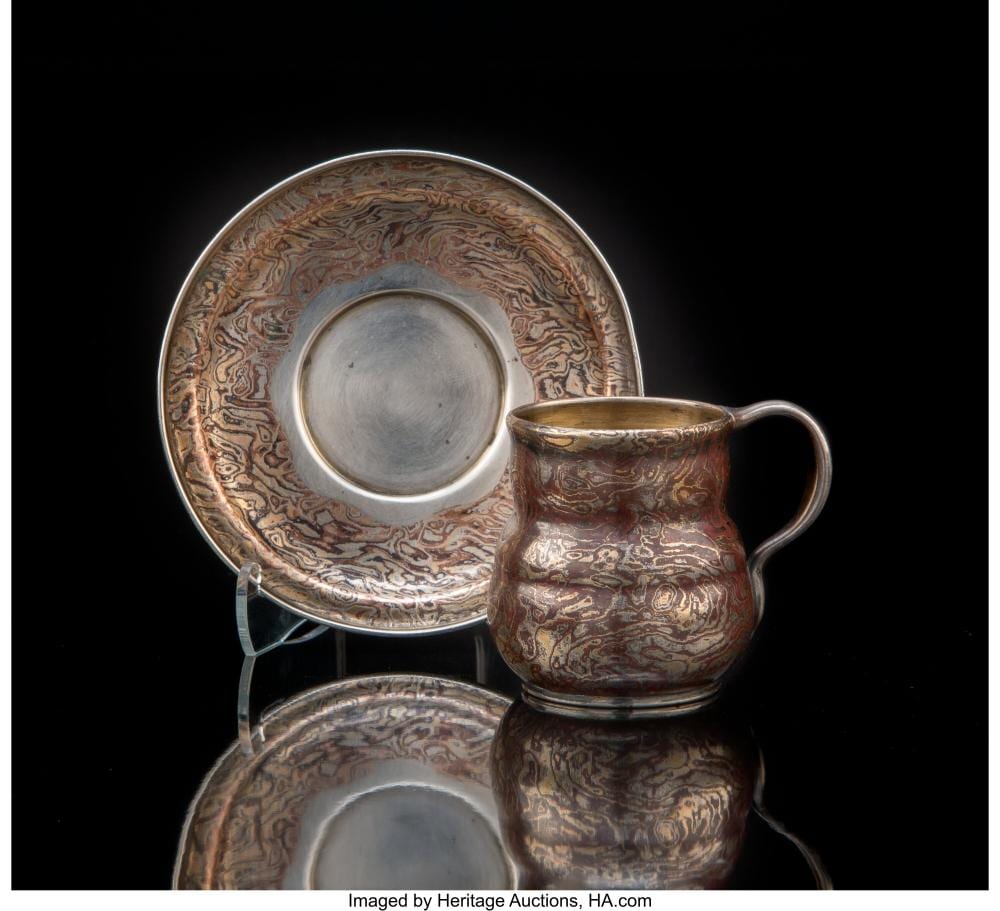
A Rare Tiffany & Co. Mokume and Partial Gilt Silver Demitasse Cup and Saucer from the Collection of Mary Jane Morgan, New York, circa 1878 Marks to both: TIFFANY & CO., 5041 M 3124, STERLING SILVER, AND, OTHER METALS 2 inches (5.1cm) (cup height) 3-3/4 inches (9.5 cm) (saucer diameter) 158 grams (gross) PROVENANCE: Mary Jane Morgan; Her sale, Thomas E. Kirby via the American Art Galleries at New York's Chickering Hall, 1886; Lot 749 (in part) Private Swiss collection; Acquired from the above LITERATURE: American Art Association, Priced Catalog of the Art Collection Formed by the Late Mrs. Mary J. Morgan, 1886, pp. 143. The demitasse cup and saucer with mokume technique to rim of saucer and exterior of lobed cup having gilt interior, each bearing the distinct monogram of Mary Jane Morgan to underside. This example was sold in 1886 as part of a lot of twelve cups and saucers in the sale of Mary Jane Morgan's estate. Tiffany mokume is rare, and it is even rarer to have a piece with traceable provenance from a great American art collection. Mary Jane Sexton Morgan (1823-1885) was the daughter of Francis Sexton, a New York City Merchant involved East Indian trade. She married shipping, railroad and iron magnate Charles Morgan (1795–1878) in 1851 and inherited $9 million upon his death in 1878. Mary Jane Morgan used this sizable inheritance to fund an ambitious and seemingly unending quest to assemble a world-class art collection. Her voracity for collecting was perhaps only matched by her cousin-in-law, J. Pierpont Morgan (1837-1913). When Mary Jane Morgan died in 1885, the press reported that "the house of the late Mrs. Morgan is literally honeycombed with secret closets and drawers filled with works of art of the most varied kind. Since the first inventory was made there have been several supplements. Now the total value is put down at something like four million dollars." (Town Topics, November 1885) Her estate was sold over three days at no reserve and was attended by notable collectors and society members like Charles L. Tiffany, William Walters, Henry G. Marquand, Henry O. Havemeyer, Mrs. Collis P. Huntington, and Mrs. Ogden Goelet. The multi-category sale was comprised of but not limited to Asian ceramics and bronzes, silver, fine European porcelains, glassware, paintings, sculpture, etchings, and books. According to the auction catalog, most of the 154 lots of silver, "with few exceptions made to order by Messrs Tiffany & Co." Mary Jane Morgan was one of Tiffany's most loyal clients during the late 19th century and she favored the firm's creative Japonesque pieces. She was particularly fond of mixed-metal and mokume, which represented some of Tiffany's most labor intensive, rare, and beautiful objects the firm ever produced. The present lot is described on page 143 of her auction catalog as part of lot 749: "AFTER-DINNER COFFEE CUPS AND SAUCERS, "Moku-me" or "Veins of the wood" design, 18 pieces" Though the company cataloged its mokume works as "mixed metal" in company inventories, our understanding of the craft extends beyond the simple inclusion of differing metals. To craft mokume, meaning "wood grain" or, literally, "wood eye" in Japanese, artisans laminated thin sheets of differently colored metals and alloys, folded them to increase the number of layers, cut through or bent, and, finally, hammered to produce marbleized patterns. The present lot exhibits a shimmering kaleidoscope of silver, gold, copper, and alloy laminations. The labor-intensive nature of the process meant that few pieces were created by Tiffany with this technique covering the entire body of the piece. Most commonly, Tiffany included mokume as a decorative accent, found on some applied insects or small handheld works. The extensive mokume decoration to the present lot e