Have one like this?
Upload a photo for a free check of what yours may be worth.
Lot description
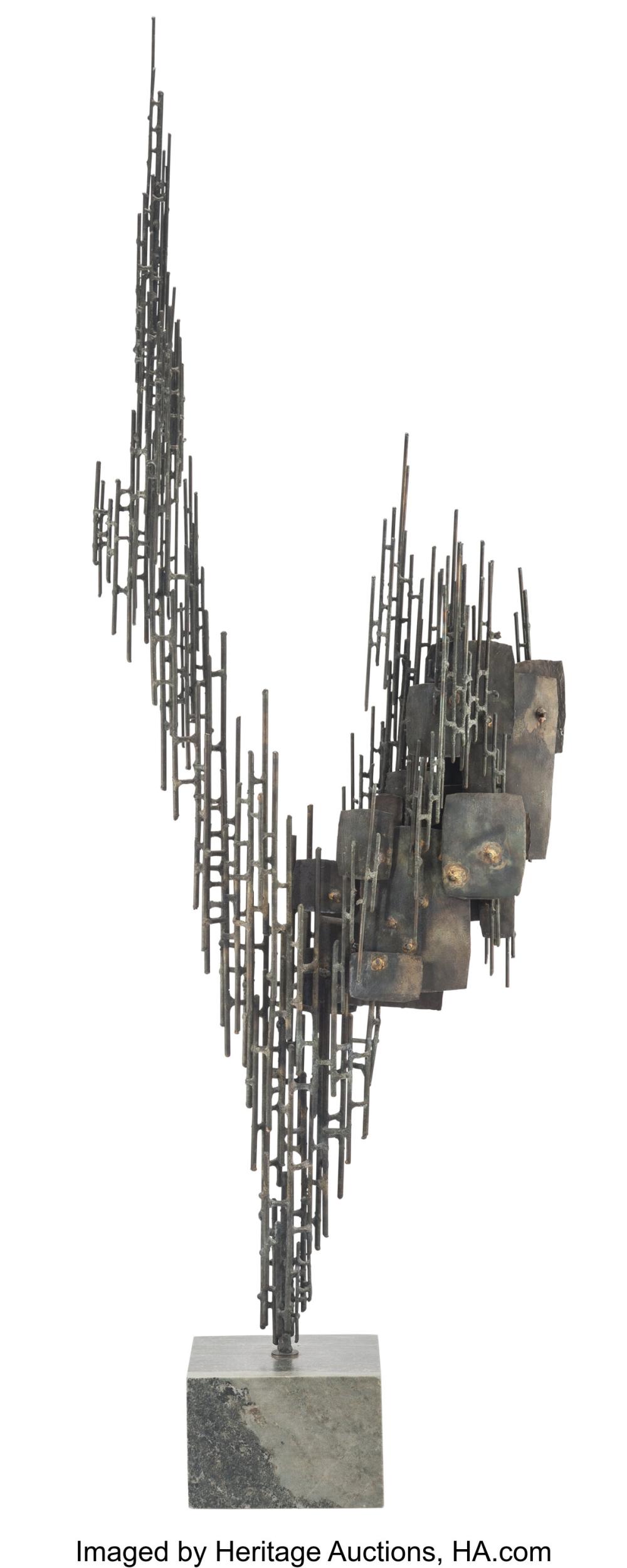
Harold Cousins (American, 1916-1992) Untitled Composition (Gothic Plaiton Type), 1962 Welded steel rods and plates 51-1/2 inches (130.8 cm) high on a 5 inch (12.7 cm) high grey marble base Inscribed on center square: Cousins / 3/62 Black Art of a Distinguished Collector Primarily celebrated as a sculptor, Harold Cousins worked in a variety of mediums including stone, wood, metal and terracotta, and in a variety of styles from realism to total abstraction. In the 1950s and 1960s, he expressed his political views about racial integration in America with figurative works including Political Prisoner (1954) , Slave (1963), and Standing Figure (1963), a silhouette suggestive of the Ku Klux Klan. By the time he left for Europe in his 30s, the artist had already established a professional reputation in America. He grew up in northwest Washington, D.C. in an area known as "Black Broadway". In 1943, he began studies at Howard University and was much influenced by Alaine Locke, art historian and writer who encouraged pride and interest in African art. From 1943 to 1945, Cousins served in the U.S. Coast Guard working with Sonar, and then returned to his job at the U.S. Post Office, while studying sculpture in night classes. In 1948, determined to further his art studies and taking advantage of the GI Bill, he moved to New York City and enrolled at the Art Students League where his teachers were William Zorach, Will Barnett and Reginald Marsh. He met sculpture student Peggy Thomas, and they remained partners for the next thirty years. The coupled moved to Paris, leaving in October 1949, and there by pre-arrangement, he studied with Ossip Zadkine in a class of a dozen students. He also exhibited at Galerie Huit, the Salon des Independents and Salon de Jeune. His early works in Paris, influenced by Zadkine, were solid forms with classical and religious themes. Included were terracotta pieces titled Salomé, Seated Old Man, Gladiator and A La Pensée, and wood carvings Orphéus and A La Pensée. Wood carving such as Tree Spirit and "Poisson Vert" showed strong African-art influences. Among his close friends were Karel Appel, who, in turn, used his influence to get Cousins involved in a project for the Hunstzaal Hamel in Amsterdam to produce a series of terracotta and wood masks for his first European one-person show. During this period, his work became increasingly abstract, and his mediums included mixed-media facilitated by oxygen-acetylene welding that he learned from Shinkichi Tajiri, a fellow student at Zadkine's studio. However, this experimentation, which allowed him to assemble odd-seemingly unrelated pieces, earned the disapproval of Zadkine, and led to a distancing of their relationship. Cousins associated with many modernists and was part of The Parisian School, the European avant-garde that included Appel as well as Americans Paul Jenkins, Sam Francis and Joan Mitchell. Cousins also became much influenced by the work of Julio Gonzalez, whose work he saw first-hand due to a friendship with the daughter of Gonzalez, who had her father's private collection and freely shared it with Cousins. The last two decades of Cousins' live were marred by his ill health from oral cancer, which some attribute to his refusal to use a mask when he worked with oxygen-acetylene. However, he continued to exhibit and even did theatre sets for the production of "Four Penny Opera". In 1996, the Studio Museum in Harlem held a posthumous traveling exhibition of his work: "Explorations in the City of Light: African-American Artists in Paris, 1945-1965". In 2000, the Metropolitan Museum of Art in New York acquired his sculpture, Torso (1952). HID01801242017