Have one like this? Check yours freeOr have an appraiser value it
Lot description
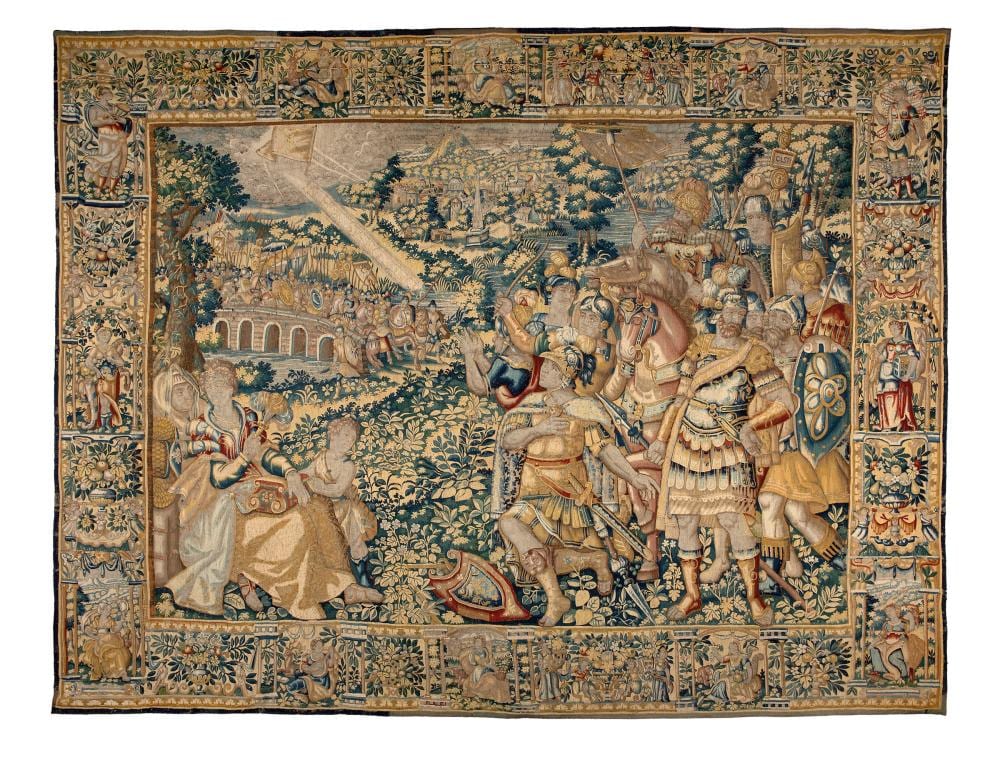
Flemish tapestry, 17th century. "Constantine Seeing the Cross on the Milvian Bridge". Wool and silk. Hand knotted. Measurements: 295 x 383 cm. The art of tapestry in Flanders underwent a notable development from the end of the 14th century, when Arrás, Tournai and Brussels were established as the main centres of production. The tapestry in question, from the Baroque period, is clearly indebted in quality and workmanship to the exquisiteness of Renaissance Burgundian tapestries. As for the theme, the triumph of the Church over paganism was one of the most common themes in Flemish workshops of the time, a triumph embodied in the figure of Constantine. However, while in the pro-Renaissance tapestries the compositions were inspired by ecclesiastical altarpieces, in the tapestry shown here the scene of the last Roman emperor is depicted with a singular narrative richness and topographical precision in the north of Rome. Thus, the detailed description of the landscape (in the millefleur style) and the architectural elements (the obelisk of Constantine, the Milvian Bridge, houses and temples of the city of Rome...) are superimposed on the preciousness invested in describing the rich clothing of the soldiers, of Constantine himself and of Helen, before whose figure her son kneels. The enemies, namely the troops led by Maxentius, are crossing the bridge, which (according to legend) will break and cause the death of many of them in the river Tiber. Constantine's vision (the dream in which a cross appeared to the emperor accompanied by the words "In hoc signo Vinces") has also been reproduced above the bridge, in the form of a phylactery across the sky, and accompanied by the symbol of the Chrismon printed on a banner. It is said that the emperor, upon awakening, ordered the construction of a cross to be placed in the vanguard of his army. This brought him victory, an event that led to his conversion to Christianity. The figure of Helen is also prominent because it was Constantine's mother who was responsible for bringing the cross from Jerusalem (Constantine's mother ordered the Temple of Venus to be demolished and the three crosses of Golgotha were found there). Helena sent her son a fragment of the Holy Cross and the nails. The rest of the cross remained in Jerusalem in a rich silver case, which is depicted in the tapestry, resting on the lady's lap. An entourage of courtiers completes the scene. The border is decorated with the same descriptive care, alternating allegorical figures and vegetal decoration in the form of bouquets and vases between pilasters. From the 15th to the 17th century, Flemish tapestries were among the most prized and valuable works of art in Europe. Workshops were active in the main Flemish cities and in most major towns. They were used as diplomatic gifts, especially large-format ones. Production began with the drawing of the cartoons, which were executed on paper or parchment by skilled painters and then sent to the tapestry makers, who could be at a great distance. In the 17th century, Flemish tapestries continue to show intricate detail of pattern and colour. The success of decorative tapestry can be partly explained by its portability. Tapestries were also placed on castle walls for insulation during the winter, as well as for decorative display.