Lot description
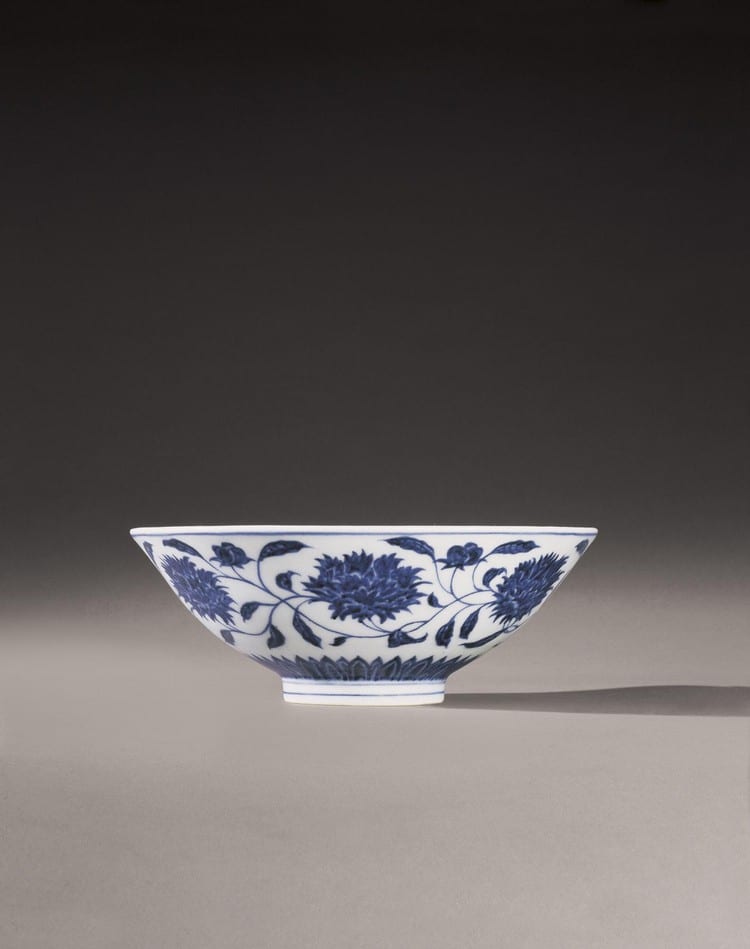
supported on a slightly tapered foot rising to broad conical sides, the exterior painted in rich tones of underglaze-blue enhanced by characteristic 'heaping and piling' with an elegantly undulating leafy stem bearing six large peony blossoms alternating with tight buds above a band of pointed overlapping petal lappets, the interior with a central mallow blossom medallion enclosed within double-circles, all encircled at the cavetto delicately incised with a broad band of leafy composite floral scrolls under the opaque blue-tinted glaze in anhua technique Quantity: 1 PROVENANCE Collection of Edward T. Chow. Mathias Komor, New York, 1951. Collection of Mr. and Mrs. Myron S. Falk. Christie's New York, 15th October 2001, lot 135. EXHIBITED Mathias Komor, Imperial Porcelains of the Ming Dynasty, New York, 1951, cat. no. 28. LITERATURE AND REFERENCES H.D. Ling, Complete Collection of Ming Dynasty Kingtehchen Porcelain from the Hall of Disciplined Learning, vol.1, Hong Kong, 1950, p. 32, no. 44. CATALOGUE NOTE This bowl represents the most exquisite type of ware produced in the imperial kilns during the Xuande reign. It is distinctive for its elegant shape and intense underglaze-blue decoration created in pure Chinese taste. Bowls of this design come in two versions: painted in underglaze-blue only; or with additional anhua slip decoration of flower scrolls on the interior, like the present bowl. These bowls were inspired by earlier bowls of the Yongle reign, also with anhua floral scrolls, such as the rare piece without a reign mark, attributed to the Yongle period, from the Ardebil Shrine, now in the National Museum of Iran, Tehran, illustrated in John Alexander Pope, Chinese Porcelains from the Ardebil Shrine, Washington, 1956, pl.48 (cat. no.29.334) and again in Takatoshi Misugi, Chinese Porcelain Collections of the Near East, Topkapi and Ardebil, vol.3, Hong Kong, 1981, pl. A60. Two Xuande bowls of this design with anhua decoration in the National Palace Museum, Taiwan, are illustrated in Mijin meihin zuroku, vol. 1, Tokyo, 1977, pl. 66, and in A Panorama of Ceramics in the Collection of the National Palace Museum, Hsuan-te (I), Taipei, 2000, pl. 107, the latter also included inthe Museum's Special Exhibition of Selected Hsuan-te Imperial Porcelains of the Ming Dynasty, Taipei, 1998, cat.no. 61; one in the Palace Museum, Beijing, is included in Gugong Bowuyuan cang Ming chu qing hua ci, vol.2, Beijing, 2002, pl. 142. A bowl from the A.D. Brankston collection is illustrated in Soame Jenyns, Ming Pottery and Porcelain, London, 1953, pl. 29B; one formerly in the collection of Mr. and Mrs. Alfred Clark and later in the T.Y. Chao collection, included in the exhibition Chinese Blue and White Porcelain, Oriental Ceramic Society, London, 1953, cat.no. 78, was sold in our London rooms, 19th May 1987, lot 230; and another from the Toguri Art Museum, Tokyo, illustrated in Zaidan hojin Toguri Bijutsukan zohin senshu Seireki 2000 nen kinen zoroku (Selected Works from the Toguri Art Museum Foundation: Commemorative Catalogue of the Year 2000 AD), Tokyo, 2000, pl. 25, was sold in our London rooms, 9th June 2004, lot 367. The elegant design of these Xuande bowls was much admired by the Qianlong Emperor, who ordered precise copies of these to be made by the imperial kilns. A Xuande bowl of this design in the Percival David Foundation, London, was exhibited together with a Qing copy of Qianlong mark and period in the same collection, in the exhibition Elegant Form and Harmonious Decoration: Four Dynasties of Jingdezhen Porcelain, Percival David Foundation, London, 1992, cat.nos. 34 and 168.