Have one like this?
Upload a photo for a free check of what yours may be worth.
Lot description
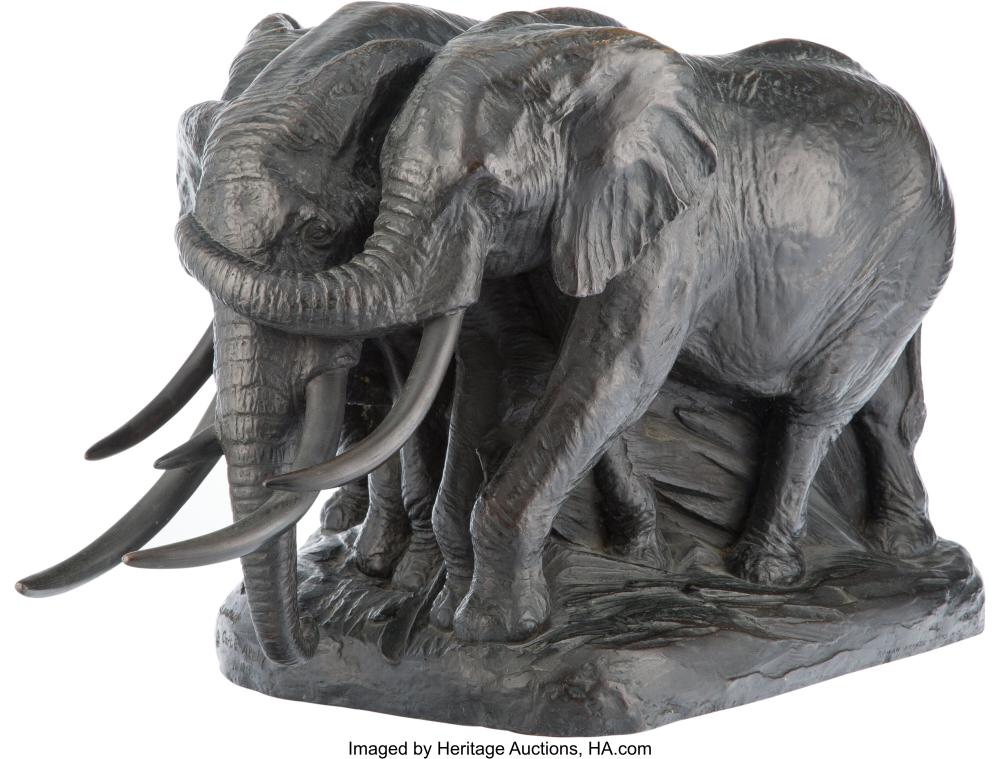
Carl Ethan Akeley (American, 1864-1926) The Wounded Comrade, conceived 1913, cast 1927 Bronze with brown patina 12 inches (30.5 cm) high Inscribed on base: The Wounded Comrade / Carl Akely [ sic] / 1913 Inscribed on the underside: A. No. 2. PROVENANCE: Mary Akeley, the artist's wife; Tiffany & Company, New York, acquired from the above, July 1927; The Perkins Family, Lee, Massachusetts, acquired from the above; By descent to the present owner. LITERATURE: P.J. Broder, Bronzes of the American West, New York, 1974, pp. 247-49, another example illustrated; V.S. Schmitt, Four Centuries of Sporting Art, Mumford, New York, 1984, p. 142, another example illustrated. Renowned as a taxidermist, conservationist, biologist and photographer, Carl Akeley was also a skilled sculptor. In 1909, Akeley accompanied Theodore Roosevelt on a year-long expedition in Africa funded by the Smithsonian Institution, and subsequently he began his work at the American Museum of Natural History in New York, where his efforts can still be seen in the Akeley African Hall of Mammals. Akeley specialized in African mammals following his first African trip in 1896, particularly the gorilla and the elephant. The artist conceived the idea of creating a full-scale African diorama to show the animals in their natural habitat. As a taxidermist, he improved on techniques of fitting the skin over a carefully prepared and sculpted form of the animal's body, producing very lifelike specimens, with consideration of musculature, wrinkles, and veins. He also displayed the specimens in groups in a natural setting. Many animals that he preserved he had personally collected. The Wounded Comrade portrays a scene that Akeley had directly observed in the wild; when an elephant is wounded, others from the herd will rush towards the injured animal in an attempt to convey it to safety. Fellow sculptor Alexander Phimister Proctor suggested that Akeley cast a series of these models into bronze. The first and most famous work in the series is The Wounded Comrade. Akeley initially cast The Wounded Comrade in 1913, and between 1913 and 1917, he went on to produce 23 examples in total at the Roman Bronze Works foundry in New York. Much like the authorized posthumous castings by Frederic Remington's widow, Mary Lee Jobe Akeley cast a number of her late husband's bronzes in the late 1920s, some of which bear the letter "A" on the body of the work. The "A" numeration was the serial number assigned to this round of casts. The history behind the present work is unique and extraordinary. This particular bronze was commissioned in July 1927, one year following Akeley's death in Uganda, by Mary Akeley. This particular cast was made for Tiffany & Company, and Mary Akeley delivered it personally to Tiffany on July 27, 1927. The present work was subsequently purchased by the Great-Grandfather of the present owner from Tiffany & Company, and has remained in the family ever since. HID01801242017