Have one like this? Check yours freeOr have an appraiser value it
Lot description
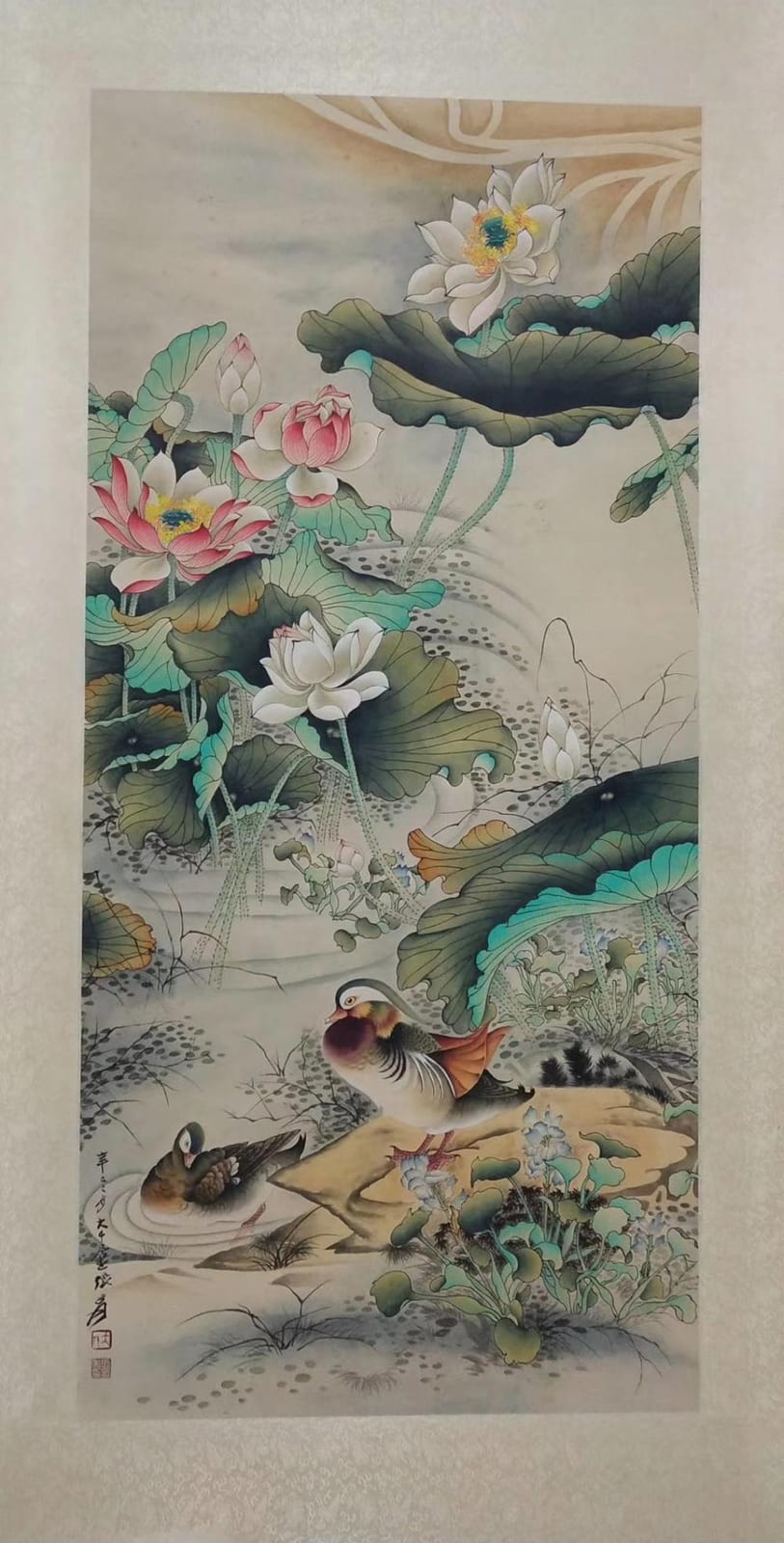
Heart size: 102.5 cm × 48 cm; Provenance: private collection in USA; Auction results: 1500 paintings sold in the range of $100,000 to $24,575,000 USD. Chang Dai-chien or Zhang Daqian (Chinese: 張大千; Wade–Giles: Chang Ta-ch'ien; 10 May 1899 – 2 April 1983) was one of the best-known and most prodigious Chinese artists of the twentieth century. Originally known as a guohua (traditionalist) painter, by the 1960s he was also renowned as a modern impressionist and expressionist painter. In addition, he is regarded as one of the most gifted master forgers of the twentieth century. Artistic career: In the early 1920s, Chang started pursuing professional studies in Shanghai, where he studied with two famous artists, Zeng Xi and Li Ruiqing. His elder brother Zhang Shanzi, who was a famous painter at the time, brought him to a literary salon in 1924 where his first appearance impressed the attendants. His first exhibition of 100 paintings was in 1925 at Ningbo Association in Shanghai.[7] In the late 1920s and 1930s, Chang moved to Beijing where he befriended other famous artists, including Yu Feian, Wang Shensheng, Ye Qianyu, Chen Banding, Qi Baishi, and Pu Xinyu. Chang had collaborated with Pu on painting and calligraphy. At the time, there was an idiom "Chang from the south, Pu from the north (南張北溥)" for those two of the most renowned artists in China. There was also a saying that Chang was "southern counterpart of Pu Xinyu in shan-shui painting, Qi Baishi in flower-and-bird painting, and Xu Cao in figure painting".[7] In the 1930s he worked out of a studio on the grounds of the Master of the Nets Garden in Suzhou. In 1933, while an exhibition of modern Chinese paintings organized by Xu Beihong was held in Paris, France, and Zhang's exhibited painting "Golden Lotus (金荷)" was purchased by the French government. In 1935, he accepted the invitation from Xu Beihong to be a professor at National Central University Art Department in Nanjing. In the same year, his portfolio was published in Shanghai. In 1936, his personal exhibition was held in the United Kingdom. In the early 1940s, Chang led a group of artists in copying the Buddhist wall paintings in the Mogao and Yulin caves. In order to copy the inner layer of the multilayered murals in the Mogao Caves, Chang removed and damaged several outer layers of the paintings in Cave 108, 130 and 454. In 1943, he exhibited his copies of murals and supported the establishment of the Dunhuang Art Institute, the predecessor of the Dunhuang Research Academy. In 1945, Chang's works, as a part of a UNESCO's touring contemporary art exhibition, were showed in Paris, London, Prague and Geneva.[8] In the late 1950s, his deteriorating eyesight led him to develop his splashed color, or pocai, style, which combines abstract expressionism with traditional Chinese styles of painting.[9] In the 1970s, he mentored painter Minol Araki. In 1957, Zhang Daqian was invited to hold exhibitions in The Louvre and Musée Guimet in Paris, where Picasso was also holding a show. Zhang seized this opportunity to meet the him. Picasso was delighted to meet Zhang and even asked him to criticize his Chinese paintings. Zhang directly told Picasso that he did not have the right brushes to do Chinese art. Ten years later, Picasso received a gift from Zhang– two Chinese writing brushes made from the hair of 2500 three-year-old cows.[9] 张大千 荷花鸳鸯图立轴 画心尺寸 attributed to Zhang Daqian (1899-1983) “Mandarin duck in lotus flowers”, Chinese paper scroll painting