Have one like this?
Upload a photo for a free check of what yours may be worth.
Lot description
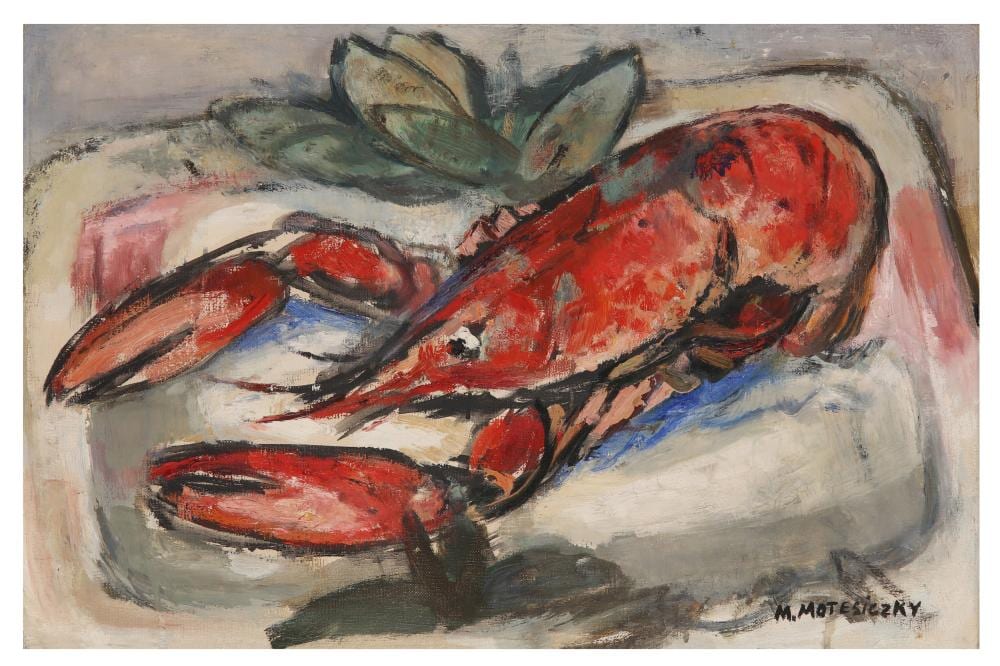
Property from the Marie-Louise von Motesiczky Charitable Trust (lots 820 - 827) MARIE-LOUISE VON MOTESICZKY (AUSTRIAN 1906 - 1996) Lobster oil on canvas 40.3 x 60.5 cm (15 3/4 x 23 3/4 in) EXHIBITED: London, Roland Browse & Delbanco, The Renaissance of the Fish. Paintings from the 17th to the 20th Century, 1953, no. 42 (erroneously dated 1952) Munich, Städtische Galerie, Erna Dinklage, Marie-Louise Motesiczky, 1954, no. 118 London, Beaux-Arts Gallery, Marie-Louise Motesiczky, 1960, no. 28 (erroneously dated 1954) Linz, Wolfgang Gurlitt Museum, Neue Galerie der Stadt, Marie-Louise Motesiczky, 1966, no. 34 (erroneously dated 1954) Vienna, Wiener Secession, Marie-Louise Motesiczky, 1966, no. 34 (erroneously dated 1954) Munich, Galerie Günther Frank, Marie-Louise Motesiczky, 1967, no. 34 (erroneously dated 1954) Bremen, Kunsthalle, Marie-Louise Motesiczky, 1968, no. 34 (erroneously dated 1954) London, Goethe-Institut, Marie-Louise von Motesiczky. Paintings Vienna 1925 - London 1985, 1985, no. 39 (illustrated in the catalogue; erroneously dated 1954) LITERATURE: Eva Michel, Marie-Louise von Motesiczky 1906-1996. Eine österreichische Schülerin von Max Beckmann, diploma thesis, University of Vienna, 2003, p. 55, pl. 76, illustrated in colour (erroneously dated 1954) Marie-Louise von Motesiczky 1906-1996, exh. cat., 2006, p. 200, discussed; p. 202, fig. 49, illustrated in colour Jill Lloyd, The Undiscovered Expressionist. A Life of Marie-Louise von Motesiczky, New Haven/London, 2007, p. 148, discussed Ines Schlenker, Marie-Louise von Motesiczky 1906-1996, A Catalogue Raisonné of the Paintings, New York, 2009, p. 231, no. 119, illustrated Painted in 1953, the artist's playful depiction of a cyclopic-eyed lobster, served up on a silver salver with accompanying garniture borders on the humorous. Indeed, in her diary Marie-Louise's month-long struggle to capture the essence of the crustacean is tinged with a hint of the absurd. She triumphantly marked the painting’s completion on 13th April 1953 with the words: ‘Finally lobster finished, a weight lifted from my heart’. In her catalogue entry Schlenker wryly notes: 'To celebrate - and possibly as a little revenge for the trouble it had caused - Motesiczky went out to eat half a lobster the next day' (Schlenker p. 230). The particular significance of Lobster for Marie-Louise is not clear, but an important influence on her following her arrival in London was Oskar Kokoschka who was also living in exile in England. The subject of the present work could well have been inspired by the older artist's rendition of another crustacean: his influential painting The Crab of 1939-40 (collection of Tate). Lobster was included in The Renaissance of the Fish. Paintings from the 17th to the 20th Century – a surely tongue-in-cheek exhibition title – at Roland Browse and Delbanco the year it was painted. Other artists represented in the show included Picasso, Matisse and Max Ernst beside emerging British artists William Scott, Prunella Clough, Edouard Paolozzi and Lucian Freud (see Lloyd p. 148). Property from the Marie-Louise von Motesiczky Charitable Trust (lots 820 - 827) Viennese emigré artist Marie-Louise von Motesiczky (1906-1996) parted with few of her works during her lifetime, and since her death less than a handful have appeared on the open market. Lots 820 - 827 span four decades - from 1945 to the early 1980s - and mark the first time a group of her paintings is to be offered at auction. Born into wealth, Marie-Louise lived in Vienna until the Anschluss in 1938, when Austria was annexed by Germany and she and her Jewish mother were forced into exile in Holland. In 1939 they emigrated to England. After the War Marie-Louise was increasingly based in Hampstead, where she and her mother purchased a house in 1960 that remained their home for the rest of their lives. From the very beginning, the primary influence on her art was the German painter Max Beckmann whom Marie-Louise had first met in 1920 when she was just thirteen. She recalled of the introduction: ‘A winged creature from Mars could not have made a greater impact on me’. Beckmann was full of encouragement. From the early 1920s, she attended classes in different studios in Holland, Germany and France. Throughout, she and Beckmann kept in regular contact. He visited her in Paris, and she accepted his invitation to attend his masterclasses in Frankfurt. During these formative years Marie-Louise enjoyed a privileged life. Her mother Henriette was descended from one of Vienna’s most illustrious Jewish banking dynasties. Her maternal grandfather, Leopold von Lieben, was President of the Stock Exchange; her maternal grandmother, Anna, was one of Freud’s early patients. She counted the Todescos, and Ephrussis among her family circle. Growing up in an apartment on Brahmsplatz in the centre of Vienna, she, her mother and her brother Karl spent their summers at Villa Todesco in Hinterbrühl, to the south west of the capital. But over time family tragedy, financial difficulties and above all the rise of Nazi Germany took their toll. Marie-Louise’s father had died in a hunting accident many years before and her mother’s considerable inheritance gradually diminished through a combination of high taxation, ill-advised investments, and the financial crash of 1929. Then, with the rise of the Third Reich she and her mother felt compelled to flee Austria. Further distress followed when her brother Karl, who had remained in Austria, was arrested for assisting the escape of a Jewish family and deported to Auschwitz, dying of typhus there on 25 June 1943. Immediately following the Anschluss Marie-Louise and her mother travelled to Holland. Arriving in mid-March 1938, they stayed with relatives in The Hague, and Marie-Louise renewed contact with Beckmann who was living in Amsterdam. The following January she and her mother emigrated to Britain, living first in London then in Amersham to escape the Blitz. In England she reconnected with Oskar Kokoschka, a family friend in Vienna but now similarly exiled. Marie-Louise later confided that during the war years Kokoschka ‘…sort of adopted me’. Kokoschka ensured that her work was shown in a series of group exhibitions, culminating in a one-person exhibition at the Czechoslovak Institute in the autumn of 1944; he also affected her painterly approach. In her years on the Continent it had been Beckmann who had informed Marie-Louise’s distinctive aesthetic. His Expressionist manner was evident in her use of bold compositional forms, commanding characterisation, strong lighting and vivid colours. But in London Kokoschka’s influence also began to infuse her work. Marie-Louise’s palette softened, her brush strokes became lighter and more feathery, and the gestures of her sitters less angular and severe. The change represented a more tempered approach that suited her increasingly thoughtful, enigmatic, and poetic narratives that typified her post-war canvases. But despite Kokoschka’s support, starting afresh in Britain proved challenging. Marie-Louise commented in an interview in 1952 ‘I myself have exhibited a few times in London, but in spite of positive reviews… I have not had much success. It is a very difficult scene for foreigners.’ Thus, it wasn’t until 1960 that she had her next one-person show in London, at the influential Beaux Arts Gallery. However, bar a notably positive review by J.P Hodin, the show received mixed reviews, and was not a financial success. It was to be a further 25 years before she had another solo exhibition in the capital. Her struggle to establish her painterly credentials was not helped by her relative affluence, as it meant she had no pressing need to sell her work. The situation suited both her own ambivalence towards her talent, her naturally hesitant character and the demands of her overbearing mother. But it exasperated many of those who recognised her special qualities as a painter. These included Beckmann and her brother Karl, and the Nobel prize-winning author Elias Canetti, who became her long-time companion and lover, and the single most important influence on her in the decades after her arrival in England. Meanwhile, on the Continent Marie-Louise’s reputation was growing. She received wide acclaim when her work was exhibited in Amsterdam and The Hague in 1952, one of her canvases being purchased by the Stedelijk Museum. And when she showed in Munich in 1954 and Düsseldorf the following year. In the 1960s also she enjoyed solo shows in Austria and Germany: in Vienna, Linz, Munich and Bremen. Finally, in 1985 her work was once again shown in London, at the Goethe-Institut, and this time it was a triumph. Fortuitously, it coincided with an upswing in interest in German art, and the Royal Academy’s major retrospective German Art in the Twentieth Century. The Goethe-Institut catalogue included contributions by Tate curator Richard Calvocoressi, Gunther Busch, former director of the Kunsthalle in Bremen, and fellow émigré and renowned cultural historian Sir Ernst Gombrich. Widely acclaimed in the press in the UK and abroad, finally it seemed the climate was favourable for the re-discovery of Marie-Louise’s work. Further exhibitions and critical literature on Marie-Louise followed. In 1994 she was the subject of a major retrospective in Vienna at the Osterreichische Galerie, Oberes Belvedere and in Manchester at the City Art Gallery. In 2006-07 her work was shown in an extensive centenary exhibition that started in Tate Liverpool, and travelled to Frankfurt, Vienna and Passau, ending in Southampton City Art Gallery. In 2007 Jill Lloyd’s compelling biography of Marie-Louise appeared, followed in 2009 by the catalogue raisonné of her oil paintings by Ines Schlenker. Most recently, from October 2019 to September 2020, Tate Britain held an exhibition devoted to her life and context, to inaugurate the gallery that has been named in perpetuity as the ‘Marie-Louise von Motesiczky Archive Gallery’ for all future displays of Tate’s archive holdings in general. The work of Marie-Louise von Motesiczky held in public collections In the UK institutions holding paintings and works on paper by Marie-Louise von Motesizcky include: the British Museum, Freud Museum, National Portrait Gallery and Tate in London (which also holds her archive); the Fitzwilliam Museum in Cambridge, New Walk Museum and Art Gallery in Leicester, Manchester Art Gallery, National Galleries of Scotland in Edinburgh and the Hunterian Art Gallery in Glasgow. Elsewhere in Europe her work is to be found in the National Gallery of Ireland in Dublin; in the Netherlands at the Stedelijk in Amsterdam and the Boijmans van Beuningen Museum in Rotterdam; in Germany at the Städel Museum in Frankfurt and the German Literary Archive in Marbach, and in Austria at the Albertina, Österreichische Galerie Belvedere, the Leopold Museum and the Museum Wien in Vienna, and the Lentos Kunstmuseum in Linz. The Marie-Louise von Motesiczky Charitable Trust The Marie-Louise von Motesiczky Charitable Trust, is a company limited by guarantee registered in England and Wales (no. 7572024) and a registered charity (no. 1140890): www.motesiczky.org. The copyright for Marie-Louise von Motesiczky’s paintings, drawings and sketches lies with the Marie-Louise von Motesiczky Charitable Trust.