Have one like this? Check yours freeOr have an appraiser value it
Lot description
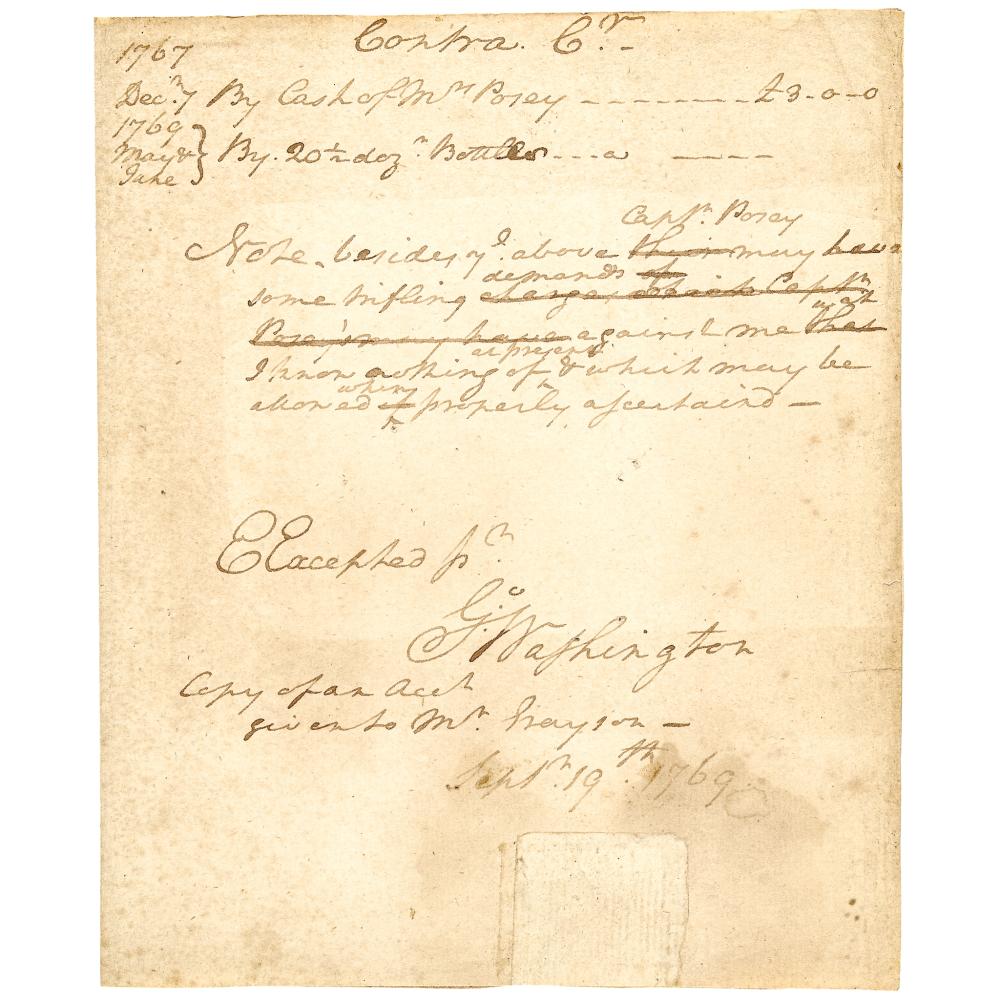
Autographs George Washington's Handwritten Account for Debt Due from His Longtime Friend and Neighbor "Captain" John Posey's "Land" a Six Acre Plantation with Ferry Near Mount Vernon & Posey's "Negroes" being Washington's Collateral with Connection Between Three Great Virginians: George Mason, William Grayson and George Washington GEORGE WASHINGTON (1732-1799). First President of the United States (April 30, 1789 to March 4, 1797); a Founding Father of the United States, serving as the Commander-in-Chief of the Continental Army during the American Revolutionary War; presided over the 1787 Constitutional Convention held at Philadelphia. September 19th, 1769-Dated Colonial Era, Autographed Document Signed, "G. Washington" (written at Mount Vernon), Virginia, being a multiyear financial Accounting Statement of debt due from his longtime friend and neighbor Capt. John Posey, "Copy of an Acct. given to Mr. Grayson - September 19th, 1769," Very Fine. Besides having been completely handwritten and signed, "G. Washington", he mentions two other great historic Virginians, George Mason and William Grayson as having involvement with this well documented debt situation. George Washington presents an updated accounting information in a standard "double-entry" format, written on two opposing pages. One page is headed with "Dr" (Debits) and the other "Cr" (Credits). This Document is 2-pages (1 sheet folded at middle), measuring fully about 7.5" tall x 12.25" wide, then folded at its middle creating two side by side opposing pages for quick review. There is some light tone and a few scattered trivial pinholes. It is written entirely by Washington's own hand. This Document is well written in medium brown ink on "Crown" watermarked laid period paper and is fully readable. Col. George Mason (1725-1792) of Fairfax county, Virginia is perhaps best known for his authorship of Virginia's Declaration of Rights which was drawn upon by Thomas Jefferson for the opening paragraphs of the Declaration of Independence. It was widely copied by the other colonies and became the basis of the Bill of Rights. Written by George Mason, it was adopted by the Virginia Constitutional Convention on June 12, 1776. Mason was an American patriot and statesman who insisted on the protection of individual liberties in the composition of both the Virginia and the U.S. Constitution (1776, 1787). He was ahead of his time in opposing Slavery and in rejecting the constitutional compromise that perpetuated it. In October 1767, this accounting document records a further loan to Posey which was Co-signed and guaranteed to Mason by George Washington for 220, its repayment currently due in September 1769 to Mason, an uncomfortable debt situation for which Washington asks Grayson for assistance in trying to settle. According to two diary entries, Mr. William Grayson (1736-1790) of Prince William County, Virginia, visited George Washington at Mt. Vernon from September 15 to 17, 1769. He was an attorney who Washington was apparently considering retaining his services or soliciting advice in the settling of Posey's debt as its other legal complication was a further entanglement involving Washington's associate Col. George Mason as Washington was a Cosigner and guarantor on Posey's debt to Mason, as listed on this document. William Grayson was to become an honored statesman, lawyer, and soldier. He is tied closely to both the birth of the United States, and later to the ascension of George Washington to the nation's highest office. Grayson would complete his law degree at Oxford, with additional studies in Latin, Greek, and English history, spending his early career practicing law. However, upon the breakout of the American Revolution, Grayson enlisted in the Continental Army, at one point serving in the position of aide-de-camp to General George Washington. His greatest success came in Philadelphia, the home of his early education, where under the guidance of General Washington, his volunteer regiment helped the rebels regain Philadelphia after General Howe's siege of the city in 1777-1778. In 1781, he resigned his post, retiring to Dumfries, Virginia to resume his law practice. Grayson would later serve as a member of the Constitutional Convention, serving in the Virginia delegation along with such names as George Mason, Patrick Henry, and James Monroe. Grayson was selected by George Mason and other fellow Virginians to be the first Senator in the state's history. This Document is noted as Washington's copy of the debt accounting that was given to William Grayson prior to his leaving Mt. Vernon (September 17th). It is dated, "September 19th, 1769" and nicely Signed by Washington just two days after Grayson's departure. Here George Washington specifies his collateral against Posey's debt as, "Security on his (Posey's) Lands and Negroes...". Captain John Posey, Washington's neighbor in Fairfax County was a heavy drinker, Posey played cards with Washington and the two were friends. After falling deeply into debt, Posey mortgaged to Washington in 1765 Twenty-six Enslaved people, including "Hercules". In 1770, Posey leased to Washington land that contained a ferry operated by Hercules and another enslaved man, Jack, and two years later Washington purchased it. At some point, Washington came to own Hercules, most likely as a result of foreclosure involved with this current document. Later, Washington's Slave Hercules was described by George Washington Parke Custis as a "celebrated dandy" who ran a strict and clean kitchen, Hercules used the proceeds from selling kitchen slops to purchase nice clothes. Late in 1790, Hercules and his thirteen-year-old son, Richmond, joined President Washington in Philadelphia where Hercules labored as chief chef in the President's House. This accounting being updated from two years prior, when George Washington found it necessary to send John Posey a lengthy letter, dated September 24, 1767, regarding his frustration over lack of repayment of this debt. In that letter (not part of this lot) Washington carefully outlines and explains in great detail the circumstances and obligations required of Capt. Posey's loan. Ultimately, the debt was never paid by Capt. Posey and Washington took possession and ownership of this collateral, including six acres of land, the ferry, and Posey's 26 Negroe Slaves. This Document is dated two years later on September 19, 1769, where Washington notes just below his signature: "Copy of an Acct given to Mr. Grayson - Sept. 19th, 1769." This accounting reads, in full: Capt. Posey - Dr. Currency. 1765 Oct. - To Security on his Lands and Negroes for .............. 750.00 Oct. 1769 - To A Years Int(erest) on Ditto ................................. 150 -- 900-- Oct 2, 1767 - To a subsequent & a further Security on y. above Negroes for ... 70. Oct 1769 - To 2 years Int(erest).......................................................................... 7. 77.-- Oct 1767. - To a Bill of Sale for Sundry Stock, Goods, & Chattels as a Counter Security to Me against a joint Bond of his & mine to Col. Mason for Sterlg (Sterling). .......................................................................... 200. 1769. - To 2 years Int.(erest) on Ditto ................................................................. 20. 220.0 977.0.0 The Opposing Page Reads: Contra Cr. - 1767 Dec. - By Cash of Mr. Posey ................... 3-0-0 1769 May & June - By 20 1/2 doz. Bottles ..... ---- Note, besides ye above Capt. Posey may have some missing demands against me I know nothing at present & which may be allowed when properly ascertained - E(rrors) Excepted Pr. - (Signed) G. Washington Copy of an Acct given to Mr. Grayson - Sept. 19th. 1769" There are early thin reinforcement paper strips are placed along sections of the extreme outer margin edges on the blank reverse, and traces of two small red wax seal thins at the top right and left of the first written page. Overall, George Washington's written text and notations are clear and fully readable on the fine quality watermarked laid period paper. More significant are two marginal repairs in the blank selvage areas at the very bottom edge, well away from any written text. These two early period contemporary laid paper repair patches measure about 1.75" tall x 2.75" wide, and the other 1" tall x 1.25" wide, covering where it appears the original wax seal damaged the laid paper when opened, worthy of professional conservation. Note: Full images are shown here and online, whereas our cover images show this document cropped to enlarge and better display its written portions. This historically significant Virginia document, combining well known relations between George Washington, Capt. John Posey, together with great two American figures William Grayson and Col. George Mason. Ultimately, the foreclosure on Posey's pledged collateral resulted in adding 6 Acres of Land to the estate at Mount Vernon together with Posey's 26 Negroe Slaves. It is difficult to place an estimate on such a unique historic item, therefore ours may prove conservative. This seemingly simple George Washington accounting document having an important connection to Slavery, and his longtime associates who were later instrumental in the founding of the United States and Washington's presidency. Note: We thank the curator and management of the Mount Vernon Ladies Association for their important research assistance. Further information surrounding this historic item is available to read in our EAHA website online version. Provenance: A collection formed in the late 19th century where it has remained there until now. At age 11, George Washington inherited 10 Slaves from his father. In those days in Virginia, the institution of Slavery was considered "a given" and Slaves, like land and other property, could be bought, sold, given away, rented out, and passed down through inheritance. As a young man, George was no different from other members of the Virginia planter class in his attitude that there was nothing morally wrong with Slavery. When he married Martha, Washington more than doubled the number of Slaves under his control through "dower slaves" that she brought to the marriage. In 1759, there were about 40 slaves living at Mount Vernon. Although Washington had control over the dower slaves as a result of his marriage, they were not his property; instead they belonged to the estate of Martha's first husband. Washington's enslaved manservant, Billy Lee, entered the war at Washington's side and stayed with him throughout the revolution. Like his owner, Billy Lee was widely known as a courageous and expert horseman. As Washington prepared his will, he drew up a list of the Mount Vernon Slaves who belonged to either the Custis estate or to him. He found that altogether there were 316 enslaved men, women, and children living at Mount Vernon. Some of these individuals worked in the fields, while others were employed as house servants or as craftsmen in more than a dozen specialties ranging from blacksmithing, to spinning, to bricklaying, weaving, and cooking, to name just a few. At the time of the 1799 census, nearly half of Mount Vernon's enslaved population was either too old or too young to work. Washington made provisions in his will to free all of his own Slaves but could not free those (or the descendants of those) whom Martha had brought to the marriage. By Virginia law, her grandchildren would inherit her "dower slaves." Because the two groups had intermarried, emancipation of Washington's Slaves proved bittersweet. By freeing his Slaves, George Washington tried to set an example for others to follow. He was the only slaveholder among the founding fathers to free all his Slaves. From: Mountvernon.org ___________ From: "The Writings of George Washington" George Washington to John Posey, 11 June 1769 To John Posey Mount Vernon June 11th 1769 Sir, Hearing by your son Price, and perceiving by the Maryland Gazette that you are again entered into the Estate of Matrimony I wish you joy. Your Affairs in this County having now come to a Crisis, I am under a necessity of reminding you of matters as they stand between Us; and hope you will consider them with that attention & care, which the Subject deserves. You will no doubt be informd by your Sons, that every thing which is not under Security to me hath been Attached-Many of them sold-and the rest on the point of selling; 1. It remains however for me to add, that, some of the Effects which were Included in your Bill of Sale to me, have undergone the same fate, and many of the others continually wasting by various and unforseen Accidents. 2 That Colo. Mason hath several times spoke to me on Acct of your Bond (to which I am Security) since he wrote to you himself;3 and I shoud presume, must now have greater Calls for the money than he himself apprehended, inasmuch as he has been disappointed of receiving 350 of the Publick for his executed Negroes; but as I have not seen him since my return from Williamsburg, this is the result of my own Conjectures only4-That Mr Ross and others have brought a Bill in Chancery against you and me, to compel a Sale of yr Estate (under Engagements to me) and which, in a Court or two, I expect will be finally decreed.5 And lastly, that whilst others are adopting the most short and easy method of obtaining their Money, I, by forbearance am not only lying out of mine (which I really stand in need of) but am Subjected in honr to pay Colo. Mason's demand whensoever he shall say he can wait no longer; And moreover, by the Deminution of the Goods, which by one means or another are greatly lessen'd, I may, if some speedy steps are not taken to raise money to discharge my demand, be a considerable looser by that forbear[anc]e and Indulgence, which was meant as a favour to you, without you or yours, gaining any thing by it; as I coud easily demonstrate were I to set myself about it. It is not at all probable; however, lest you shoud entertain any thoughts of redeeming your Estate in Virginia by a Sale of what you have lately acquired in Maryland, you will permit me to observe, that if it was for your Interest to do so, there is an effectual bar put to every attempt of the kind (for sometime to come) by the Bill in Chancery brought by James Cheston (which appears by the Gazette) against your pres[en]t Wife, her Sister &ca in behalf of Messrs Sedgley & Hilhouse for Subjecting the Real Estate of Robt Idair (for want of sufft Personal Estate) to the payment of his Debts.6 But admitting that you coud raise wherewithal to do it, a moments consideration must convince you, that your Land in this Neck is of no value to you as a Seat to live on, since it is seperated from that which you held in right of your late Wife; and, as you will most assuredly loose the Six Acres with the Improvements thereon which you bought of Mr Marshall (it being the concurrant opinion of the Lawyers, and every body else that I have heard speak of it, that Mr West has an undoubted right to it)7 I say then, as distinct from other Land and as having neither Timber, Fencing, nor Firing upon it, It is of no other value than what it will sell for; this reason therefore in my opinion if no other existed, is sufficient to turn your thoughts another way: And having given you this short, & I flatter myself just state of the thing, and of your affairs in general on this side of the Water, I am Inclind to make you a proposal, In which, if I am not explicit enough to be clearly understood, I must refer you to Mr Lund Washington (who is acquainted with my Sentiments on the matter) for further explanation. As I have endeavourd to shew you that the 200 Acres of Land which you bought of my Brothr Charles considered distinctly from those of Mr Wests, and the Slipe on which your dwelling House stands will never answer for a Seat; I have now desired Lund Washington to ask what you woud take for it, delivering me possession immediately;8 He knowing the extent of my price, and being desired also to talk more fully to you on this, and some other matters, than I have time or recollection to mention in this Letter-One principal reason however for my wanting to know for a certainty, if I can purchase the Land, and get it at this time I shall candidly own to you and this is it-I have it now in my power to Rent out some Lands which I hold near Williamsburg but durst not do it, nor give the Overseers on it notice to go of, unless I coud be upon a certainty of a place (in this Neighbourhood, where I want to draw all my force to) to put some of the Hands upon; there being too many to distribute among my other Quarters-and again, I shoud like to be making some preparations, and alterations on the place (agreeable to my own fancy) between this and the Fall for the hands, & Crop.9 Perhaps you may say, how is possession to be given when I have a Crop now growing on the Premises? This objection is easily removd: and as I conceive may turn out much to your advantage, I mean by a Sale of the Crop as it stands upon the Ground, the value of which may be ascertaind in one or t'other of these three ways, either by an agreement between ourselves-by the valuation of three Sensible, and honest Men-Or, by setting it up to the highest bidder as it is growing-And that I may not appear to advance any thing without assigning reasons for it, I will explain what I meant by saying, that a Sale of the Crop in this manner (and in short of every thing that is containd in the Bill of Sales, at an early day) might turn to your advantage. In the first place then; if you coud, with the greatest ease and convenience imaginable, Cut your Grain-& pull your Corn-I have but too much reason to believe, that both will be attached so soon as it happens; and by this means, and the neglect and waste, that consequently follows, the proceeds of either, woud turn to very little Acct. In the next place, Hanson10 informs me that in a very few days your People will be without bread, at present the Horses have nothing to eat; and how a Crop is to be made under these Circumstances, is beyond my management to discover-Again, if you can dispose of your Crop, as it now stands, to any tolerable advantage, the expences, & Inconveniences which are here pointed out, are avoided, your Negroes and other things will be then sold at once, & but a very little while perhaps before the Court may decree it; and at a time (it being about Market) when money is easiest obtaind; which will be better in my opinion, than to make two Sales; for one must be made to raise money for Colo. Mason, if he will wait no longer, unless you intend to let me suffer in this matter, which I hope, & am convincd, you do not; the Articles therefore from which this money of Colo. Masons is to be rais'd are such, (if sold) as to put an end to any further progress in the Crop; Horses, Carts, &ca constituting a principal part of the Money. These therefore are the Reasons which I offer in support of my opinion-but as it is the Land which I have principally in view at this time, and for the Reasons mentioned, I shoud be glad to know yr ultimate determination in respect to it, even if you shoud not Incline to deliver possession till the Fall; because, a certain knowledge of what I have to depend upon, is to fix my conduct in respect to the removal of my People from below; any agreement therefore which you and Lund Washington may come to on this head, will be binding on me. But it may not be amiss to observe, that no private agreement which even you and I can make, will be valid, unless Mr Ross accedes thereto;11 but as I am willing to give a greater price at this time for the Land (in order to put myself upon a certainty) than I am sure Mr Ross expects it will sell at, there is no doubt of his readily agreeing to it, however, it would be a good way to say nothing of it as yet to him, or any body else, till matters coud be properly prepared-It may not be amiss to observe also, that nothing more than a conditional agreement coud be made for the Crop; for if Mr West recovers possession before it is gatherd, it goes with the Land-for by this you may perceive, I mean to Include your whole Crops; as well that wch grows on Mr Wests Land, as your own, that your Negroes may be entirely disengag'd; But as the Crop is a matter I am by no means anxious abt, I only proposed it for yr consideration; and to shew that by this method, whch had a good deal of eligibility in it to me, you might remove every obstruction to a Sale, and dispose of the whole at once. I am Sir Yr Very Hble Servt Go: Washington