Have one like this? Check yours freeOr have an appraiser value it
Lot description
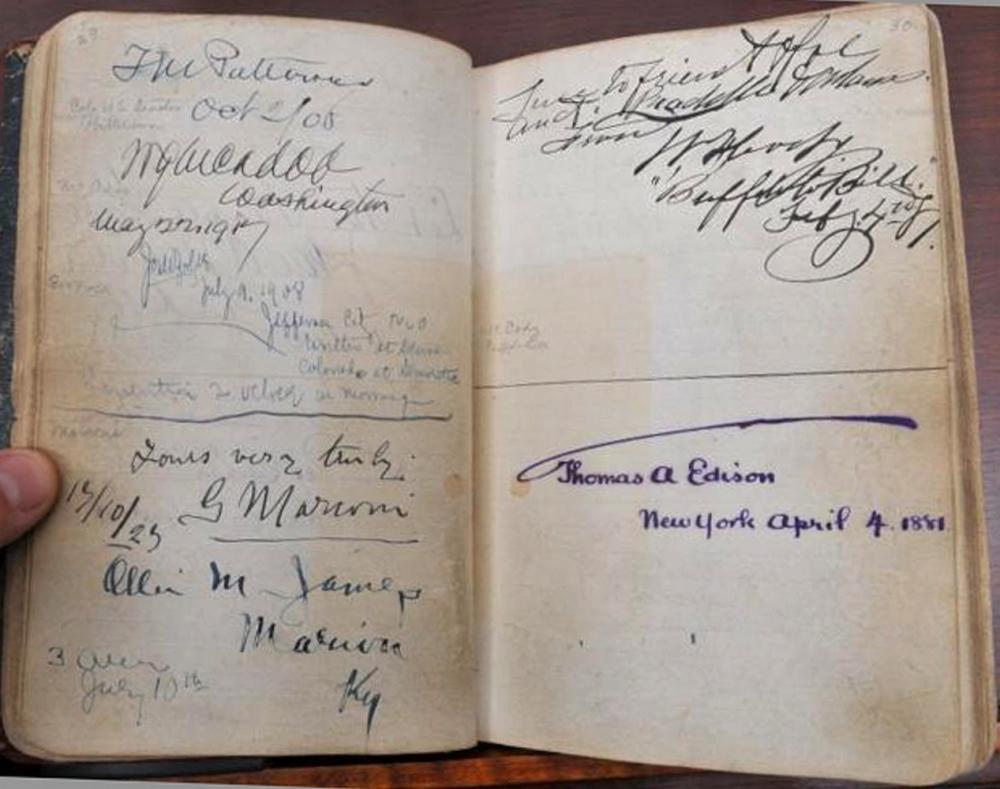
THE FINEST, MOST REMARKABLE AND MYSTERIOUS AUTOGRAPH ALBUM EVER OFFERED FOR SALE! Over 400 Entries Spanning 200 Years of History From Industrialist Peter Cooper (born 1791) to WWI Ace Major George A. Vaughn (died 1989) “Autograph Albums,” first known by their Latin name, “Album Amicorum” or “Book of Friends,” have existed for hundreds of years. They originated in 16th-century Germany and Holland where university students collected signatures and sentiments written by their professors and classmates into books of blank pages. Autograph albums’ popularity in America peaked during the 19th century, when it was not unusual for collectors of all ages to preserve signatures from presidents, politicians, clergymen, academics, and other notable personalities in small, easy to carry, leather or cloth bound albums. The range of the collection and the method by which the signatures were acquired were limited only by the owner’s personal interests and tenacity to obtain the desired autographs. Many autograph albums from the 19th century that appear on the market are filled with names of U.S. senators and congressmen, suggesting that either the autograph collector had political connections, or the book was passed around the halls of congress or the White House by someone who did. During the Civil War, signatures were collected in such albums and then auctioned at Union “Sanitary Fairs” to benefit the U.S. Sanitary Commission. Lincoln and his cabinet were known to have occasionally added their signatures to autograph albums for these wartime fundraisers. Collecting signatures into blank books diminished in the 20th century, though interesting examples can still be found, though overwhelmingly with entertainment or sports personalities signatures. The autograph album of Lafyette F. Cornwell, however, stands head and shoulders above any other collection ever to appear on the market. The range and rarity of the autographs and sentiments penned by so many well-known personalities from across the country, including those of foreign celebrities who visited the U. S., combined with Cornwell’s unrelenting determination to obtain them, doubtlessly in person, is astonishing. Yet, Cornwell’s collection of more than 400 examples is especially unusual, even mysterious: oftentimes the signatures of individuals were combined on the same page or on a facing page with others in the same field of endeavor, though separated by months, years, or even decades. Additionally, there is the baffling question of how Cornwell could have met the many celebrities whose signatures he sought. The question remains unanswered and is, perhaps, unanswerable. But unquestionably there was, to borrow from “Hamlet,” “a method to his collecting madness.” Even during Cornwell’s lifetime, his remarkable album received well-deserved recognition when it was featured in the “New York Times” Sunday magazine section of November 13, 1927. The unnamed reporter describes how Lafayette Cornwell, a (former) jeweler from Yonkers, NY, managed to gather the signatures of no less than eight presidents (Grant, Hayes (twice!), Arthur, Cleveland, Theodore Roosevelt, Taft, Wilson and Hoover) and several First Ladies, including Mary Lincoln (who signed the album with a very rare form of her signature, “Mrs. Abraham Lincoln”). In addition to Union and Confederate Generals, admirals, WWI aces, explorers, opera singers, or inventors like Steinmetz and Edison and celebrities including Houdini, Valentino and “Buffalo Bill” Cody, many famous women are also represented: Lucy Stone (who penned, “The consent of the governed woman is as necessary to the success of the principle of a representative government by the people as is the consent of the governed man”); Helen Keller (“Keep your face to the sunshine and you cannot see the shadow”); Jane Addams (“The new Humanitarianism! The Progressive Party!); and the great thespian Sarah Bernhardt whose autograph Cornwell obtained only after agreeing to her specific demand. As the “Times” reports: “Sarah Bernhardt’s signature was placed last, at her own insistence, Mr. Cornwell says. The French actress received him in her private [railway] car at Pueblo, Col., while on her American tour in 1911, and granted his request—but she specified: ‘I write the last! No one must write after me!’ So the great French actress placed her signature on the last flyleaf in the album and, to make assurance double sure, pasted the flyleaf to the back cover,” There it still remains, permanently affixed to the back cover, more than 100 years later. Beginning in December 1880, Cornwell began to collect autographs of many personalities who lived in, performed, or traveled to Manhattan and Brooklyn. Lion Heart Autographs prepared several lengthy Excel spreadsheets dedicated to tracking down Cornwell’s whereabouts, and delving into contemporary newspaper reports that suggest Cornwell likely attended many public lectures, religious meetings and performances in search of his quarry. In 1889, Cornwell moved from Yonkers to Pueblo, Colorado and in 1896 set up a jewelry shop at 222 North Main Street. He made a name for himself in Colorado for offering high quality jewelry and timepieces and was “considered one of the finest watchmakers in the West and enjoy[ed], without question, the largest repair trade west of Kansas City, being assistant chief watch inspector for the Denver and Rio Grande Railroad, Missouri Pacific, Colorado and Southern Railroad. All employees entering Pueblo [were] required to register their watches at his store each week. His trade extend[ed] all over Eastern and Southern Colorado, Western Kansas and Northern New Mexico,” (“Camp and Plant,” The Colorado Fuel and Iron Company, June 13, 1903.) Here is an image of Cornwell’s jewelry store in Pueblo: http://cdm16620.contentdm.oclc.org/cdm/ref/collection/p16620coll9/id/47 Working for the railroad allowed Cornwell to travel to different parts of the country and add names to his growing collection. In a letter, included in this lot, Cornwell writes his 53-year-old niece in 1933, two years after the last dated entry in his precious album: “To my dear Niece, Mabel Bentley Barteau, 17 Livingston Ave. Yonkers, NY…To you I take great pleasure in presenting this Book of autographs of distinguished persons in all walks of life and various countries. It represents many years of strenuous efforts and the traveling of many thousands of miles and much expense in meeting and securing of the autographs of the persons of note here inscribed and the sentiments they express. Wishing you a Merry Christmas and a Happy New Year, Your Uncle, L.F. Cornwell.” Cornwell then, poignantly, adds his own autograph to the album with a holiday presentation inscription. What the “New York Times” article failed to describe, and what became clear only after extensive research, is that Cornwell did not collect autographs in typical, chronological order. He purposely asked signers to inscribe their names and sentiments in different parts of the album, either purposely selected at that moment, or add their autograph onto blank pages where Cornwell reserved space for future contributors, so that a signature was or would be shared with a person in a related profession or endeavor. How did Cornwell convince people who would normally have been reluctant to add their signature into an autograph album owned by a stranger (Herman Melville, Walt Whitman, Oscar Wilde, and Louisa May Alcott, for example) or who had, literally, just stepped off the boat in New York to do so? King Kalakaua of Hawaii, for example, signed his name adding “Aloha oe,” after registering at New York’s Hotel Brunswick, on September 23, 1881, the very day he arrived from Scotland aboard the “Celtic,” as part of his historic 281-day round-the-world-tour to save his people and Hawaiian culture. Oscar Wilde, too, wrote out several lines of poetry in Cornwell’s album within days of his arrival in New York to begin his memorable cross-country tour. Former President Rutherford B. Hayes signed his name on his 59th birthday, the same day he checked into a New York hotel. Equally perplexing is how Cornwell managed to approach and then obtain the signatures of aviators, Fitzmaurice, Koehl and Huenefeld on the same day as their New York City ticker tape parade, April 30, 1928, that celebrated the first East-West crossing of the Atlantic Ocean. What kind of connections did a former jeweler from Yonkers have to meet them? Yet, the single album page reveals even more: On the same page, but five months later, is the signature of Clarence Alvin “Duke” Schiller, the Canadian pilot who rescued the above three aviators after their plane, the “Bremen,” crash landed on Greenly Island, Quebec, on April 13. Also, on the same page is the undated signature of Clarence Chamberlin, the now, nearly forgotten American pilot who made the second (after Lindbergh) but much longer West to East flight across the Atlantic. Sixty pages later, is the signature of Erwin S. Davis, the radio operator who received the wireless message from Greenly Island that Huenefeld, Koehl and Fitzmaurice had safely crossed the ocean. Davis sent the message to the Associated Press, which broadcast the story around the world. Beneath his signature, Davis added, “Manchester, NH, Relayed radiogram April 13, 1928,” the date the crew of the “Bremen” crash landed in Canada. Herman Melville signed Cornwell’s autograph book with a quotation from Shakespeare’s “Henry IV, Part 1”. Decades later this unusual entry became the subject of some serious scholarly research (see “Melville,” below, under WRITERS) when the album was shown to a librarian at the New York Public Library in the 1940s, years after Cornwell’s death. Who brought the book to the library and why? Adding to the mystery is that Melville’s signature on page 114, and dated March 2, 1882, was written the same day as the signature of Edward Stiles Stokes, a notorious oilman who, in a jealous rage, murdered his business partner, “Diamond” Jim Fisk, but at the time was the well-respected proprietor of the fashionable Hoffman House hotel. Stokes’ signature, however, appears 12 pages after Melville’s and not on the same page as one would expect if the album had been assembled in chronological order. Did Cornwell meet the author of America’s greatest novel, “Moby Dick,” then eking out a living as a U.S. Customs inspector living on Manhattan’s East 26th Street, and then walk over to the nearby Hoffman House on Broadway between 24th and 25th streets and ask Stokes for his autograph? Or, perhaps, Melville was dining at the hotel and Cornwell recognized him? On the same page as Melville’s signature is that of American pastor and hymnist, Ray Palmer, but that autograph was added seven months after Melville’s. George Kennan, the American explorer and cousin, twice removed, of American historian George F. Kennan, signed the same page as Stokes, but nine years later. Is there a connection yet to be discovered between Kennan and Stokes, Melville and Palmer? Similar juxtapositions and associations abound throughout the album and can be explored in greater detail in the description below. It is mind-boggling to realize that Cornwell’s unique album spans the period from someone born during the presidency of George Washington (Peter Cooper) to one who died during the term of George H.W. Bush (George Vaughn). Lafayette Cornwell’s autograph album, a remarkable time capsule of America’s culture and history, reflects a single-minded collector’s fifty-year passion. AUTOGRAPH ALBUM. First flyleaf (recto): “Autograph Album of L.F. Cornwell c/o C.E. Barto [sic.], R. Route No 3, Grand Junction, Colo.” First flyleaf (verso): “Property of L.F. Cornwell. Inscribed by Cornwell, “To my niece Mabel Bentley Barteau [1880-1968] I herewith present this autograph album wishing you a Merry Christmas and a Happy New Year, Your uncle, L.F. Cornwell. Grand Junction, Colo. December 20, 1933.” The album pages have been numbered in pencil in an unknown hand: 1-8; 12-164. The album’s internal appearance does not suggest that leaves 9-11 were removed; it is more likely that the pages were incorrectly numbered. Binding: Brown calves’ leather with the word “AUTOGRAPHS” printed in gold on the cover. CORNWELL, LAFAYETTE F. ALS. 1p. 8vo. Grand Junction, December 20, 1933. “To my dear Niece, Mabel Bentley Barteau, 17 Livingston Ave. Yonkers, NY…To you I take great pleasure in presenting this Book of autographs of distinguished persons in all walks of life and various countries. It represents many years of strenuous efforts and the traveling of many thousands of miles and much expense in meeting and securing of the autographs of the persons of note here inscribed and the sentiments they express. Wishing you a Merry Christmas and a Happy New Year, Your Uncle, L.F. Cornwell.” PHOTOGRAPHS: Photo No. 1: A carte-de-visite photograph of a young Lafayette Cornwell taken by C.R. Clark, 338 River Street, Troy, (NY). Circa mid-1870s. Photo No. 2: An image of a seated Cornwell holding his autograph book. Photo No. 3: Postcard photograph of Cornwell’s sister, Mary Cornwell Barteau (1854-1930) and her three daughters, Myrtle, Mable and Sylvia. Photo No. 4: Photograph of Lafayette and his sister Mary standing in a garden. The verso has the address 17 Livingstone Ave. (Yonkers). The album is somewhat worn, as can be imagined, after so much handling over the years; details available on request. *Names are organized by subject area and in the order in which they appear in the album. **Note that “Signature” may also include incidental inscription or the addition of a place and date. ***Women are denoted by a [w] after their name ARTISTS: Renouf, Emile. (1845-1894). French painter. Signature. November 6, 1886. Renouf was likely part of the French entourage that attended the ceremonies for the opening of the Stature of Liberty, of which there are numerous other examples in the album. He painted a picture of the Brooklyn Bridge in 1889. Page 156. Bartholdi. Frederic A. (1834-1904). French sculptor of the Statue of Liberty. Signature. November 6, 1886. November 6 was the last evening during which the Statue of Liberty was illuminated free of charge for a week using a steam plant located on Bedloe’s Island; Bartholdi attended that occasion. Page 158. ASTRONOMERS: Howe, Herbert A. (1858-1926). American astronomer. AQS. June 6, 1918. Howe quotes from the Bible’s Psalm 19:1: “’The heavens declare the glory of God, and the firmament showeth his handiwork.’ The eclipse of June 8, 1918 is one of the most impressive of celestial phenomena…[signature] Director of Chamberlin Observatory, University of Denver…” This was the last solar eclipse to cross the entire contiguous United States until 2017. An attempt to validate Einstein’s Theory of Relativity had been planned, but cloud cover at the designated location prevented it. Page 73. Lewis, L. Howell. (?-?). Astronomer. Signature, beneath which he has added, “Total eclipse, Denver, Colo, June 8th, 1918.” Page 73. Stroemgren, Elis (1870-1947). Danish astronomer. Signature, below which he has added, “Copenhagen Observatory. October 8, 1917.” Page 75. Frost, Edwin B. (1866-1935). American astronomer. Signature, beneath which he has added, “May 28, 1918, Total Eclipse Denver, Colorado.” An asteroid and crater on the far side of the moon are named in his Frost’s honor. Page 75. Cannon, Annie Jump [w]. (1863-1941). American astronomer who developed the Harvard Classification Scheme, organizing and classifying more than 350,000 stars based on temperatures and spectral types. Cannon was the first women to receive an honorary doctorate from Oxford University. Signature. June 8, 1918, beneath which she has added, “Harvard College Observatory, Cambridge, Mass.” Page 75. Proctor, Richard A. (1837-1888). English astronomer. AQS. Brooklyn, April 12, 1881. Proctor quotes Shelly’s “Queen Mab:” “Spirit of nature here! / In this interminable wilderness of worlds / At whose immensity e’en soaring fantasy staggers / Here is thy fitting temple / Yet not the lightest leaf / That quivers to the passing breeze / Is less instinct with thee,” Page 76. AVIAT0RS: Hambleton, John A. (1897-1919). WWI American Army pilot and one of three co-founders of Pan Am Airways; Hambleton flew on Pan Am’s inaugural flight to Panama with Charles Lindbergh. ANS. “May American aviation remain impressive (?). Victory Loan, Flying Circus, Denver May 2nd, 1919.” (See Fullard below). Page 55. Fitzmaurice, Major James. (1898-1965). Navigator of the “Bremen,” on the first successful East-West flight across the Atlantic Ocean from April 12-13, 1928. Signature April 30, 1928. Signed the day he and his crew arrived in New York City for a tickertape parade. Page 81. Koehl, Herman. 1888-1938). Pilot of the “Bremen,” on the first successful East-West flight across the Atlantic Ocean from April 12-13, 1928. Signature April 30, 1928. Signed the day he and his crew arrived in New York City for a tickertape parade. Page 81. Huenefeld, Ehrenfried Guenther Freiherr von. 1892-1929). Initiator and participant in the flight of the “Bremen,” on the first successful East-West flight across the Atlantic Ocean from April 12-13, 1928. Signature April 30, 1928. Signed the day he and his crew arrived in New York City for a tickertape parade. Page 81. Schiller, Clarence Alvin “Duke.” (1899-1943) Pilot of the Canadian aircraft that rescued the crew of the “Bremen” when it crash landed due to a fuel shortage on Greenly Island, Quebec, in the Strait of Belle-Isle on April 13. Signature. New York, September 24, 1928. Page 81. Chamberlin, Clarence D. (1893-1976). American pilot who made the second (after Lindbergh) and longer distance East-West flight across the Atlantic Ocean, and the first to carry a passenger on that stretch. Signature. Page 81. Paulhan, Louis. (1883-1963). Celebrated French aviator. Signature. Denver, February 2, 1910. Signed during Paulhan’s extended tour throughout the United States where he took William Randolph Hearst on his first flight, but failed to do so for William Boeing whose financial support he could have used, and was sued by the Wright Brothers for patent infringement. Additionally signed by his wife Charlotte Paulhan [w]. Page 117. Beachey, Lincoln J. (1887-1915). American aviator, stunt flyer and barnstormer; known as “The Man Who Owns the Sky.” Signature. Pueblo, October 9, 1914. Signed upside down (!) during one of Beachey’s airplane races against racecar driver, Barney Oldfield (see CELEBRITIES, below). During 1914, Beachey performed in front of more than 17 million spectators. His death inspired the popular jump rope rhyme: “Lincoln Beachey thought it was a dream, To go up to Heaven in a flying machine. The machine broke down and down he fell. Instead of going to Heaven he went to…” Page 117. Holliday, Major F. P. (?-?). Royal Air Force pilot during WWI; awarded the Distinguished Service Order and the Military Cross. Signature. May 2, 1919, beneath which he has added, “British Royal Air Force, Victory Loan Flying Circus.” Page 117. Hall, Lieutenant Bert. (1885-1948). One of America’s first fighter pilots and one of the seven original members of the Lafayette Escadrille which flew during WWI. Signature. May 2, 1919. Page 119. Fullard, Major Philip F. (1897-1984). Royal Air Force ace during WWI; shot down four German enemy aircraft in a single day. On another occasion, Fullard and another pilot shot down seven planes before flying back to base for breakfast. ANS. May 2, 1919. “Major Royal Air Force, 60 Hun Planes. With the Victory of our Flying Circus, I have learned to appreciate America and the Americans at their true worth.” (See Hambleton above). Page 133. Wellman, Walter. (1858-1934). American explorer and aeronaut. Signature. Denver, July 9, 1908. Wellman was likely in Denver to attend the Democratic National Convention held at this time. He was also in-between unsuccessful attempts to reach the North Pole using an airship. Page 136. Rickenbacker, Captain Eddie. (1890-1973). America’s most successful WWI ace; MOH winner. Rickenbacker was also an automotive designer and president of Eastern Airlines. ANS. (Denver), August 4, 1925. “In appreciation of the City of Denver’s Hospitality.” Page 143. Vaughn, Jr. Major George A. (1897-1989) America’s second ranking WWI ace. Signature followed by “A[ir] S[ervice] N[ew] Y[or]) N[ationa] G[uard].” July 22, 1928. Vaughn is the most recently deceased person represented in Lafayette Cornwell’s autograph album. Page 143. Elder, Ruth [w]. 1902-1977). American aviatrix known as the “Miss America of Aviation” and “the Flying Flapper;” a charter member of the Ninety-Nines. Signature, below which she has added, “New York – Paris attempt / Oct. 11-13, 1927.” March 19, 1928. She and her co-pilot George Haldeman were forced to ditch their plane about 360 miles NNE of the Azores where they were rescued by a Dutch tanker. Despite her failed attempt, Elder launched a successful lecture and Hollywood career. Page 145. Davis, Erwin Stuart. (?-?). Received the wireless message from Greenly Island that Huenefeld, Koehl and Fitzmaurice had successfully made the first East to West airplane crossing of the Atlantic. Davis sent the message on to the Associated Press, which broadcast the story around the world. Signature, beneath which Davis has added, “Manchester, NH, Relayed radiogram April 13, 1928,” the date when the crew of the “Bremen” landed in Southern Labrador. Page 146. Harding, John T. “Jack.” (1896-1968). Harding was part of an eight-man, U. S. Army Service team that completed the first circumnavigation of the world by air in 1924. The 26,345-mile trip took 175 days. Harding was part of a crew of four on board the “New Orleans” that completed most of the trip. ANS. April 30, 1925. “The only ring I ever gave away was the one I put on Mother Earth.” Harding and Lowell Thomas engaged in a national lecture tour about the historic flight during 1925. (Signed the same day as Lowell Thomas; see CELEBRITIES, below.) Page 147. Earhart, Amelia [w]. (1897-1937). American aviatrix and author; first woman to fly solo across the Atlantic Ocean (as a passenger) on June 17-18, 1928. On May 20, 1932, Earhart became the first woman to pilot a plane solo across the Atlantic. On July 6,1928, the date she signed Cornwell’s autograph album, Earhart received the New York City Medal following a parade with pilots William Stultz and Luis Gordon. Page 149. CELEBRITIES & SPORTS: Oldfield, Barney. (1878-1946). American racecar driver. AQS. “You know me,” Oldfield’s classic catchphrase. October 9, 1914. Signed during one of his racing car competitions against stunt pilot Lincoln J. Beachey (see AVIATORS, above). Page 25. DePalma, Ralph. (1882-1956). Italian American racecar driver. Signature. July 16, 1925. Page 25. Cody, William F. “Buffalo Bill.” (1847-1917). American scout and showman. MOH winner. AQS. “True to friend & foe, from W. F. Cody, ‘Buffalo Bill,’ Feby. 4th, 81.” Page 30. Baker, Lewis H. “Johnny.” (1869-1931). Joined W. F. Cody’s Wild West Show at the age of 14, as “The Cowboy Kid.” Signature, below which he has written, “A Marksman, September 3rd, 1908.” Page 31. Oropeza, Vicente. (?-?). Joined W. F. Cody’s Wild West Show as the first “Trick and Fancy Roping” champion. Signature, below which he has added, “Sept. 3, 1908. Mex.” Page 31. Dempsey, Jack. (1895-1983). American world heavyweight boxing champion, known as “The Manassa Mauler.” ANS. September 28, 1927. “To a good Man, Laf. Cornwell…” Signed six days after the famous Dempsey-Tunney rematch, known as “The Long Count.” Page 59. Flynn, “Fireman Jim.” (1879-1935). American boxer and the only fighter ever to knock out Jack Dempsey. Signature. Pueblo, May 16, 1913. Page 65. Peterson, Charles. (1880-1962). American billiard player and teacher; known as the “Missionary of Billiards.” AQS. December 10, 1917. “Show me a Billiard Shot I can’t make.” (See W. F. Hoppe, below). Page 79. Windsor, William. (1857-1922). American phrenologist and promoter of the Sand Cure (“Eat Some Sand”) and Vitosophy; a typical 19th century quack. AQS. Pueblo, May 3, 1898. “I hold all in love and in kindness / My foes have themselves to endure / I haven’t the time to be angry / When smiles and god nature will cure / I revel in joys of the present / I do all the good that I can / Tomorrow I’ll deal with its problems / And live up to the part of a man.” Published as “Thoughts Serene,” in Vol. 5, No. 8 of “Ye Quaint Magazine.” Page 113. Hoppe, W. F. (?-?) Turn of the century champion billiard player. Denver, (December) 10, 1917. (See Charles Peterson above) Page 127. Fitzsimmons, Bob. (1863-1917). British boxer and the world’s first three-division champion. Ranked #8 in “The Ring’s” greatest punchers of all time. AQS. July 9, 1917. “If you must fight hit first.” Fitzsimmons died of pneumonia five months later in Chicago. Page 135. Thomas, Lowell. (1892-1981). American writer and broadcaster best remembered for publicizing Lawrence of Arabia whom he had met in 1918. ANS. April 30, 1925. “May you live forever and may your shadow never grow less.” Page 149. Thomas had made his first of many radio broadcasts the previous month. Signed the same day as “Jack” Harding, see AVIATORS above.) Page 149. COMPOSERS & MUSICIANS: Busoni, Ferruccio. (1866-1924). Signature, beneath which he has added, “Festival.” Denver, 1910. Page 3. Arbuckle, Matthew. (1828-1883). Scotch-born, American Cornettist. AMusQS. Five measures marked “Dolce.” New York, December 16, 1880. Page 13. Sousa, John P. (1854-1932). AMusQS. Three measures from his most famous composition, “The Stars and Stripes Forever.” Page 13 Pachmann, Vladimir de. (1848-1933). Russian pianist. Signature. January 12, 1924. Page 21. Stebbins, George Coles. (1846-1945). Gospel song writer. AQS. Brooklyn, October 13, 1881. A biblical quotation from Proverbs 11: 30: “He that winneth souls is wise.” Page 37. Zach, Max. (1864-1921). Ukrainian-born, musician and conductor of the Saint Louis Symphony Orchestra. Signature. St. Louis, 1910. Page 59. Oberhoffer, Emil. (1867-1933). German-born, American conductor; founder of the Minnesota Orchestra. Signature. Denver, April 19, 1910. Page 59. Arditi, Luigi. (1822-1903). Italian violinist, composer and conductor. AMusQS. (Unidentified). New York, April 5, 1881.Signed while conducting operas at NY’s Academy of Music. See OPERA SINGERS below.) Page 61. Elman, Mischa. (1891-1967). Ukrainian-born, American violinist. Signature. Denver, April 4, 1918. Page 61. Hofmann, Josef. (1876-1957. Polish-born, American pianist and inventor. AMusQS. Denver, 1921. Two measures from an unidentified composition marked “Theme.” Page 111. Ysaye, Eugene. (1858-1931). Belgian violinist, composer and conductor. Signature 1913. Page 121. Ward, Charles F. (?-?). Conductor and band master. ANS. “With all good wishes of the allied Band … Yours for luck.” Page 139. Godowsky, Leopold. (1870-1938). Polish-American pianist and composer. Signature. Denver, February 14, 1921. Page 153. EXPLORERS: Wallace, Alfred Russel. (1823-1913). British naturalist and explorer who reached similar conclusions about Natural Selection as Darwin. ANS. “With the compliments of a Fellow Truth-Seeker, A. Wallace, M.D., 146 Harley Street, London, W., England.” Page 41. Baker, Samuel. (1821-1893). English explorer (discovered Lake Albert), naturalist, big game hunter, and writer. Served as Governor-General of the Equatorial Nile Basin. Signature. October 4, 1881. Baker went to the Rocky Mountains in 1881 to hunt elk, grizzly bear and buffalo. Page 80. Hayes, Isaac Israel. (1832-1881). American explorer, physician and politician. His 1860-1861 expedition to Ellesmere Island was immortalized in F. E. Church’s 1865 painting, “Aurora Borealis.” Signature. New York, November 30, 1881. Hayes died of a heart attack less than three weeks after signing Cornwell’s autograph album. (Signed the same day as General Abner Doubleday). Page 100. Danenhower, John W. (1849-1887). U. S. Naval officer and explorer. Signature, below which Danenhower has added, “Lt. U. S. N. ‘Jeannette.’ Brooklyn, October 3, 1882.” Danenhower served on board the “USS Jeannette” during its Arctic voyage but was rendered unfit for duty in December 1879 due to an inflammation of his eye from syphilis. In June 1881, the “Jeannette” was crushed by ice forcing the crew to abandon ship. Three separate boats reached open water but were separated by storms and only one returned to port. On May 28, 1882, Danenhower arrived in the U.S. where he subsequently wrote “Lieutenant Danenhower’s Narrative of the Jeannette.” Failing health and a serious naval accident in 1887 precipitated his suicide. His son was a commander of the submarine “Nautilus,” and his grandson, a captain in the Coast Guard during WWII became known as the author of “The Man in the Gray Flannel Suit.” (See George W. Melville, below.) Page 116. Stanley, Henry M. (1841-1904). Welsh American journalist and explorer; famous for finding the explorer and missionary, David Livingstone. Signature. Pueblo, March 5, 1891. At this time Stanley was on tour through the United States aboard a special Pullman-car named the “Henry M. Stanley.” Page 120. Kennan, George. (1845-1924). American explorer of the outer regions of the Russian Empire. AQS. Pueblo, April 4, 1890. At first supportive of the Russian monarchy, Kennan changed his mind after meeting exiled dissidents on his travels. He became a staunch critic of the Russian Imperial system and actively lectured throughout the United States in 1890-91 in support of a Russian Revolution. Here, Kennan quotes an old Russian proverb that suggests the Russian authorities are not concerned about local interests, “God is high above and Tsar is far away.” Page 126. Cook, Frederick A. (1865-1940). U. S. Arctic explorer best remembered for having falsely claimed to have reached the North Pole before Admiral Peary. Signature above which he has added, “Yours with Arctic…(?)” Pueblo, February 28, 1911. Page 145. McGee, Paul. (?-?). Radio technician who assisted the 1925 MacMillan Arctic Expedition. Signature. “…Radio Opr. 1925 MacMillan Arctic Expedition ‘S. S. Peary.’” Page 145. MacMillan, Donald B. (1874-1970). American Arctic explorer. Signature. November 6, 1925. Page 145. Byrd, Rear Admiral Richard. (1888-1957). American aviator, polar explorer and MOH recipient. Signature. June 25, 1926. A testimonial in Byrd’s honor was held this day at New York’s Carnegie Hall. Page 145. Greely, Adolphus W. (1844-1935). U. S. Army officer and Arctic explorer; MOH recipient. Signature. November 21, 1884. (Signed the same day as Arctic explorer, George W. Melville). Page 146. Stefansson, Vilhjalmur. (1879-1962). Canadian Arctic explorer and ethnologist. Signature. Denver, December 8, 1924. Page 146. Melville, George W. (1841-1912). American Arctic explorer; crew member of the “USS Jeannette,” who commander the only boat of three to return home safely. (See John W. Danenhower, above). Signature. New York, November 21, 1884. (Signed the same day as Arctic explorer Adolphus Greely). Page 146. Amundsen, Roald. (1872-1928). Norwegian Arctic and Antarctic explorer; first to reach the South Pole in 1911 ahead of Captain Robert F. Scott. Signature. October 19, 1925. Page 149. Amundsen had just returned from his failed attempt to fly over the North Pole and was in the United States to raise money for financing an airship flight over the Pole which was attained on May 12, 1926. A few days after signing Cornwell’s album Amundsen met with President Coolidge in Washington, DC. Page 149. FIRST LADIES AND FIRST FAMILIES: Grant, Julia D. [w]. (1826-1902). Signature. December 4, 1880. Written on the same page as her husband. Page 5. Roosevelt, Theodore. Jr. (1887-1944). Eldest son of President Roosevelt, Governor General of the Philippines and Governor of California. Signature, beneath which he has added “American Legion.” Roosevelt was one of the organization’s founders. September 10, 1919. Page 8. Hayes, Lucy W. [w]. (1831-1889). Signature. (New York) October 6, 1881. Written on the same page as her husband, who had arrived in New York City two days earlier. (Signed on the same day as Union Civil War General William Belknap, writer Edgar Fawcett, and French historian Achille de Rochambeau). Page 63. Lincoln, Mary [w]. (1818-1882). Rare signature as “Mrs. Abraham Lincoln.” October 13, 1881. Mary Lincoln came to New York City for medical treatment and stayed at Manhattan’s Clarendon Hotel. She was nearly blind and suffered from severe back pain, which eventually paralyzed her. This is an extremely rare form of her signature, which faces the page of the only other (future) widow of an assassinated president up to that time, Lucretia Garfield. Page 87. Garfield, Lucretia [w]. (1832-1918). Signature as First Lady. April 18, 1881. Signed the same day as American children’s book author, Mary Mapes Dodge.) Page 88. Garfield, James Rudolph. (1865-1950). Son of President James Garfield, and the 23rd U. S. Secretary of the Interior under President Theodore Roosevelt. Signature. August 4, 1905 (?). Garfield has signed his name beneath his mother’s 24 years later. Page 88. Wilson, Margaret Woodrow [w]. (1886-1944), Eldest daughter of President Wilson who briefly served as “First Lady” in-between her father’s marriages. Later in life she joined an ashram in India and was known as “Nistha.” Signature. Denver. Page 119. Hoover, Lou Henry [w]. (1874-1944). Signature. July 4, 1928. Page 151. ILLUSTRATORS AND CARTOONISTS: McCutcheon, John T. (1870-1949). Pulitzer Prize-winning American newspaper cartoonist; known as the “Dean of American Cartoonists.” Signed sketch of a boy holding a dog on a leash. August 19, 1912. Page 77. Steele, A. W. (1862-1925). American political cartoonist on staff at the “Denver Post” and “Rocky Mountain News.” Signed sketch of Uncle Sam in profile. Page 79. Johnstone, Will B. (1883-1944). American cartoonist and writer, which included scripts for the Marx Brothers’ first two movies. Signed sketch of a smiling man hanging from gallows, exclaiming, “No more ideas!” Johnstone has added, “End of a perfect day.” 1929. Page 83. Finch, Doc Bird. (1879-1950). Denver newspaper cartoonist. A sketch of his famous “Little Doc” bird banging a hammer against a wall, with the caption, “Gee I’m bustin’ into big company.” Page 99. Cornwell, Dean. (1892-1960). American illustrator, known as the “Dean of Illustrators.” Signed color sketch of a bearded man wearing a turban. New York, 1927. Page 129. INVENTORS, FINANCIERS, INDUSTRIALISTS & PHILANTHROPISTS: Moffat, David. (1839-1911). Railroad and mining businessman with interests in the Denver area. Signature. Denver. Page 6 Morgan, G. D. (died 1915). Banker and cousin of J. P. Morgan. Signature, beneath which he has added, “I cheerfully comply with your request.” New York, December 4, 1880. Page 7. Reid, James D. (?-?). Scotsman who became general superintendent of the Magnetic Telegraph Company. AQS. New York, December 7, 1880. Six lines from Rossitor Johnson’s poem, “The Victory” referring to the telegraph. Page 9. Bausch, John Jacob. (1830-1926). German born, American businessman; co-founder of optical manufacturer, Bausch and Lomb. Signature, beneath which he has added, “Rochester N.Y., August 25, 1925.” Page 17. Cooper, Peter. (1791-1883). Industrialist and inventor; built the first American steam locomotive and founded the Cooper Union. His signature is from the earliest born person in Lafayette Cornwell’s autograph album. AQS. January 11, 1881. Portions of this text, according to the May 31, 1882, issue of the Indiana State Sentinel, were given by Cooper “to a social gathering of aged men in Boston.” The text is: “Mankind throut the world, will improve, and beter there condition, in proportion, as they come , to se, know, and understand, That, what a man soweth, That., must he also reap. Some where, Some how, And at Some time. And that by the operation of a reighn of laws, so wise and good, they will never require to altered, amend or revoked.” Page 18. Marconi, Guglielmo. (1874-1937). Italian inventor of the radio telegraph. Signature. October 13, 1923. His signature is opposite Thomas A. Edison’s, written 42 years earlier. Page 29. Edison, Thomas A. (1847-1932). American inventor and businessman. Signature, beneath which he has added, “New York, April 4, 1881.” (Signed the same day as actress Mary Siddons and temperance orator, John Gough.) Page 30. Gray, Elisha. (1835-1901). Telephone and electronic music pioneer. AQS. New York, February 9, 1881. “’Who learns and learns but / acts not what he knows / Is one who plows and flows / but never sows…Harmonic telegraph invented Ap—1874, Speaking telephone invented 1875.” Page 32. Steinmetz, Charles P. German-born, American engineer and inventor; promoted the development of electrical AC. ANS. “At my first trip to the great breadth & width of our country, enjoying the hospitality of Denver.” Page 37. Humphreys, Albert E. (?-?). “The Wildcatter Deluxe” known for his oil strikes in Wyoming, Oklahoma and Texas. Namesake of the Grant-Humphreys Mansion in Denver. Signature. Denver, July 26, 1925. Page 43. Gould, Jay. (1836-1892). Railroad developer and “Robber Baron.” Signature. May 21, 1892. Page 49. Gould, Kingdon. (1887-1945). Financier and champion polo player. Son of Jay Gould. Signature. July 24, 1908. Page 49. Gould, Helen Miller (nee Shepard) [w]. (1868-1938). Philanthropist and daughter of Jay Gould. AQS. “This is one of my favorite verses,” quoting the Bible, John 17:3: “And this is life eternal, that they might know thee the only true God, and Jesus Christ, whom thou hast sent.” Page 49. Field, Cyrus W. (1819-1892) Businessman and financier responsible for laying the first telegraphic cable across the Atlantic Ocean. (Brother of D. D. Field and Henry M. Field; see LAWYERS and SOCIAL and SOCIAL SERVICE FIGURES below). Signature. June 4, 1881. Page 50. Gatling, Richard J. (1818-1903). American inventor best known for the Gatling Gun, considered the first machine gun. AQS. Hartford, July 14, 1881. “Do right and act justly. Pleasure will come in due season.” Page 52. Mudge, Henry Uri. (1856-1920). Railroad executive; president of the Denver & Rio Grande Railroad. Signature. Pueblo, September 27, 1910. Page 65. Bush, Benjamin F. (1800-1927). Executive for numerous railroad lines including the Denver & Rio Grande Railroad. April 27, 1912, at the time Bush was president of the above-mentioned railroad. Page 65. Pullman, George M. (1831-1897). American engineer and industrialist; designed and manufactured the Pullman sleeping car. Signature. New York, September 17, 1881. Page 66. Burns, William J. (1861-1932). Known as “America’s Sherlock Holmes,” and the founder of the William J. Burns International Detective Agency.” Director of the Bureau of Investigation, the predecessor to the FBI. His agency was famously involved in the Leo Frank murder trial. Signature. Page 77. Rockefeller, John D., Jr. (1874-1960). Financier and only son of John D. Rockefeller; builder of Rockefeller Center. Signature. Pueblo, October 2, 1915. Rockefeller has signed his name beneath that of his father-in-law, Nelson W. Aldrich (see POLITICIANS below). Page 87. Lipton, Thomas. (1848-1931). Scottish merchant and yachtsman. Founder of Lipton Tea. AQS. May 4, 1926. Lipton quotes American-born, contemporary English department store magnate, Henry Gordon Selfridge, “There’s no fun like work.” Page 97. Stokes, Edward Stiles. (1841-1901). American oilman who shot and killed his business partner and rival for the affection of Josie Mansfield, James “Diamond Jim” Fisk. Stokes later became the proprietor of the Hoffman House hotel. Signature. Hoffman House, New York, March 2, 1882. Page 126. (Signed the same day as Herman Melville; see WRITERS below). Martin, Anna Mebus [w]. (1843-1925). German-born, American rancher and Texas businesswoman who chartered the Commercial Bank of Mason in 1901. AQS. October 8, 1917. A variant of a line from the U. S. Declaration of Independence: “Governments derive their just powers from the consent of the governed.” (See Lucy Stone SOCIAL SERVICE FIGURES on facing page 132). Page 131. Fels, Joseph. (1853-1914). American soap manufacturer, millionaire and philanthropist. Signature. February 22, 1911. Page 134. Eads. James Buchanan. (1820-1887). American civil engineer and inventor; designed the St. Louis bridge in St. Louis that crosses the Mississippi River. Signature, New York, June 10, 1884. Page 138. Leffingwell, Russell C. (1878-1960). American banker and chairman of J. P. Morgan; president of the Council on Foreign Relations from 1946-1953. Signature. February 28, 1927. Page 148. Hoe, Richard M. (1812-1886). American inventor who designed several rotary printing presses beginning in 1843. Signature. New York City. Page 152. Eastman, George. (1854-1932). American businessman and philanthropist; founded the Eastman-Kodak Company in Rochester, NY. Signature. Rochester, November 20, 1925. Page 153. Lipton, Thomas. (1848-1931). Scottish merchant and yachtsman. Founder of Lipton Tea. Signature. London, August 21, 1930. Lipton’s second signature in Cornwell’s autograph album. 1930 was the last year Lipton attempted to win the America’s Cup yacht race. Page 155. De Lesseps, Ferdinand. (1805-1894). French diplomat and developer of the Suez Canal and promoter of the Panama Canal. Signature. November 6, 1886. De Lesseps succeeded Edouard De Laboulaye as head of the Franco-American Union (which promoted the Statue of Liberty’s creation) and attended its unveiling in New York a few days earlier. Page 158. Welby, A. E. (?-?). Superintendent of the Rio Grande Railroad Company. AQS. Denver April 11, 1908. “Do good while you live, you will be a long time dead.” Page 161. Ridgeway, A. C. (?-?). General Manager of the Rio Grande Railroad Company. Signature. Denver, June 1908. Page 161 Andrews, J. B. (?-?). General Consul for the Globe Express Company. Signature. Denver, April 16, 1910. Page 161. Vallery, G. W. (?-?). General Agent for several Western railroad companies. Signature. May 6, 1910. Page 161. Murphy, E. R. (?-?). Accountant for the Rio Grande Western Railway. Signature. Page 161. LAWYERS: Field, David Dudley II. (1805-1894). American lawyer and law reformer; brother of Cyrus Field and Henry M. Field (see FINANCIERS and RELIGIOUS FIGURES). Signature. March 18, 1881. Page 50. Lindsey, Ben. (1869-1943). Denver based pioneer who established the juvenile court system and promoted voter registration reform. AQS. May 9, 1910. “I believe all chillins good if they are only understood.” Page 77. Delmas, Delphin M. (1844-1928). French-born, American defense attorney of Harry K. Thaw in his sensational trial for the 1906 murder of noted architect, Stanford White. Invented the term “dementia Americana” to describe Thaw’s state of mind at the time of White’s murder. ANS. February 7, 1912. “Honored to find myself in such distinguished company.” Page 159. Darrow, Clarence. (1857-1838). One of America’s most famous attorneys and a leading member of the ACLU. Signature. Page 160. Coudert, Frederic R. (1832-1903). Prominent American lawyer of French descent. Signature. November 6, 1886, during the festivities surrounding the unveiling of the Stature of Liberty. Page 160. MILITARY PERSONALITIES: Porter, Fitz John. (1822-1901). Union Civil War General. Signature. January 4, 1881. “With the greatest pleasure and with hearty good wishes…” Page 9. Hobson, Richmond F. (1870-1937). U.S. Navy Rear Admiral and MOH winner in the Spanish-American War. AQS. Pueblo, May 1, 1903. “Both consideration of material and calls of sacred duty demand American Naval supremacy.” Page 15. Schley, Winfield Scott. (1839-1911). U.S. Navy Rear Admiral during the Spanish American War. Signature, beneath which he has added, “Rear Admiral USN, Pueblo, Colo.” Page 15. Sherman, William T. (1820-1891). Union Civil War General. Signature, beneath which he has added, “General, December 22, 1880.” Page 16. Kilpatrick, Hugh J. (1836-1881). Union Civil War General. AQS. January 17, 1881. “Love your country’s flag – as you love your home and God – that both may find in you a brave defender in the years of strife to come—” Page 20. Wood, Leonard. (1860—1927). U.S. Army Chief of Staff and organizer of the Rough Riders with Theodore Roosevelt. MOH winner. Signature. April 27, 1918. Page 25. Banks, Nathaniel P. (1816-1894). Union Civil War General. Signature, beneath which Banks has added, “At New York, 30th Sept. 1881, Fifth Avenue Hotel.” (Signed the same day as Lincoln’s Secretary of War, Simon Cameron.) Page 26. Hancock, Winfield Scott. (1824-1886). Union Civil War General. Signature. Governor’s Island, N.Y., February 22, 1881. Page 38. Benson, William S. (1855-1932). U. S. Navy Admiral and first Chief of Naval Operations. Signature. May 3, 1922. Page 51. McCook, Anson G. (1835-1917). Union Civil War Brigadier General and a member of the “Fighting McCooks” family. Member of New York’s delegation to the U. S. House of Representatives. Signature. New York, October 6, 1881. Page 56. Beauregard, P. G. T. (1818-1893). Confederate Civil War General. Signature. October 4, 1881. Page 80. Beaumont, Eugene. B. (1837-1916). Union Civil War officer and MOH recipient. New York Hotel, New York, November 8, 1881. Page 82. Sickles, Daniel. (1819-1914). Union Civil War Major General, politician and diplomat. MOH recipient. Made the first use of a “temporary insanity” defense in the U. S. at his trial for murdering the son of Francis Scott Key who was carrying on an affair with Sickles’ wife; he was acquitted. Signature from his home on 14 Fifth Avenue, New York. February 3, 1882. Page 82. Signed the same day as General Johnston. Allenby. Viscount Edmund, (1861-1936). English Field Marshal who led his army into Palestine after defeating the Ottoman Empire in WWI. Signature, after which he has added the initials, “F. M.” New York, October 2, 1928. Page 85. Belknap, William W. (1829-1890). Union Civil War Brigadier General and controversial 30th U. S. Secretary of War under President Grant. Signature (ink blot on the first three letters of his last name). New York, October 6, 1881. Page 98. Doubleday, Abner. (1819-1893). Union Civil War general; fired the first shot to defend Fort Sumter. Signature, beneath which Doubleday has added, “U. S. Army.” November 30, 1881. (Signed the same day as arctic explorer Isaac Hayes.) Page 106. Johnston, Joseph E. (1807-1891). Confederate Civil War Genera. Signature. New York Hotel, New York, February 3, 1882. Page 108. Signed the same day as General Sickles. Terry, Alfred. (1827-1890). Union Civil War General. Signature. New York, September 21, 1882. Beneath his signature, Terry has added, “Brig. General U.S.A.” Page 112. Emory Jr., William H. (1846-1935). American Navy Admiral; captain of the USS “Yosemite” and USS “Indiana.” Signature. November 20, 1884, the year he commanded the “Bear” as part of the Greely Relief Expedition. Page 148. Baldwin, Frank. (1842-1923). Union Civil War Major General; two-time recipient of the MOH. Signature. May 7, 1918. Signed during his service as Adjutant General of the Colorado National Guard. Page 151. Pershing, John J. (1860-1948). U. S. Army general and Commander of the AEF during WWI. Signature. Denver, August 22, 1924. Page 151. Sheridan, Philip. (1831-1888). Union Civil War General. Signature. New York, August 9, 1885. Likely signed after attending the funeral of General Grant (Signed the same day as William Endicott). Page 152. Butler, Benjamin. (1818-1893). Union Civil War General. Signature. Massachusetts (?), October 7, 1885. Page 154. Jaures, Benjamin (1823-1889). French Admiral. Signature November 6, 1886. Jaures was in New York City representing the French Senate at the inauguration ceremonies of the Statue of Liberty. Page 154. OPERA SINGERS: Campanini, Italo. (1845-1896). Signature. New York, December 3, 1880. Page 3. Galli-Curci, Amelita [w]. (1882-1963). Italian coloratura soprano. Signature. Denver, 1918. Page 23. Abbot, Emma [w]. (1850-1891). American operatic soprano. AQS. “Vouloir et savoir.” [“To want and to know”]. January 15, 1881. Page 24. Cary, Annie Louise [w]. (1842-1921). One of America’s most popular opera singers. Signature. New York, April 5, 1881. Page 54. Gerster, Etelka [w]. (1855-1920). Hungarian soprano and mother-in-law of conductor Fritz Reiner. Signature. New York, 1881. Page 54. Puente, Giuseppe del. (1841-1900). Italian-born, American opera singer. Performed at New York’s Metropolitan Opera 1883 opening. Signature. New York, April 2, 1881. Page 56. Mapleson, Marie Roze [w]. (1846-1926). French operatic soprano who inspired Bizet to write “Carmen,” though she refused to sing the title role. Signature, above which she has added, “My autograph!” New York, April 8, 1881. Page 58. Norelli, Jennie [w]. (1863-1942). Swedish opera singer. Signature. Denver, April 19, 1910. Page 59. Belocca, Anna de [w]. (1854-?). Russian-born contralto. AQS. New York, April 5, 1881. The quotation, in French, is untranslated. Page 60. Gelassi, Antonio. (1845-1904). Italian baritone who debuted at New York’s Academy of Music during the 1878-79 season, remaining there through 1884. Signature. New York, April 5, 1881. Page 60. Kellogg, Clara Louise [w]. (1842-1916). American opera singer. ANS. Brooklyn, October 11, 1881. “Good bye forever!” Page 62. Hauk, Minnie [w]. (1851-1929). American operatic soprano. Signature. New York, October 1881. Page 62. See NYT article for French opera singers, including some of the above. Mapleson (husband of Marie Roze) was an impresario whose opera company performed at NY’s Academy of Music. Cornwell either attended some performances or simply waited to obtain the autographs perhaps at the stage door. https://timesmachine.nytimes.com/timesmachine/1881/04/03/98552137.pdf?pdf_redirect=true&ip=0 Garden, Mary [w]. (174-1967). Scottish-American opera soprano. Signature as “Directa” of the Chicago Opera Association, which gave the world premiere of Prokofieff’s opera, “The Love for Three Oranges” on December 30, 1921. Signature. Denver, April 28, 1921. Page 91. Muratore, Lucien. (1876-1954). French operatic tenor. Signature. Denver April 28, 1921. Page 91. Raisa, Rosa [w]. (1893-1963). Polish-born, American operatic soprano. Signature. Denver, 1921. Wife of Giacomo Rimini. Page 91. Rimini, Giacomo. (1887-1952). Italian American operatic baritone. Husband of Rosa Raisa. Signature. Page 91. Claussen, Julia [w]. (1879-1941). Swedish mezzo-soprano who sang with the Metropolitan Opera from 1917 until her retirement in 1932. Signature. June 19, 1926. Page 95. Tetrazzini, Luisa [w]. (1871-1940). Italian coloratura soprano. ANS. “Ricordo del mio concerto. Denver, April 10, (1911?).” Page 101. Tetrazzini made an extensive U.S. tour during 1911 and sang with the Boston Opera Company from 1911-1914. Page 101. Gluck, Alma [w]. (1884-1938). Romanian-born, American soprano. Wife of violinist Efrem Zimbalist and mother of actor Efrem Zimbalist, Jr. Her recording of “Carry Me Back to Old Virginny,” was the first million copy seller of a song performed by a classically trained singer. ANS. Denver, November 29, 1917. “Greetings to those fortunate ones who have a Lento Grey Dome [?] in the West.” Page 101. Patti, Adelina [w]. (1843-1919). Italian French coloratura soprano; considered by Verdi (and others) to have been the finest singer who ever lived. Signature. 5th Avenue Hotel, New York, November 5, 1881. Page 102. Nordica, Lillian [w]. (1857-1914). American opera soprano and the country’s first diva. Signature. Pueblo, St. Patrick’s Day (March 17), 1913. Later that year, she contracted hypothermia during the wreck of the “Tasman,” which led to her death in May 1914. Coincidentally, Nordica was aboard the “Tasman” along with ex-Colorado Governor Alva Adams (see POLITICIANS below) when it crashed into Bramble Cay, in the Gulf of Papua. Page 102. Nicolini, Ernesto. (1834-1898). French operatic tenor and Adelina Patti’s husband. Signature. 5th Avenue Hotel, New York, November 5, 1881. Page 102. Thursby, Emma C. [w]. (1845-1931). Very popular American singer, professor at Juilliard and Geraldine Farrar’s teacher; owner and trainer of a Mynah bird capable of singing in five languages and playing tunes on the piano. AQS. New York, October 7, 1882. “Giunse alfin il momento,” (“The moment finally arrives”) from the fourth act of Mozart’s “The Marriage of Figaro.” Page 118. Schumann-Heink, Ernestine [w]. (1861-1936). Austrian-born, American operatic contralto. AQS. Denver, January 23, 1912. “In Art, Life / In..Truth!” Page 124. Farrar, Geraldine [w]. (1882-1967). Internationally acclaimed American soprano who starred in the Met’s first performance of Puccini’s “Madama Butterfly,” and made an historic radio broadcast in 1907. Signature. Page 129. Yaw, Ellen Beach [w]. (1869-1947). American coloratura soprano who originated the title role of Sir Arthur Sullivan’s “The Rose of Persia.” AQS. Pueblo, April 5, 1910. “My garden is filled with flowers / Of every description and kind / Flowers with human faces / That dwell within my mind.” Page 137. McCormack, John. (1884-1945). Irish-born, American tenor. Signature. March 24, 1924. Page 147. Chaliapin, Feodor. (1873-1938). World famous Russian bass. Signature. Denver, 1927. Page 149. Jeritza, Maria [w]. (1887-1982). Czech soprano. Signature. 1925. Page 162. PERFORMERS ON THE STAGE AND SCREEN: Jefferson, Joseph. (1829-1905). American actor known for his portrayal of Rip van Winkle. AQS. January 29, 1881. Jefferson quotes from Washington Irving’s Rip van Winkle, “May you all live long and prosper.” This was also one of Spock’s favorite quotations from “Star Trek.” Page 24. Phillips, Philip. (1834-1895). Singing teacher and performer known as “The Singing Pilgrim.” (See Fanny Crosby under SOCIAL SERVICE FIGURES.) AQS. May 20, 1881. “Music may soften when language may fail us. In Faith & Song…” Page 44. Sankey, Ira D. (1840-1908). American gospel singer and composer, known as “The Sweet Singer of Methodism.” Signature, May 20, 1881. Sankey has added, “Num VI: 24-26.” Sankey was closely associated with Dwight L. Moody (see RELIGIOUS FIGURES). Though not written out, the biblical text Sankey refers to is: The LORD bless you and keep you / The LORD make his face shine on you and be gracious to you / The LORD turn his face toward you and give you peace. Page 48. Bates, Blanche [w]. (1873-1841). American actress. Signature. Pueblo, 1909. Her second husband whom she married in 1912, was the journalist and politician George Creel (see POLITICIANS). Page 67. Carter, Mrs. Leslie [w]. (1857-1937). Actress known as “The American Sarah Bernhardt.” Signature. Page 67. Siddons, Mary Frances Scott [w]. (died at the age of 53). Indian-born, English actress; great granddaughter of Sara Siddons. Signature. April 4, 1881. Page 68. Davenport, Fanny [w]. (1850-1898). English-born, American actress. Signature. New York, April 5, 1881. Page 68. Claxton, Kate [w]. (1848-1924). American actress; created the part of Louise in the immensely popular French play “The Two Orphans.” Signature, beneath which she has added, “One of the ‘Two Orphans’.” October 4, 1881. Page 70. Herrmann, Alexander. (1844-1896). French magician known as “Herrmann the Great.” Signature. August 24, 1881. Page 72. Fairbanks, Douglas (1883-1939). American screen idol and co-founder of United Artists and husband of Mary Pickford. Signature. Page 79. Pickford, Mary [w]. (1892-1979). Canadian born movie star known as “America’s Sweetheart.” Co-founder of United Artists and wife of Douglas Fairbanks. Signature. Page 79. Mix, Tom. (1880-1940). American movie star of Western movies. Signature. Page 83. Houdini, Harry. (1874-1926). Hungarian-born, American magician. AQS. May 8, 1923. “Love Laughs at Locksmiths so does…” On May 7th, Houdini had performed one of his death-defying straitjacket escapes suspended from the Patterson Building in Denver, Colorado. The next day, May 9th, Houdini met Sir Arthur Conan Doyle (see WRITERS below), a staunch believer in the spirit world, who was in Denver lecturing at the Ogden Theatre. (See Valentino below). Page 93. Valentino, Rudolph. (1895-1926). Italian American movie star; the quintessential “Latin lover.” ANS. Denver, June 9, 1923. “Very sincerely and most appreciatively. May I be able to free myself of my present contract with the same ease I saw Houdini free himself from a straight [sic.] jacket.” Valentino had just re-married Natacha Rambova, a costume and set designer (whose real name was Winifred Shaughnessy), because their first marriage had been annulled due to charges of bigamy and an ensuing trial, and because of an ongoing contract dispute with Jesse Lasky’s Famous Players, when Valentino conducted a “one-man strike” against the studio. Instead of working in Hollywood, Rambova and Valentino undertook a highly successful tour with a dance company throughout the U. S. and Canada, sponsored by the Mineralava Beauty Clay Company. Valentino danced and judged beauty contests attended by hordes of admiring female fans. His return to movies began with “Monsieur Beaucaire,” a box-office flop. Page 93. Corbin, Virginia Lee [w]. (1910-1942). Silent screen actress who began her short-lived career at the age of 6. ANS. Written when 11. Denver, January 14, 1921. “Am happy indeed to have my little name among such world-famous stars. Little Virginia Lee Corbin.” Page 99. Russell, Lillian [w]. (1860/61-1922). Very popular American actress and singer; long-term companion of “Diamond Jim” Brady. Signature. Page 101. Drew, John. (1853-1927). American actor. Signature. May 17, 1909. Page 103. Barrymore, Ethel [w]. (1879-1959). American actress: “The First Lady of the American Theatre.” Sister of John and Lionel Barrymore and niece of John Drew. Signature. May 24, 1909. Page 103. Lorimer, Wright. (1874-1911). American actor and author of the successful play “The Shepherd King.” ANS. February 11, 1910. “It is a great honor to write my name among such illustrious ones.” Page 103. Booth, Edwin. (1833-1893). American actor and brother of Lincoln’s assassin, John Wilkes Booth. AQS. November 1881. A quotation from Shakespeare’s “As You Like It:” “All the world’s a stage / And all the men and women / merely players. They have their exits / and their entrances and one man / in his time plays many parts / his acts being seven ages.” Page 104. Warfield, David. (1866-1951). American actor. Signature. 1913. Page 105. Goodwin, Nathaniel C. (1857-1919). American actor and vaudevillian. Signature 1914. Page 105. Mantell, Robert B. (1854-1928). American Shakespearean actor. AQS. January 16, 1912. “Aye, every inch a King. ‘King Lear.’” Page 106. Hopper, DeWolf. (1858-1935). American actor, comedian and theatre producer; best known for his performance of Ernest Thayer’s classic baseball poem, “Casey at the Bat.” Signature. Page 111. Gilbert, John Gibbs. (1810-1889). American stage actor. AQS. New York, February 28, 1882. Gibbs quotes from Shakespeare’s “Romeo and Juliet.” “What’s in a name -- that which / we call a rose by any other / name would smell as sweet.” Page 112. Langtry, Lillie [w]. (1853-1929). British-American actress and socialite; mistress of Albert Edward, the future King Edward VII. Signature. Page 120. Bushman, Francis X. (1883-1966). American film star and director whose most notable movie was “Ben-Hur,” 1925. Husband of Beverly Bayne (see below). AQS. July 4, 1923. “Nothing succeeds like industry be at it late & early, even right on through censure & applause, else abandon art.” Page 120. Warde, Frederick (1851-1935). English Shakespearean actor; “discovered” the actor Douglas Fairbanks, Sr. AQS. Pueblo, October 24, 1902. Warde quotes Prospero from Shakespeare’s “The Tempest.” “Thou poisonous slave, got by the devil himself / Upon thy wicked dam, come forth!” Page 123. James, Louis. (1842-1910). American classical actor and a member of Frederick Warde’s company. AQS. October 24, 1902. James quotes Caliban from Shakespeare’s “The Tempest.” “As wicked dew as ere my mother brushed / With raven’s feather from unwholesome fen / light (sic.) on you both! A south west blow on you / And blister you all over.” Page 123. Modjeska, Helena [w]. (1840-1909). Polish actress known for her Shakespearean and tragic roles. Signature 1882. The first to produce an Ibsen play in the United States. Page 124. Hanford, Charles B. (1859-1926). Shakespearean actor whose experience as a set designer, caused him to join Thomas Edison in designing camouflage for US troops and ships. AQS. April 10, 1909. Hanford quotes part of a line from Shakespeare’s “Macbeth,” “A poor player.” Page 124. McCullough, John E. (1832-1885). American Shakespearean actor. Signature. New York, April 5, 1884. Five months after signing our album, McCullough had a breakdown while performing in Chicago and was unable to continue. Suffering from paresis, he was committed to insane asylums and died a year later. Page 124. Bayne, Beverly [w]. (1894-1982). American silent film actress and wife of Francis X. Bushman (see above). AQS. July 3, 1923. Bayne quotes Polonius in Shakespeare’s “Hamlet.” “To Thine own self be true / And it must follow, as the night the day / Thou canst not then be false to any man.” Page 125. Fiske, Minnie Maddern [w]. (1865-1932). American actress known as “Mrs. Fiske.” Signature. Page 125. Foy, Sr. Eddie. (1856-1928). American actor, dancer and comedian. Signature. St. Louis, July 16, 1910. Foy’s third wife, Madeline, bore him eleven children, of which seven survived childhood. Beginning the year he signed our album, Foy started touring with his offspring in an extremely popular vaudeville act called, “Eddie Foy and the Seven Little Foys,” popularized in the 1955 movie starring Bob Hope and Jimmy Cagney. Page 127. Lauder, Harry. (1870-1950). Scottish singer and vaudevillian; at one time, the highest paid performer in the world. AQS. “I Love to be a Sailor,” a popular song written and performed by Lauder. Page 127. Ray, Charles. (1891-1943). American actor, director, producer and screen writer. Lost his entire fortune of nearly 30 million in today’s dollars, producing “The Courtship of Miles Standish,” which ultimately cost $43 million. His lavish personal expenditures included hosting a $30,000 dinner party, the night before he filed for bankruptcy, at which each guest had a personal butler. Asked how he could justify such folly, Ray reportedly replied, “We thought it was the thing to do.” He died at 52 from an infection caused by an impacted wisdom tooth. Signature. Page 127. Salvini, Tommaso. (1829-1915). Italian actor famous for his portrayal of Othello, a performance of which inspired Russian actor and teacher Constantin Stanislavski. AQS in Italian. New York, May 2, 1883. Page 128. Terry, Ellen [w]. (1847-1928). The leading English Shakespearean actress of her time. AQS. A quotation from one of Hamlet’s famous soliloquies, “The readiness is all.” Page 137. Forbes-Robertson, Johnston (1853-1937). English actor considered to be the finest Hamlet of the Victorian era. AQS. Pueblo, December 1, 1911. Forbes-Robertson quotes from Shakespeare’s “Hamlet,” “There is a special providence in the fall of a sparrow.” These lines precede the one quoted by Ellen Terry, above. Page 137. Irving, Henry. (1838-1905). English actor and theater manager. AQS. New York, 1884. A line spoken by Francois in Bulwer-Lytton’s play, “Richelieu,” which was Irving’s first appearance in a play (1856), where he performed the role of Gaston. “There’s no such word as fail.” Page 138. Pavlova, Anna [w]. (1881-1931). Russian prima ballerina and the leading dancer of her time; created the role of “The Dying Swan.” Signature. February 28 (?), 1921. Page 153. Held, Anna [w]. (1872-1918). Polish-born, French actress; wife of impresario Florenz Ziegfeld. Signature. December 11, 1911. Page 163. Young, Clara Kimball [w]. (1890-1960). Popular American film actress. AQS. Denver, October 4, 1921. “May the Shadows of Today remain the “reel” figures of tomorrow. Long live the art of motion pictures.” Beneath her signature, Young has added the name of her recent motion picture, “Straight from Paris,” which was directed by her lover Harry Garson. Page 163. Bernhardt, Sarah [w]. (1844-1923). The leading French stage actress of her time. ANS. In French. Pueblo, 1911. Bernhardt was touring the United States as part of her many farewell tours that ran from 1901-1913. According to a “New York Times” article about Lafayette Cornwell’s autograph album, Sarah Bernhardt agreed to sign for Cornwell providing her page was the last one in the book so that no one would write anything after her – and it is, having been pasted onto the inside rear cover of the book. (See the New York Times, Sunday Magazine from November 13, 1927, “From an Autograph Album,” wherein it is reported that Bernhardt received Cornwell in her private railroad car.) Page 164. POLITICIANS, STATESMAN & JURISTS: Bryan, William J. (1860-1925). 41st U.S. Secretary of State. AQS. Pueblo, November 24, 1896. “To Thine own self be true.” (Shakespeare, “Hamlet,” Act I, Scene 3.) Page 1. Owen, Ruth Bryan [w]. (1885-1954). Politician and daughter of William J. Bryan. First woman appointed a U. S. ambassador. ANS. July 10, 1908. “We’re all proud of Oklahoma.” Obtained during the 1908 Democratic National Convention in Denver. Page 1. Woodford, Stewart L. (1835-1913). Minister to Spain until the outbreak of war between Spain and the US. ANS. Pueblo, (?) 16, 1900. “With the cordial greeting of an old Brooklyn neighbor.” Page 1. Parker, Alton B. (1852-1926). Democrat who lost the 1904 election against Theodore Roosevelt. Signature. “Very truly yours.” (on the same page as Theodore Roosevelt). Page 4. Daniel, John W. (1842-1910). Democratic Senator from Virginia. Signature. Denver, July 8, 1908. Obtained during the 1908 Democratic National Convention in Denver. Page 4. Pinchot, Gifford. (1865-1946). 28th Governor of Pennsylvania, best remembered as conservationist. AQS. September 29, 1910. “It is better to help the small man make a living than helping the big man make a profit.” Page 6. (Same page as railroad magnate, David Moffat. This quotation is taken from Pinchot’s remarks at the American Mining Congress held in Los Angeles from September 26 to October 1, 1910.) Page 6. Cornell, Alonzo B. 27th Governor of New York. Signature. December 4, 1880 (as Governor). Page 7. (Signed the same day as President and Mrs. Grant Hitchcock, Ethan A. (1835-1909). 22nd U.S. Secretary of the Interior. Signature. Omaha, Nebraska. Page 7. Evarts, William M. (1818-1901). 27th U.S. Secretary of State and 29th U.S. Attorney General. Signature, beneath which he has added, “Secy. Of State, December 20, 1880, Brooklyn, N.Y.” Page 16. Wilbur, Curtis D. (1867-1954). 43rd U. S. Secretary of the Navy. Signature, beneath which he has added, “Sec. Navy.” Page 17. Murphy, Charles Francis. (1858-1924). “Boss” Murphy headed New York’s Tammany Hall from 1902-1924. Signature. July 9, 1908. Obtained at the Democratic National Convention in Denver. Page 21. Smith, Alfred E. (1873-1944). 42nd Governor of New York. Signature. Page 21. Schell, Augustus (1812-1884). New York state Democratic politician and Grand Sachem of Tammany Hall. Signature, above which he has written, “I with pleasure comply with your request, Vy truly,” and below, “39 W 33 St. NY, Febr. 8, 1881.” Page 22. Clark, Charles N. “Champ.” (1860-1933). Prominent Democratic politician; 36th Speaker of the U. S. House of Representatives. Signature, beneath which he has added “Bowling Green, Mo.” Page 27. Haskell, Mrs. Charles N. [w]. (1862-1940). Wife of Oklahoma’s first governor. Page 27. Owen, Robert Latham. (1856-1947). One of Oklahoma’s first two senators; co-sponsor of the Glass-Owen Federal Reserve Act, which established the Federal Reserve. Signature, beneath which he has added, “Muskogee, Oklahoma.” Page 27. Bell, Theodore Arlington. (1872-1922). Democratic politician and prohibition advocate who represented California’s wine country in the U. S. House of Representatives. Signature, beneath which he has added, “Napa, Cal, July 9, 08.” Signature obtained during the 1908 Democratic National Convention in Denver, where Bell gave the nominating speech for William Jennings Bryan. Page 27. Tilden, Samuel J. (1814-1886). Democratic politician and 25th Governor of New York; presidential candidate in the disputed 1876 presidential election. Signature. July 16, 1881. Page 28. Martin, John Andrew. (1868-1939). Democratic member of Colorado’s delegation to the U.S. House of Representatives. AQS. Pueblo, September 27, 1910. “Let the People Rule.” Page 28. Hoffman, John T. (1828-1888). Democratic politician; 78th mayor of New York City and 23rd governor of New York. Signature. March 18, 1881. Page 28. Marshall, Thomas R. (1854-1925). Democratic politician and 28th vice president of the United States. Signature. Pueblo, October 27, 1914. Made the famous quip, “What this country needs is a good five-cent cigar.” Page 28. Patterson, Thomas M. (1839-1916). Democratic politician and newspaper publisher. Member of the U. S. House of Representative and Senator from Colorado. Signature. October 2, 1908 (?). Page 29. McAdoo, William G. (1863-1941). Democratic senator from California and 46th U.S. Secretary of the Treasury; son-in-law of President Woodrow Wilson. Signature, beneath which he has added, “Washington, May 22, 1917.” Page 29. Folk, Joseph W. “Holy Joe.” (1869-1923). 31st Governor of Missouri. Signature, beneath which he has added, “July 9, 1908, Jefferson City. Mo, Written at Denver Colorado at Democratic Convention 2 o’clock in morning.” Page 29. Ollie, Murray J. (1871-1918). Democratic politician from Kentucky and member of the U.S. House of Representatives and Senate. Signature, beneath which he has added, “Marion, KY, [?] July 10th.” Most likely obtained at the 1908 Democratic Convention in Denver. Page 29. Lane, Franklin Knight. (1864-1921). Democratic politician. 26th U. S. Secretary of the Interior. Signature. October 6, 1913. Page 33. Lowden, Frank Orren. (1861-1943). Republican politician and the 25th governor of Illinois. Signature as governor. October 2, 1920. Page 33. Hawley, Joseph Roswell. (1826-1905). Republican politician who served as a representative, senator and 42nd governor of Connecticut. Signature as senator. Hartford, July 13, 1881. Page 34. Stone, William J. (1848-1918). Member of the House, Senate and 28th governor of Missouri. Signature. Page 39. Ingersoll, Robert G. (1833-1899). American politician, lawyer and orator; called “the great agnostic.” AQS. March 29, 1881. A quotation about justice. “The school house is my cathedral.” [The quotation in full is: “The universe is my bible. I believe in that gospel of justice, that we must reap what we sow.”] Page 42. Cameron, Simon. (1799-1889). U. S. senator from Pennsylvania and 26th U. S. Secretary of War who served under President Lincoln. Signature. September 30, 1881. Cameron has added “Penna” below his name. (Signed the same day as Union Civil W