Have one like this? Check yours freeOr have an appraiser value it
Lot description
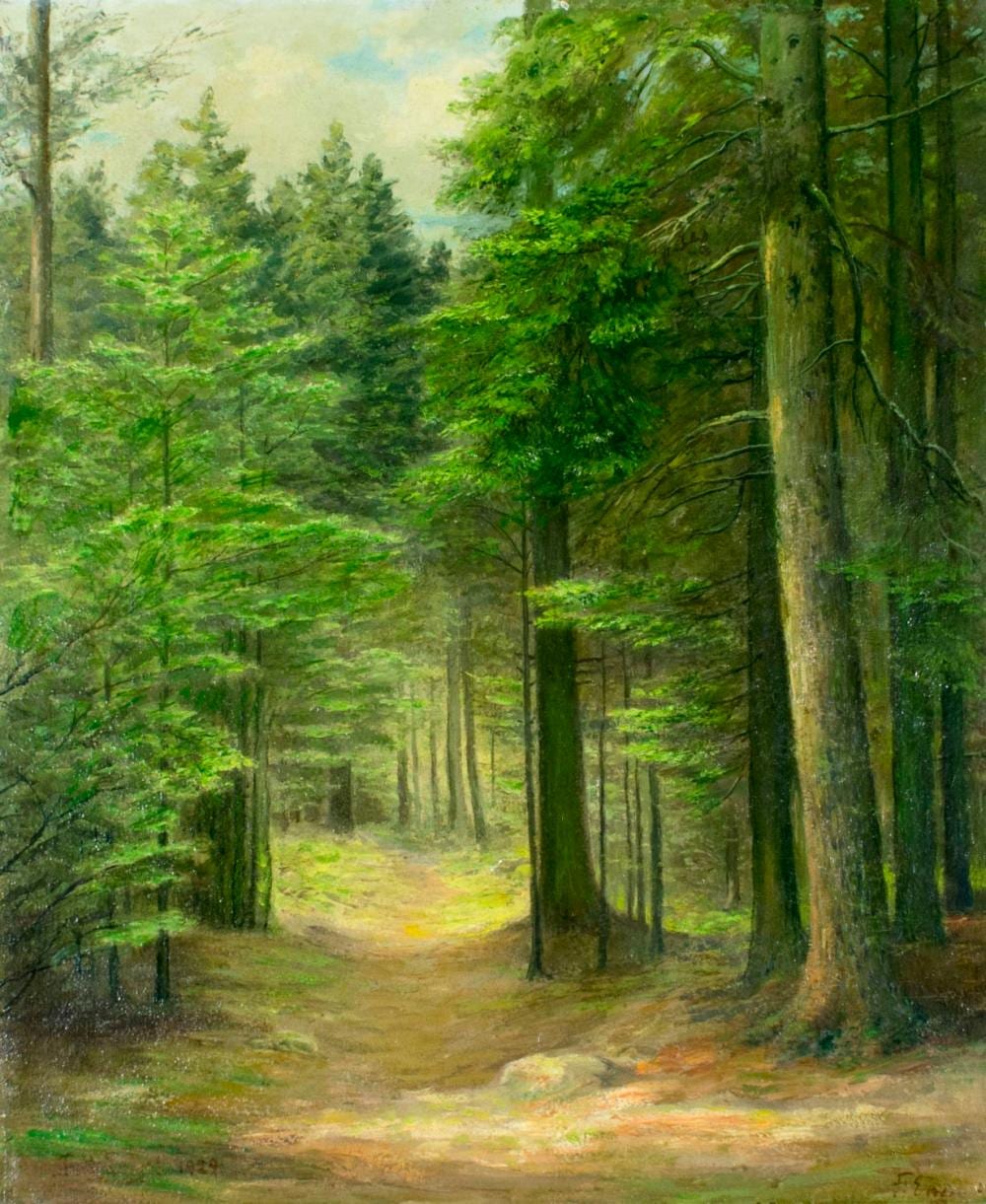
ARTIST: Fritz Franz Engel (Maine, New York, Germany, 1877-1956) NAME: Landscape - Wooded Path to Otter Cliff YEAR: 1929 MEDIUM: oil on canvas CONDITION: Very good. Missing 2 flakes of paint. No visible inpaint under UV light. SIGHT SIZE: 24 x 20 inches / 60 x 50 cm FRAME SIZE: 29 x 25 inches / 73 x 63 cm SIGNATURE: Lower right CATEGORY: antique vintage painting SKU#: 116557 US Shipping $75 + insurance. AD: ART CONSIGNMENTS WANTED. CONTACT US BIOGRAPHY: FRITZ FRANZ ENGEL was born near Eisenach Thuringia, Germany, Sept. 7, 1877. He and started his professional studies under Prof. George Kugel in that city. Obtaining a scholarship, he continued under Prof. P. Brausewetter at the Royal Academy in Berlin and later with the American, Carl Marr, and Prof. Ludwig Herterich at the Royal Academy at Munich who later sponsored him to the Grand Duke Alexander of Weimar for a scholarship which enabled Engel to study painting at the Munich Art Academy and sculpture at the Dresden and Berlin academies. In the meantime, he executed a number of portraits on commissions entrusted to him by leading families in Germany, Sweden, Russia, and France, his canvasses hanging in dozens of great private collections. From the beginning he studied the technique of the old masters in European galleries and made a great many copies of the works of Rembrandt, Reubens, Van Dyck, Velazquez, and others. His copies revealed. the inspiration and training in the methods pursued by the old exponents of technical expression and drew much favorable comment. Mr. Engel was commissioned to copy paintings of the masters which hang in the Rolfe's collection in Port Elizabeth. Union of South Africa. His triptych "Wotan" is a unique combination of sculpture and painting, interpreting Richard Wagner's "Der Ring des Nibelungen" and expressing the theme of the three main motives of the music drama. The work was on exhibition in many cities in Europe and at Bayreuth during Wagner festivals. His friendship with contemporary painters such as Zuloaga, Uhde, Boecklin, and Lenbach left. an impression on his work, and his canvasses reflected romanticism and the lighter vein of their influence. He came to the United States in 1923 and soon won wide recognition. His work increasingly reflected the stylism of the old masters which dominated his portrait, sea, and landscape painting. His Charles A. Lindbergh (q.v.) bas-relief, for which Calvin Coolidge (q.v.) wrote a warm appreciation, hangs in the White House, Washington, D.C. His later work is mainly in sculpture, and among these pieces score of figures symbolizing philosophy, poetry, and the Muses, as well as the twelve Zodiacs for the auditorium ceiling in the Benjamin Franklin High School at Rochester, N.Y. For the Kingston (N.Y.) City Hall auditorium he made twenty-three historical lunettes. He has done many portrait busts and garden sculptures. For twenty-six years he has maintained a summer studio at Bar Harbor, ME, and has succeeded in capturing the essence of the typical characteristics of the Mt. Desert Island massif in his seascapes and landscapes. He has had exhibitions at the Bar Harbor Library, the Jordan Pond House, and the new Hotel Bar Harbor. Besides artwork, he has invented and developed a composition plastic stone by which figures can be built up by the sculptor as the modelling work progresses, assuring adhesion and blending as one application is laid upon another. This material has the advantage of the hardness of stone and the smoothness of bronze in addition to being waterproof and light in weight. He became a citizen of the United States in 1930. Mr. Engel is a Republican in politics and is affiliated with the Lutheran Church. He was married in Hanover, Germany on Dee. 16, 1909, to Baroness Gertrude, daughter of Baron von Bentheim and they have a daughter, Ricarda, who married Henry George Genthe.