Have one like this?
Upload a photo for a free check of what yours may be worth.
Lot description
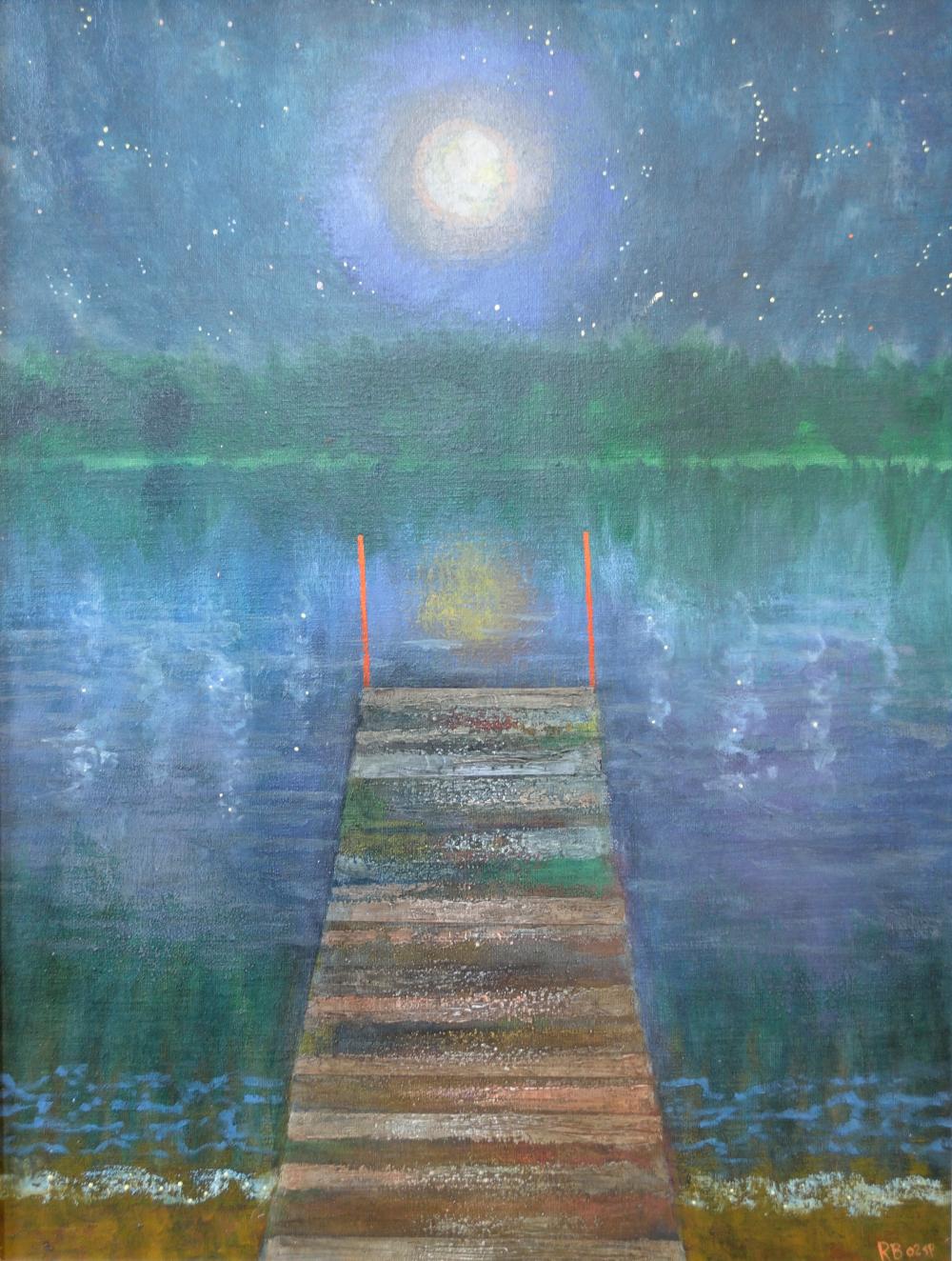
AUGUST 20, 1930 – MARCH 8, 2019 Bob was born in Racine, Wisconsin in 1930. Early on, his elder sister Carol introduced him to jazz music and guided his interest in art. In high school he studied with artists Sylvester Jerry, and George Frederickson at the Wustum Museum of Fine Arts, and Helen Sawyer at Washington Park High School. Meanwhile, he worked as a “ghost” artist on the “Big Little Books” published by Western Printing. Bob enrolled at the University of Wisconsin, Madison, where, in 1955, he and his wife Nancy obtained Masters Degrees in Fine Arts. John Wilde, James Watrous, Dean Meeker, Alfred Sessler, and Santos Zingale were among his influential professors. Bob served as professor of printmaking, painting and drawing at the University of Wisconsin-Milwaukee for 35 years, eventually heading the UWM Graphics Department. Many students remember his dedication to teaching. During his tenure, he received grants to study monoprints and photo silkscreen techniques, and to develop innovations in teaching. Bob received Boston Printmakers awards (1958, 1960, and 1968), a Wisconsin Arts Board Grant in 1979, and a Governor’s Award Print Commission in 1983 to create a serigraph celebrating Wisconsin-born artist Georgia O’Keeffe. In 1980 he was selected to deliver the Fromkin lecture on FDR, W.P.A and Wisconsin Art during the Great Depression. His family joined him for his two sabbaticals in Europe, one to study plate lithography at the Curwen Press in London, the other at Atelier Desjobert in Paris. Bob's family appreciated and learned from his openness and steadiness, and a philosophy similar to what Tolstoy expressed: "Beauty will save the world." When Rand grew organic produce in Italy, Bob was often seen sketching at the edge of the garden. When Claire worked with Nepalese women artists, Bob produced a documentary film, "Colors of Change," that captured vividly the colors of saris, offerings of fruits and flowers, and the women’s own stories. Known as a “risk taker” with regard to his versatility in subject matter and technique, his art moved fluidly between figure drawings, seascapes, and landscapes. He tried all media, from small detailed silverpoints to oil paintings and very large charcoal drawings. He is celebrated for his series of serigraphs called “The Seasons,” reflecting the changing landscapes of Wisconsin. Treasured by his family are Bob's numerous sketchbooks, in which he engaged with all that was before him at the moment, be it a horseshoe crab, an oriole, the pattern in water, or a punk rocker on a London street. Having spent many summers on the Cape, and then retiring to East Orleans, his work often reflected the sea, beaches, and clouds, and included a series on lifeguards, his “observers of the world.” He also loved to depict the family cottage in northern Wisconsin, a place of reverie and happiness. His work is represented in many institutions, including the Racine Art Museum, Chazen Museum, Milwaukee Art Museum, the Metropolitan Museum and Museum of Modern Art in New York, the Museum of Fine Arts, Boston, the Philadelphia Museum of Art, the Tate Gallery, London, the Art Institute of Chicago, the Brooklyn Museum, Camden Arts Center, London, the Denver Art Museum, The Museum of Fine Arts, Houston, the San Francisco Museum of Modern Art, and the Walker Art Center, Minneapolis.