Have one like this?
Upload a photo for a free check of what yours may be worth.
Lot description
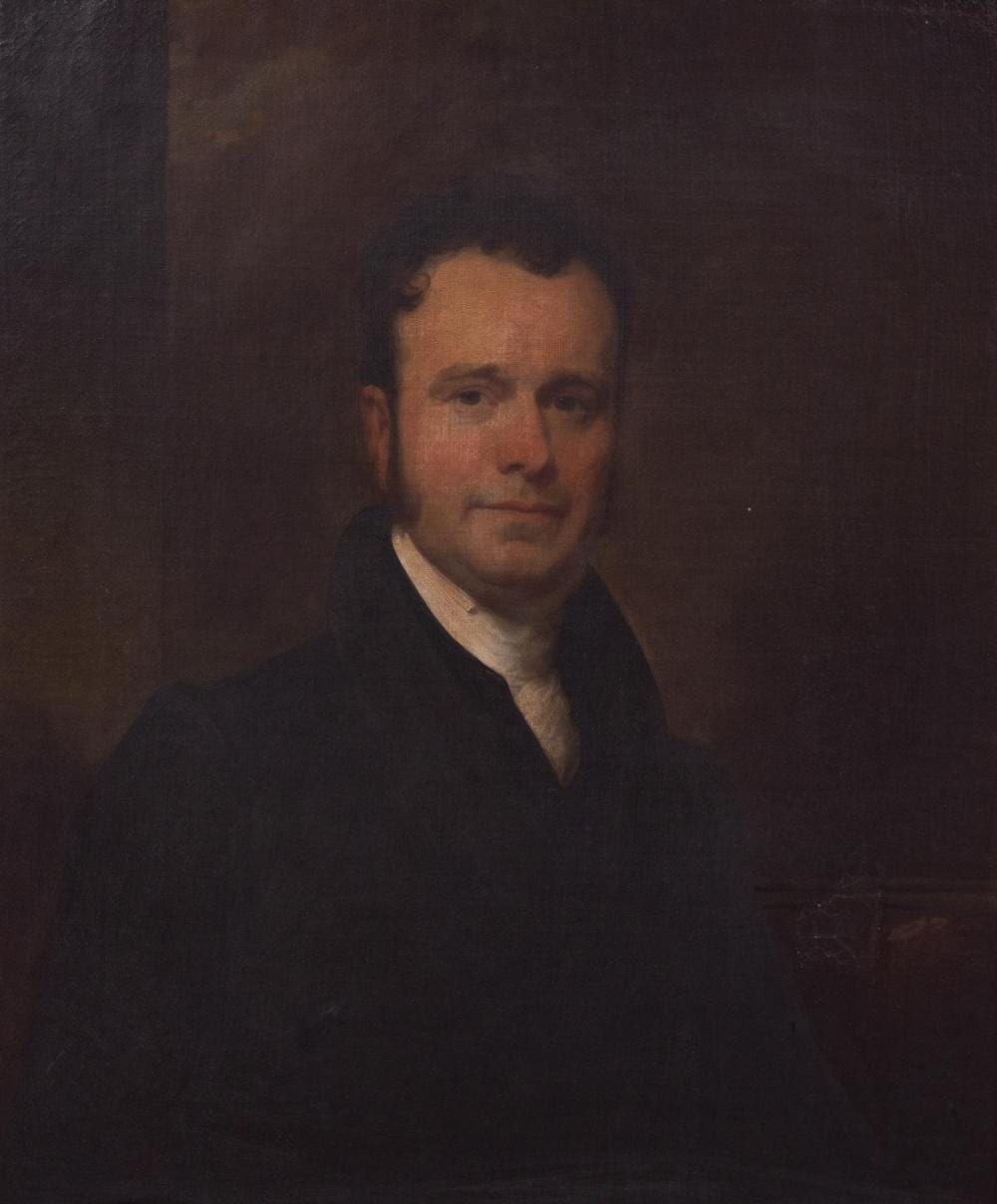
Henry Inman (American, 1801-1846) Portrait of William Swaim (1781–1846), oil on canvas, mounted in original carved and gilded wood and gesso frame, no visible signature, attributed by Hopkinson family, 30" x 25", framed 43" x 38", good condition, old restoration and relining, small patch bottom center, spot of age cracking lower right. Swain is connected to the Hopkinson family as his daughter, Elisa Swaim (1826-1911), married Edward Hopkinson (1850 - 1935). From the Hopkinson Family History --- "William Swaim served in the War of 1812 as a first lieutenant in Captain John Cooke's company. Third Regiment, New York State Artillery. (this is directly referenced in Lot #222 of this sale, with his "Muster Roll" from the War of 1812) William Swaim was living in Philadelphia in 1820, at which time his occupation was that of "paper marbler." In 1822 he became known to the public as the "discoverer of Swaim's Panacea," a syrup for the cure of ulcers, scrofula and kindred diseases. In 1828, the Philadelphia County Medical Society investigated Mr. Swaim's prescription and published an adverse report. In reply William Swaim issued a pamphlet alleging unfairness in the society's report and quoting numerous testimonials from patients and physicians of high standing and also editorials from the "National Gazette" and the "New York Evening Post." Dr. Gibson, of the University of Pennsylvania, commended him for the generosity he had shown in the distribution of his medicine to the poor. The real value of the "Panacea" seems to be indicated by the number of fraudulent imitations placed upon the market. A record dated December 23, 1825, states that John C. Lohra sold to William Swaim, of Philadelphia, physician, a three-story brick tenement house and a two-story brick kitchen on the west side of Chestnut Street. In 1826, Mr. Swaim purchased land at the corner of Chestnut and Seventh streets for his residence, office and laboratory, adding later a public bathing establishment at Seventh and George streets. Among other properties which he acquired in that neighborhood was the Washington House." (Washington House is referenced in Lot #138 of this sale) He was also the proprietor of The Philadelphia Baths startubg 1828. From the Francis Hopkinson Family Archives