Have one like this?
Upload a photo for a free check of what yours may be worth.
Lot description
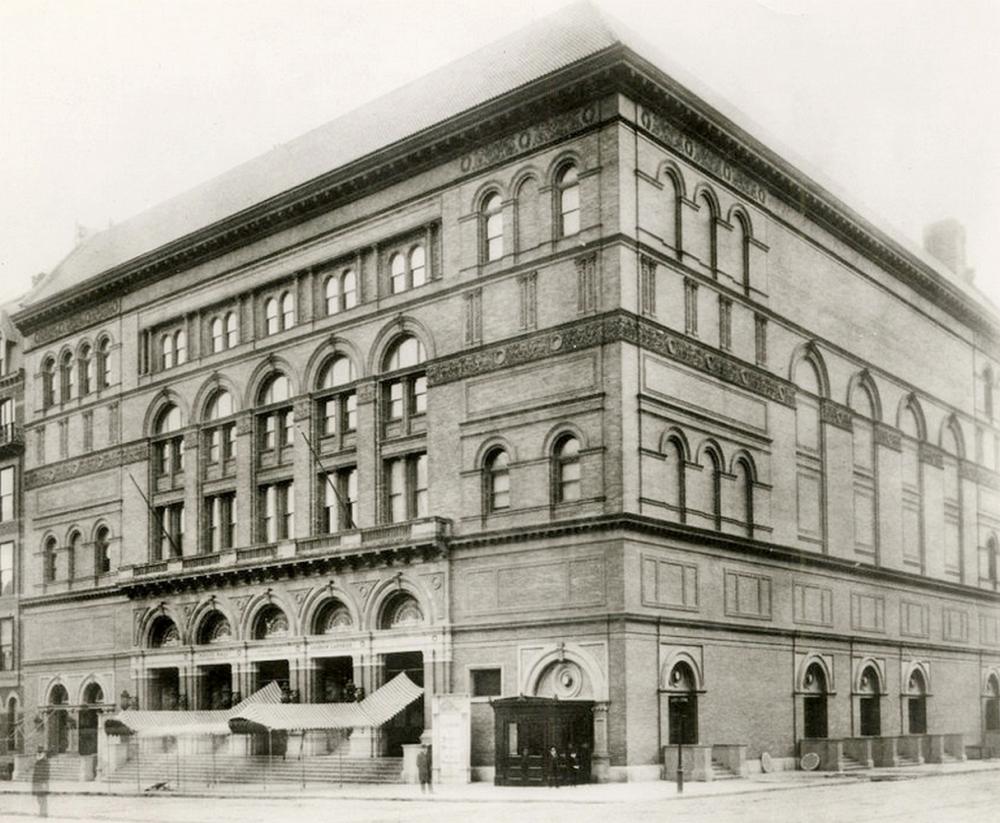
CARNEGIE, ANDREW. (1835-1919). Scottish-born, American industrialist and philanthropist. ALS. (“Andrew Carnegie” and “AC”). 2pp. Small 8vo. Dungeness, (February 10, 1906). Written on two separate sheets of “The Cottage” stationery to the treasurer of the New York Oratorio Society. “Hearty congratulations Mr. Treasurer upon splendid showing Oratorio Society for 1905. Tuthill & you have done it. I think Tuthill a wonder & you are one also in your work for the oratorio. Surely there is room for the society if it keep[s] to its mission. Yours always... A balance of three thousand five hundred is good proof of health...” A Scottish immigrant and self-made man, Andrew Carnegie was already wealthy by age 40. However, in his 1889 article Wealth, Carnegie set forth his philosophy that one who had amassed great wealth had an obligation to use it for “the improvement of mankind,” (Encyclopaedia Britannica). It was to this altruistic pursuit that Carnegie devoted himself and his fortune beginning in 1901 when he sold his company, Carnegie Steel, to J.P. Morgan for $250,000,000. Among Carnegie’s notable charities were the Carnegie Institute of Washington, founded in 1902, which funded scientific research; the Carnegie Corporation of New York, the largest of all his foundations, founded in 1911 to promote “the advancement and diffusion of knowledge and understanding among the people of the United States,” and the Carnegie Hero Fund, founded in 1904, (ibid.). In 1873, conductor Leopold Damrosch founded the Oratorio Society of New York and in 1884, Carnegie joined its board of directors, serving as president from 1888-1919. Under his leadership, the Oratorio Society undertook the construction of a venue for choral music, and engaged American architect William Tuthill (1855-1929), also a member of the Oratorio Society’s board. Tuthill, himself a singer and married to a church organist, made an extensive study of acoustics and, funded by Carnegie, the Oratorio Society’s Music Hall opened in 1891 to great acclaim. In 1893, Carnegie acceded to requests that the performance hall be named in his honor. Our letter was written from the family compound built by Carnegie’s brother on Georgia’s Cumberland Island. Written on two separate sheets (previously attached). Folded with very slight age toning at the edges. Mounting traces on the verso and in very good condition.