Have one like this?
Upload a photo for a free check of what yours may be worth.
Lot description
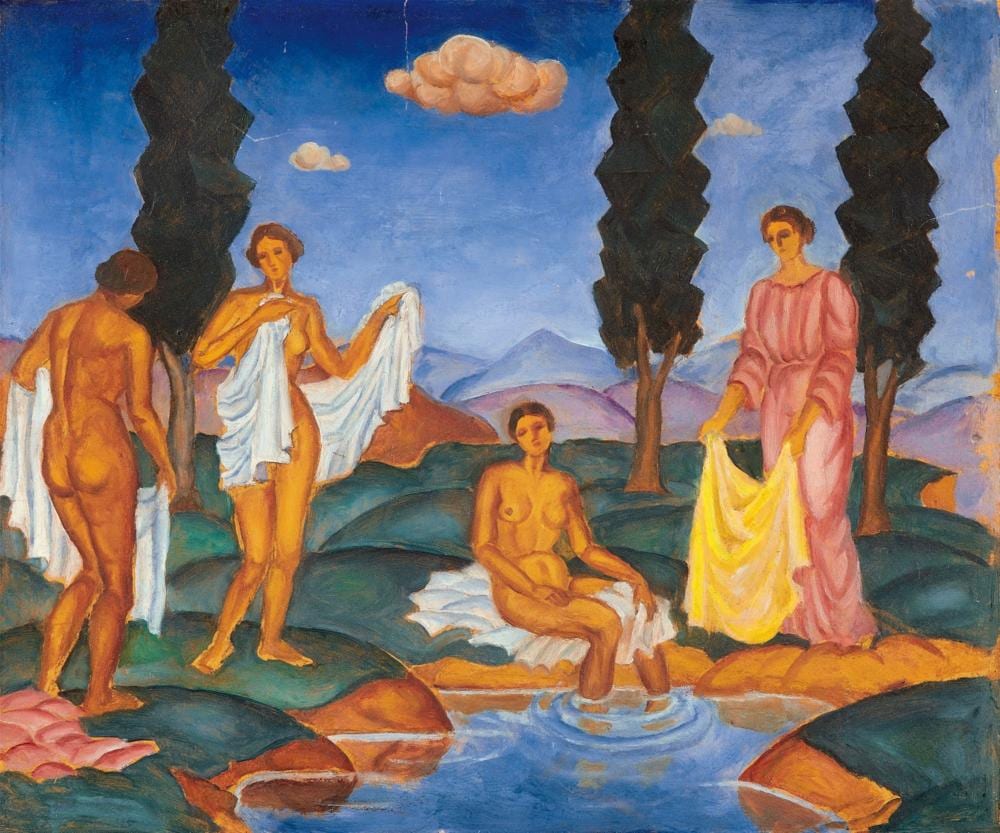
Unsigned. With a photo-certificate by Valeriy Stanislavovich Silaev, Moscow, dated 21 March 2008 (copy). We would like to thank him for kind information and advice. As the child of a Jewish family in Poland, Eugeniusz, later Eugène, Zak was born on 15 December 1884 outside Minsk. After attending secondary school in Warsaw, he headed for Paris, where he trained in art, first at the École des Beaux-Arts in the studio headed by Jean-Léon Gérôme, and later at Académie Colarossi under Albert Besnard. In 1903 Zak debuted in the Paris Salon autumn exhibition, and only two years later was appointed to the Salon's jury. Eugène Zak traveled a lot, for example, in Brittany, to South France, to Italy and to Switzerland. In Paris, he was friends with many artists with Jewish Polish backgrounds, including Mela Muter. While his early work was characterized by an intensive inquiry into artists such as Leonardo da Vinci, Sandro Botticelli or Albrecht Dürer, from about 1910 onwards his works change: He starts producing idyllic landscapes and compositions, often with figures next to open water. Zak's landscapes and architectures are, with their geometricizing formal idioms, in part reminiscent of the works of Pierre Puvis de Chavannes, Maurice Denis or Paul Cézanne and at the latest in the 1920s they are suffused by an ever more tangible melancholia and loneliness. In our piece, in the Classicist-Symbolic setting, the bathers stand for the new beginnings in the 1910s, in the course of which the artist was to emerge as a major representative of the École de Paris. RefMod191119