Have one like this?
Upload a photo for a free check of what yours may be worth.
Lot description
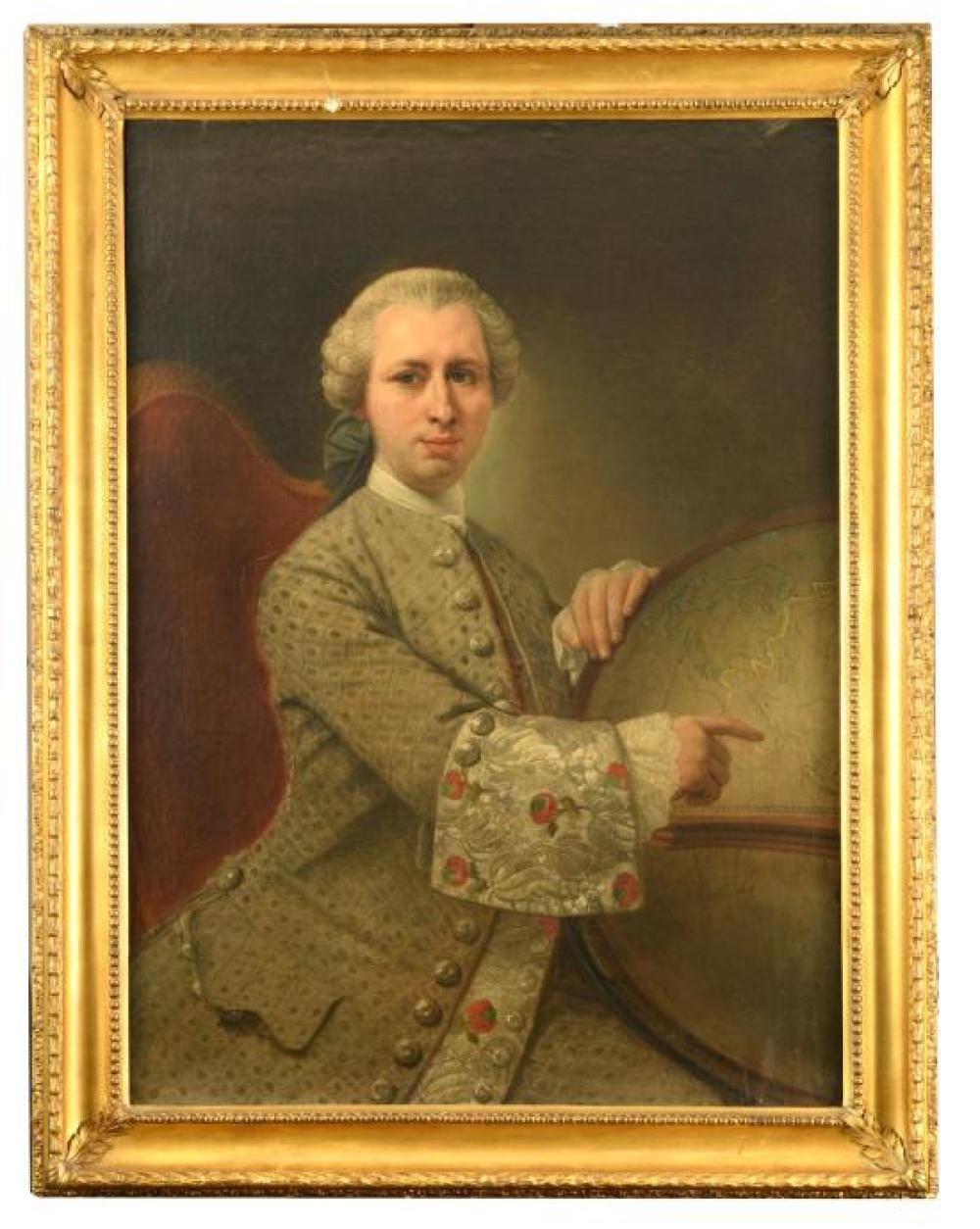
Marco Benefial (Italian, 1684-1764) Portrait of Edward Curtis of Mardyke House, Hotwells, Bristol, seated, three-quarter length in a grey coat with silver thread and scarlet pink embroidered cuffs, pointing to a globe signed lower right on the longitudinal orbit "Eqis Marcus Benefial Pinxt. Roma Anno Sal. 1750" oil on canvas, 95 x 70 cm (37.5 x 27.5in); Together with the waistcoat as worn by Edward Curtis in this portrait by Benefial; probably French, mid 18th Century, comprising brocaded weave, silk uncut with supplementary weft patterning of rococco metal threads, smooth metal purl threads and plate ribbon metal threads, lining: cream brushed linen/cotton, wooden buttons covered with rococco, purl, plate ribbon metal threads and metal spangles, centre front length: 81cm (32in), chest: 97cm (38in), waist: 86 cm (34in), hip: 102 cm (40in), buttons: 2cm (.75in) x 2cm (.75in) Provenance: By descent from the sitter to his elder daughter Hannah Fownes (died 1814) who married in 1805 John Yarde Fownes (1779-1839); Their elder son (according to a label on the reverse) Edward Curtis Fownes, born 1806, who married in 1848; Mary Margaret Haythorne ( died 1900); Thence to Mrs R A Parsons (nee W S Haythorne) who died 1977; to her son the late Sir Richard Parsons (1928-2016) Other Notes: This remarkable waistcoat, as worn by the sitter in this portrait, demonstrates the richness of mid-18th century men's dress which were often as lavish as that of women. The decorative woven pattern incorporates large feathered foliage with small four-leafed flowers of woven metal threads surrounding a single multi-coloured silk rose at the centres. At this period, Safavid textiles from Persia feature similar rose motifs as the ones woven in this waistcoat. Interestingly, the sitter, Edward Curtis, who was a well-known merchant from Bristol, is pointing in his portrait towards the Middle East (to apparently what is today known as Saudi Arabia). This may indicate a place of importance to him as a gentleman in trade, and indeed, possibly why his waistcoat though made in Europe reflects a Middle Eastern style of patterning. This waistcoat when first made would have had a remarkable sparkle and shine to it and made clear that its owner was someone of considerable standing and wealth. Curtis, who was evidently on the Grand Tour when he sat for this portrait by Benefial, would have been fully aware of the allusions and the impact he wished to convey by his wearing such a splendid waistcoat, that presumably he had acquired 'en route' for Italy. We are grateful to Tatiana Verdon for her assistance with the catalogue entry.