Have one like this? Check yours freeOr have an appraiser value it
Lot description
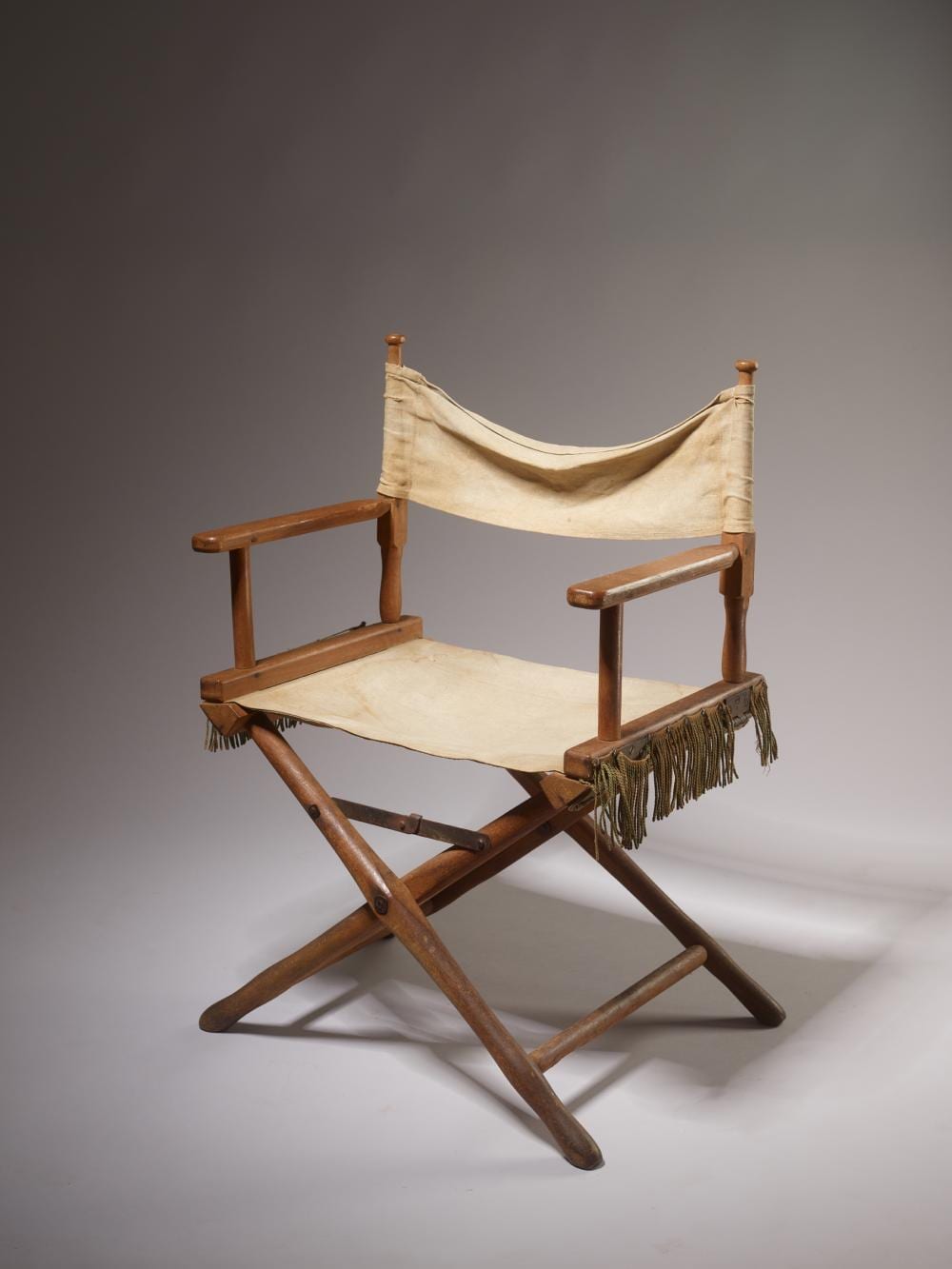
Wood, linen, iron hinges, fringes Germany, 1928 This at first sight simplistic folding chair actually is an interesting piece of history in terms of literature, theater and design. It once belonged to the theater revolutionary Bertolt Brecht and served as his director’s chair. It was part of the Schiffbauerdamm Theater’s inventory in Berlin, where Bertolt Brecht staged his piece ‘The Three Penny opera’ for the first time in August 1928. The chair was later given to Brecht as a present. The chair frame is made of wooden rods, which are covered with linen banners. A fringed border is attached on either side, below the armrest. Bertolt Brecht was an influential German theatre practitioner, playwright and poet. Born 1898 in Augsburg, Bavaria, his critical stance towards authority became evident early on. In 1915, during the First World War, he was nearly expelled from school for writing an anti-war essay. Brecht was drafted into military service shortly before the war ended, but did not participate as a soldier. After the war, Brecht quickly found success as a playwright in Munich, receiving the coveted Kleist Prize for his first three works. In 1924 he moved to Berlin and during this time his Marxist views began to inform his work more and more. In 1927 he became part of Erwin Piscator’s theatre company; Piscator originated the idea of epic theatre, the genre Brecht perfected and is arguably best known for. In the same year, he also first collaborated with the composer Kurt Weill, with whom he would develop The Threepenny Opera and Rise and Fall of the City of Mahagonny, which both found great success and are performed internationally to this day. Brecht left NS-Germany just after Adolf.H took power in 1933, living first in Scandinavia and later the United States. While in exile, he expressed his opposition to NS and Fascism with some of his most famous plays, including Mother Courage and her Children and The Good Person of Szechuan. During the Red Scare, he was blacklisted in Hollywood and interrogated by the House Un-American Activities Committee. The day after his controversial testimony, Brecht returned to Europe, living in Zurich for a year before settling in East Berlin. He established a new theatre company, the Berliner Ensemble, and focused on directing and developing new talent, while also penning some of his most famous poems. Bertolt Brecht died of a heart attack on August 14, 1956, at the age of 58 Dimensions: the chair is 79 cm high and 57 cm wide Condition: original condition with traces of wear and age, linen shows some stains and holes Provenance: Barbara Brecht-Schall (daughter of Bertolt Brecht), Swiss private collection RefDec241018