Lot description
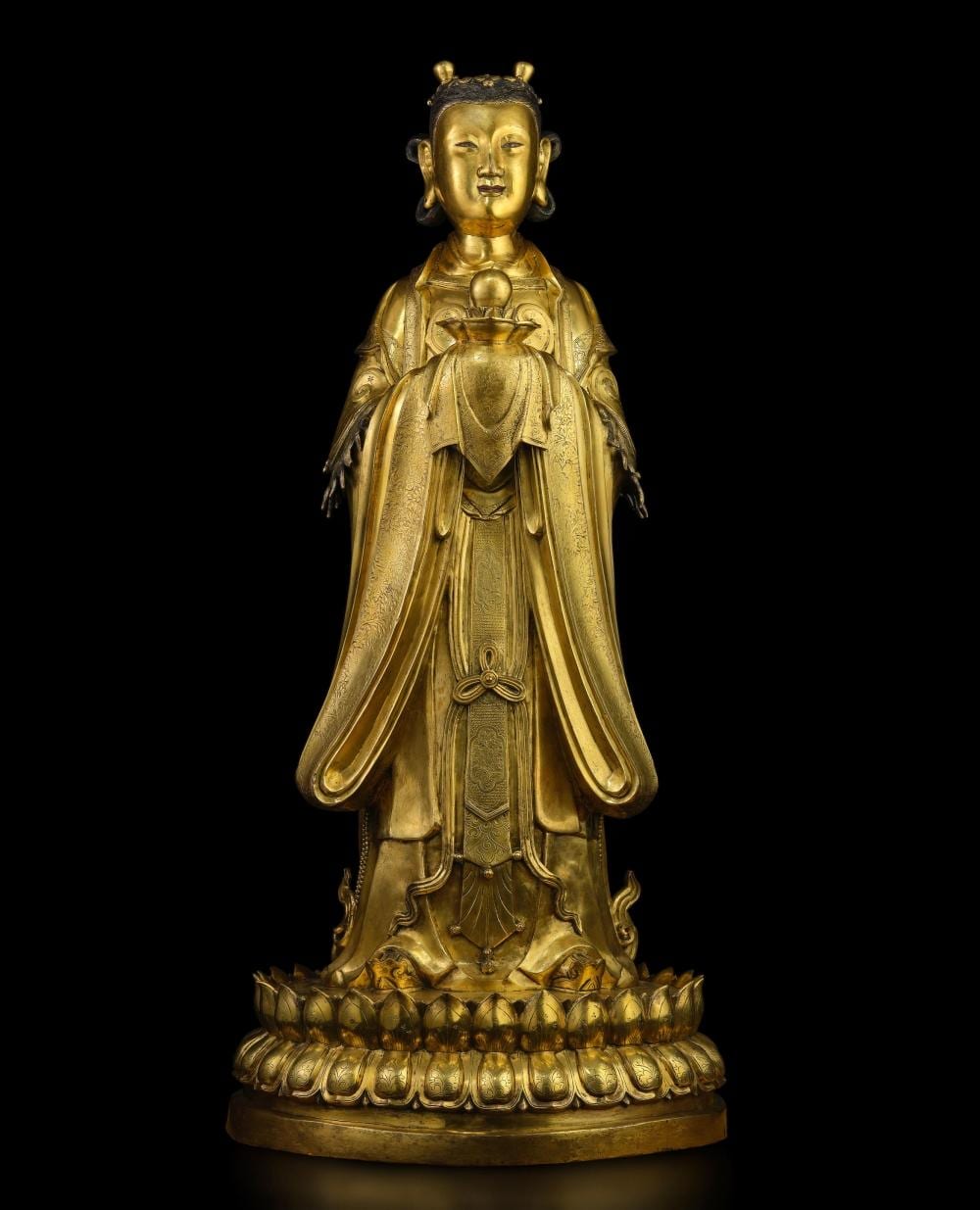
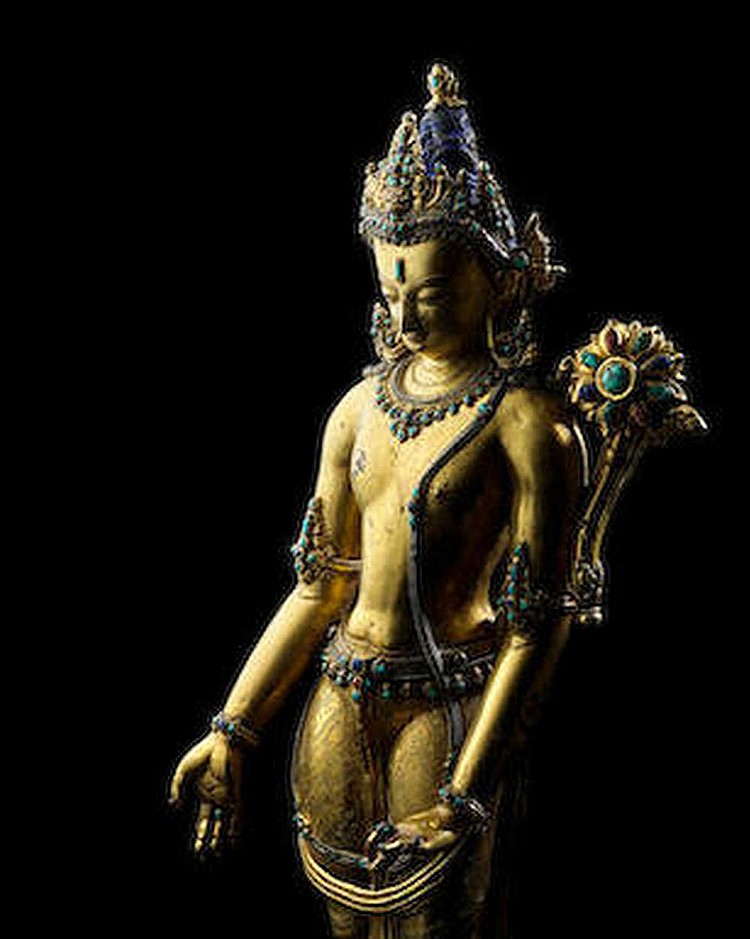
A GILT COPPER ALLOY FIGURE OF PADMAPANI LOKESHVARA TIBET, CIRCA 1400 With inset turquoise, coral, and lapis. Himalayan Art Resources item no.61740 55 cm (21 3/4 in.) high (including lotus stem); 51 cm (20 1/8 in.) high (excluding lotus stem) This refined gilded sculpture of standing Padmapani Lokeshvara follows a foreign, ancient mode of representing the bodhisattva imported to Tibet. Itinerant Newari craftsmen from the Kathmandu Valley achieved the most accomplished renditions of the standing bodhisattva form in cast bronze. Renown throughout Asia, this ethnic group passed artistic traditions and expertise between generations of masters. Tibetan patrons commissioned Newars for major artistic projects, recorded, for instance, in the tashi gomang stupas of Densatil monastery, and the thangka sets of Sakya and Ngor. The present sculpture arises from such circumstances, following the ascent of wealth and patronage in Central Tibet around the beginning of the 15th century. Combining Newari and Tibetan aesthetic proclivities, this sculpture represents the pinnacle of the standing bodhisattva form in Tibetan art. Avalokiteshvara, The Lord Who Looks Down, does just so with a kind smile and a gesture of charity with his right hand. Avalokiteshvara is the paradigm of perfected compassion, one of the key virtues a practitioner must develop towards his or her own buddhahood. The master Newar depicts Avalokiteshvara arising from a lotus flower, an ubiquitous Buddhist symbol for any being’s potential to rise from murky waters and realize their innate buddhahood. This form of Avalokiteshvara, known as Padmapani Lokeshvara, ‘The Lotus Holder’, echoes such symbolism, for by his hand help is provided toward enlightened salvation. The leitmotif of the standing bodhisattva in a limber pose, with a bare torso, supple waist, and sheer lower garment, traces back to the golden age of Indian sculpture in the Gupta period (4th-to 6thcenturies). A famed standing Padmapani from Sarnath in the National Museum, New Delhi exemplifies this root (cf. Across the Silk Road, Beijing, 2016, pp.160-1. no.70). The Newars adopted and preserved this tradition, adding exaggerated narrow waists and swollen thighs by 13th-century and the establishment of the early Malla dynastic style. A consummate Nepalese example of standing Padmapani from 14th-century is held in the Rubin Museum of Art (Collection Highlights: The Rubin Museum of Art, New York, 2014, p.80-1). By contrast, the Rubin’s Nepalese example shows more preoccupation with the figure’s modeling, whereas the present bronze stresses a more densely gilded, patterned, and inset surface. ,1400 61740 :55(21 3/4 ) :51(20 1/8 ) 16,000,000-20,000,000