Appraisily Check my item

Auction sale reference

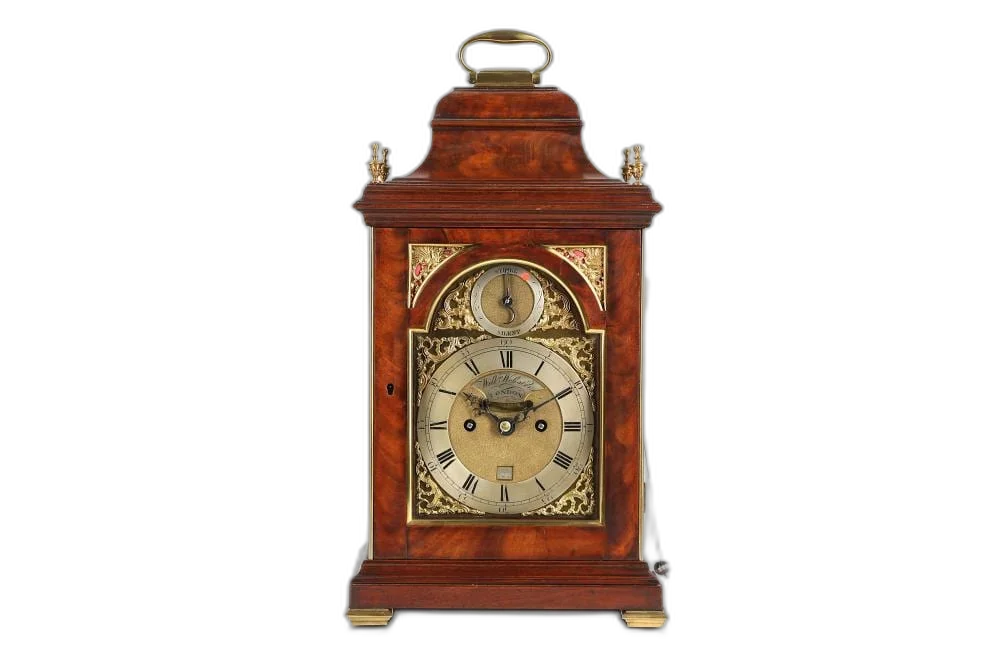
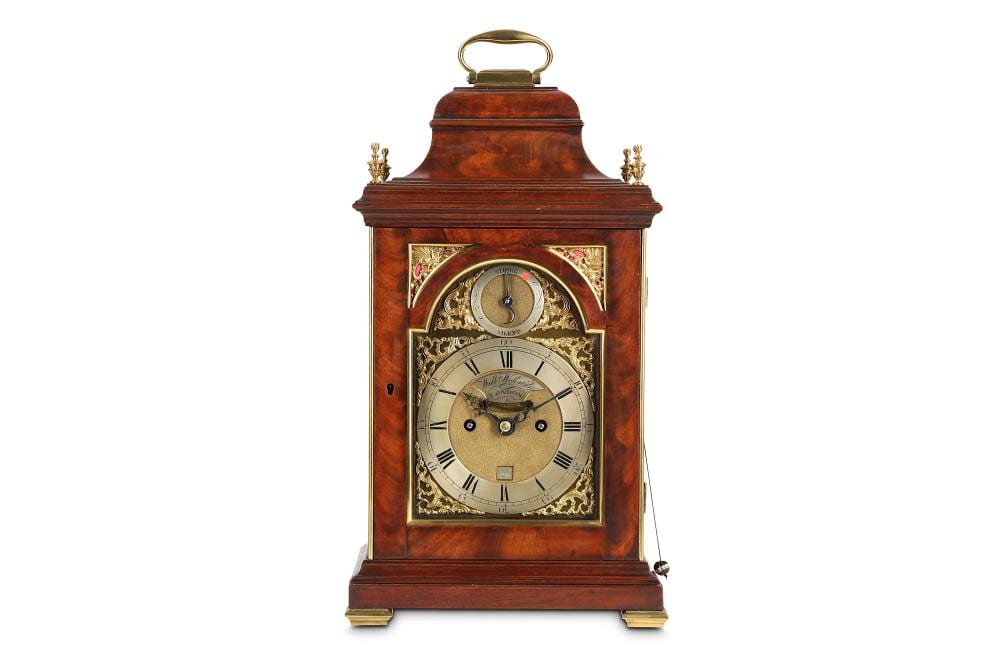
A Mid 18th Century Mahogany Fusee Bracket / TABLE CLOCK WITH PULL REPEAT BY WILLIAM WEBSTER, LONDON the bell top with brass handle over circular and shaped glazed apertures to the sides, the breakarch door with quadrant pierced gilt brass sound frets, the signed 5.75" brass dial with silvered Roman chapter ring with Arabic five minute markers, with matted centre and mock pendulum aperture, with chamfered date aperture below and silvered name plate inscribed 'Willm Webster LONDON', with strike / silent to the arch, the twin fusee movement with verge escapement striking on a bell, with pull repeat, the backplate finely engraved in the Rococo style with pedestals topped with urns and rocialles, signed 'Webster London' within a cartouche, the pendulum with pear shaped bob,  47cm high The movement is winding, ticking and striking but not fully tested or guaranteed. B. Loomes 'Watchmakers and Clockmakers of the World" (NAG Press, 1988, page 823) n records William Webster as being apprenticed in London in 1727 and made free of the Clockmakers Company in 1734. His father, also called William, was apprentice to, and journeyman with, Thomas Tompion. He worked in Exchange Alley and was made free of the Clockmakers Company in 1710. He died in 1734.

Sold for £4,000 at Chiswick Auctions on Sep 12, 2018.

A Mid 18th Century Mahogany Fusee Bracket / TABLE CLOCK WITH PULL REPEAT BY WILLIAM WEBSTER, LONDON the bell top with brass handle over circular and shaped glazed apertures to the sides, the breakarch door with quadrant pierced gilt brass sound frets, the signed 5.75" brass dial with silvered Roman chapter ring with Arabic five minute markers, with matted centre and mock pendulum aperture, with chamfered date aperture below and silvered name plate inscribed 'Willm Webster LONDON', with strike / silent to the arch, the twin fusee movement with verge escapement striking on a bell, with pull repeat, the backplate finely engraved in the Rococo style with pedestals topped with urns and rocialles, signed 'Webster London' within a cartouche, the pendulum with pear shaped bob,  47cm high The movement is winding, ticking and striking but not fully tested or guaranteed. B. Loomes 'Watchmakers and Clockmakers of the World" (NAG Press, 1988, page 823) n records William Webster as being apprenticed in London in 1727 and made free of the Clockmakers Company in 1734. His father, also called William, was apprentice to, and journeyman with, Thomas Tompion. He worked in Exchange Alley and was made free of the Clockmakers Company in 1710. He died in 1734. auction lot image A Mid 18th Century Mahogany Fusee Bracket / TABLE CLOCK WITH PULL REPEAT BY WILLIAM WEBSTER, LONDON the bell top with brass handle over circular and shaped glazed apertures to the sides, the breakarch door with quadrant pierced gilt brass sound frets, the signed 5.75" brass dial with silvered Roman chapter ring with Arabic five minute markers, with matted centre and mock pendulum aperture, with chamfered date aperture below and silvered name plate inscribed 'Willm Webster LONDON', with strike / silent to the arch, the twin fusee movement with verge escapement striking on a bell, with pull repeat, the backplate finely engraved in the Rococo style with pedestals topped with urns and rocialles, signed 'Webster London' within a cartouche, the pendulum with pear shaped bob,  47cm high The movement is winding, ticking and striking but not fully tested or guaranteed. B. Loomes 'Watchmakers and Clockmakers of the World" (NAG Press, 1988, page 823) n records William Webster as being apprenticed in London in 1727 and made free of the Clockmakers Company in 1734. His father, also called William, was apprentice to, and journeyman with, Thomas Tompion. He worked in Exchange Alley and was made free of the Clockmakers Company in 1710. He died in 1734. auction lot image
Photo: Chiswick Auctions · background removed by Appraisily ·

Have one like this? Check yours freeOr have an appraiser value it

Lot description

A MID 18TH CENTURY MAHOGANY FUSEE BRACKET / TABLE CLOCK WITH PULL REPEAT BY WILLIAM WEBSTER, LONDON the bell top with brass handle over circular and shaped glazed apertures to the sides, the breakarch door with quadrant pierced gilt brass sound frets, the signed 5.75" brass dial with silvered Roman chapter ring with Arabic five minute markers, with matted centre and mock pendulum aperture, with chamfered date aperture below and silvered name plate inscribed 'Willm Webster LONDON', with strike / silent to the arch, the twin fusee movement with verge escapement striking on a bell, with pull repeat, the backplate finely engraved in the Rococo style with pedestals topped with urns and rocialles, signed 'Webster London' within a cartouche, the pendulum with pear shaped bob, 47cm high The movement is winding, ticking and striking but not fully tested or guaranteed. B. Loomes 'Watchmakers and Clockmakers of the World" (NAG Press, 1988, page 823) n records William Webster as being apprenticed in London in 1727 and made free of the Clockmakers Company in 1734. His father, also called William, was apprentice to, and journeyman with, Thomas Tompion. He worked in Exchange Alley and was made free of the Clockmakers Company in 1710. He died in 1734.

One auction record is not a value for your item. Get an expert appraisal